
Funeral funeral of the apostolic nuncio Adriano Bernardini. Homily pronounced by Father Ariel S. Levi di Gualdo - Funeral Mass for Apostolic Nuncio Adriano Bernardini. Homily delivered by Father Ariel S. Levi di Gualdo -


Italian, english, español
Funeral funeral of the apostolic nuncio Adriano Bernardini. Homily pronounced by Father Ariel S. LEVI GUALDO
Diocese of San Marino-Montefeltro, Church of Monastery of Piandimeleto, 15 September 2025 hours 15:00. Exequine of S.E. Mons. Adriano Bernardini, Archbishop the owner of Faleri and apostolic nuncio.
- Church news -
.

Author
Ariel S. Levi di Gualdo
.
 PDF print format article – PDF article print format – PDF article in print formatO
.

.
† From the Gospel according to John (14, 1-6)
During that time, Jesus told his disciples: “Your heart is not troubled. Have faith in God and have faith in me too. In the house of my Father there are many places. if not, I would have told you. I go to prepare a place; When I am gone and I will have prepared you a place, I'll come back and take you with me, Why be you where I am. And the place where I go, You know the way ". Tommaso told him: "Man, we do not know where you are going and how can we know the way?». Jesus told him: «I am the way, the truth and the life. No one comes to the Father except through me. Your heart is not troubled. Have faith in God and have faith in me too. In the house of my Father there are many homes. if not, I would have ever told you: I'm going to prepare a place? When I am gone and I will have prepared you a place, I will come again and take you with me, Because where I am you too. And the place where I go, You know the way ". Tommaso told him: “man, We don't know where you go; How can we know the way?». Jesus told him: “I am the way, the truth and the life. No one comes to the Father except through me”».
.
Esteemed Bishops Domenico, shepherd of this ours Particular church e Andrea, emeritus, Confreres friends and all of you dear present here: «Grace to you and peace from God, our father, and by the Lord Jesus Christ ".
Receiving the 30 August the sacred anointing of the sick Adriano Bernardini Archbishop the owner of Miss and apostolic nuncio, The words of the Gospel of John whispered to me: "Dad, The time has come " (GV 17, 1-2). This is why I chose to greet him with a homily taken from this fourth Gospel, where the apostle Peter asks Jesus: "Man, where are you going?». Jesus responds to Pietro who was not yet ready: "Where I go, You can't follow me for now; You will follow me later ". The same had said just before all the disciples: «Where I'm going, You cannot come " (GV 13, 33-34).
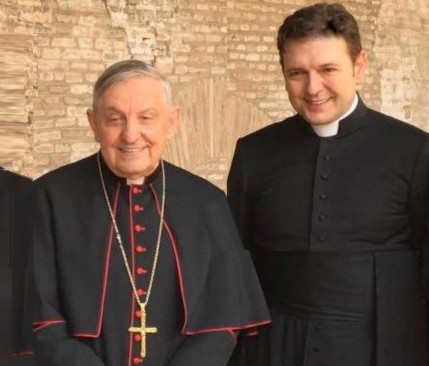
In the picture: S.E.R. Mons. Adriano Bernardini (13.08.1942 – †11.09.2025) and Father Ariel S. Levi di Gualdo, his private secretary (2017-2025)
They are fragments which reveal the emotion for the imminent detachment from the divine Master. Perhaps this is why the words of the newly proclaimed Gospel open up with an invitation of Jesus who becomes, In addition to being promised also Balsamo: “Your heart is not troubled. Have faith in God and have faith in me too. In the house of my Father there are many homes ".
With his words Jesus is making his departure and emptiness that leaves an opportunity for rebirth for his disciples. Asking for faith, He pushes them to transform the fear of the new and the terror of abandonment in the courage to give themselves, leaning on the Lord who promises to go to prepare a place for them. He lives his departure in relation to those who stay and show that he is not abandoning them, But a different phase of relationship with them is inaugurating. The detachment is in view of a new reception based on a precise promise: "I'll take you with me" (GV 14,2-3).

In a difficult circumstance like this it's nice to go back to the beginning, When the disciples, the future of the Apostle, they had the first contact with Jesus and asked him: "Rabbi, Maestro, where you live?». He told them: «Come and see».
"Staying" or "dwelling", "Coming" and "see" They are the verbs that especially in the Gospel of John describe the path of faith, The arrival of the disciple and the answer to Pietro's question: "Where are you going, where we can meet and find you again?». Jesus will say one day: “Stay in my love, how the branch remains in the vine, Because I observed the commandments of my Father and I remain in his love. That is the place where I live, I remain and live " (GV 15,9-10).
Here is the goal of the disciple for which it will not be necessary to wait for the transit of death, because it is here, Now, Available for everyone, Because Jesus got away. It is not a future reality that will prove to be beyond this life through death, hard pass for those who have to go beyond it and a painful legacy for those who have to live with memory, But it is a gift present for those who "believe in him" (GV 14,12).
It is therefore not even troubled our heart in the face of detachment, rather, let's get ready to recognize the place that each of us is responsible for the eternal home that awaits us. Similar in place of the beloved disciple who reclined his head on the chest of Jesus in the last dinner. He was placed in the breast of Jesus (GV 13,25), who, As the prologue Giovanneo says "he returned to his father's breast and opened the way" (GV 1,18), Now "he came his hour to go from this world to his father (GV 13,1) tells us: "Nobody comes to the Father except by means of me".

To try to propose the not easy reasons, but pursuable and feasible of the Holy Gospel, the Church has always used many means, including diplomacy. This is the apostolic nuncio: a bearer and announcer of the Holy Gospel called to create the Peace of Christ in the world. But let's try to depict everything with a concrete example: in October 1962 The world touched the third world war with the "Cuba crisis". By now the two interlocutors, Nikita Kruscev and John Fitzgerald Kennedy could no longer speak or treat, because neither was willing to take a step back. It was at that tragic moment that the Holy Pope John XXIII intervened that, good to remember, It was not properly that simple farmer who is affected in certain popular iconographies, it came from the world of diplomacy and had been a diplomat also refined, Especially in his mandate as an apostolic nuncio in France. The two interlocutors accepted the appeal both simultaneously and the missile heads on the course of Cuba returned back. A few months later, in April 1963, The Holy Pontiff published his encyclical Peace on Earth. The peace message of the Gospel prevailed thanks to pontifical diplomacy. Today, The books of contemporary history, They narrate that that diplomatic intervention saved humanity from the risk of a third world war.
Instead of reciting the litanies of its virtues I will mention one of its flaws, To demonstrate how a servant of the Church and the Papacy can change a defect by virtue through the three virtues of faith, hope and charity (cf.. The Cor 13, 1-13), who do not stand on emotions, worse on visceral ideologies, but on reason. Faith seeking understanding and by reverse understanding seeking faith, or: faith requires reason and by reverse the reason requires faith, As the father of the school classical Sant'Anselmo d’Aosta enunciated, in turn renovated at the thought of the Holy Father and Doctor of the Agostino Church Bishop of Hippona: I believe in order to understand and by reverse I understand that you can trust, or, I believe to understand, I understand to believe. Until to reach the Holy Pontiff John Paul II who summarized this relationship between reason and faith in the encyclical Faith and Reason, faith and reason.

Resolved by temperament, he was capable of becoming unwatchable. In the last months of life it has been weakened by the disease, but keeping its peculiar character. A day, During his last hospitalization in the Roman nursing home Villa del Rosario - where incidentally he was accurately cared for by doctors, from paramedics and nuns -, He began to consider just a wrong thing that could have been harmful to him. I said to him and, on the first ones, Almost angry, But I subsided him reminding him of the page of the Gospel in which the speech in which Jesus tells Pietro is told: "" In truth, I say to you: when you were younger, you used to dress yourself, and walked where you; but when you are old you will stretch out your hands, and someone else will dress you and lead you where you do not want ' (GV 21, 18). He smiled and replied ironic: that is fine, I will follow you, But try to take me where I want to go ".
People with a resolved character Christianity owes a lot, Just think of the passage of the acts of the apostles where it is told of the blessed apostle Paul who "discussed with the Greeks" (translation: argued with them); "But these tried to kill him" (translation: because they didn't stand it). «The Brothers, knowing it, They led him to Caesarea and from there they sent him to Tarsus " (translation: We try to save his life in the name of the newborn Christian charity). And in closing the diplomatic conclusion of this chronicle: «So the Church, Throughout Judea, at Galilea is at Samaria, he had peace " (which translated means: Luckily he left) (At 9, 29-31). but yet, What we owe to the resolute and not very angular character of the blessed apostle Paul?

I honored his will avoiding beatifications by means of epic tales and triumphal biographies, as sometimes it is used to the funeral, Things from him detestates, Also because none of us know the judgment of God, But we all know how big his reward is for his faithful servants, Because only the men of faith forged by the authentic virtues manage to change their apparent defects in precious service to the Church; and in this sense, From San Paolo to Sant’Agostino, The list of these extraordinary men is very long. To damage the Church are not the men made resolved by their strength of character, But those who don't know how to say yes when it is yes and no when it's no (See. Mt 5, 37); They are the weak proud of their veiled weakness of spiritualisms and mysticisms, unaware that we, in the following of Christ, We are called to be salt, no sugar land (cf.. Mt 5, 13-16). Indeed, When we were consecrated priests, we were not given a sweet thought, The consecrating bishop told us: "Understand what you do, imitate what you celebrate, conform your life to the mystery of the cross of Christ the Lord ". All based on the words of the divine master who warned us: “If someone wants to come behind me deny himself, Take his cross and follow me " (Mt 16, 24-25).
All this he tried to understand it, live it and transmit it through a particular way to announce and bring the Gospel: Ecclesiastical diplomacy at the service of the Church of Christ and the Apostolic See.
The source of true ecclesiastical diplomacy It is all enclosed on the lines, inside the lines and beyond the lines of the Gospel that, from century to century, until the return of Christ at the end of the time, will not cease to highlight our miseries and our human wealth, our limits and our sizes, our sins and our Christian virtues. And these days, Perhaps more than ever comes to say with the blessed apostle Paolo: «I fought the good fight, I finished my race, I kept faith " (II Tm 4,6). Because it is not easy to keep faith, Not even within that human society that is the visible Church, defined as "holy and sinner" by the Holy Bishop Ambrogio, followed centuries later by Cardinal Joseph Ratzinger who mediating in 2005 The ninth station of the Via Crucis complained: "How much dirt is in the church, and precisely also among those who, in the priesthood, they should belong completely to him!».

Who is this priest climbed on the pulpit To preach in memory of Adriano Bishop? I am a useless servant. As the Lord Jesus says in fact: “When you have done everything you have been ordered, said: “We are useless servants. We did what we had to do "" (LC 17, 10). What was my intimate relationship with him? I reply saying that in the Lucanian Gospel we speak of the great confidentiality of the Blessed Virgin Mary that "for her part, he took all these things by meditating in his heart " (LC 2, 19).
The apostle writes to the inhabitants of Corinth: "Where, death, your victory?» (The Cor 15, 55). Reflecting on this step at the end of his life, The Supreme Pontiff Benedict XVI commented: «I do not prepare in the end but to a meeting since death opens to life, to the eternal one, which is not an infinite duplication of the present time, But something completely new ".
Have a nice trip to the "new" good trip "in the eternal", Adriano Bishop, you did how much you had to do, like all of us "useless servants", I witness it as a child, friend and brother. Every 11 September, until I can physically, I will be in this place at the particular church of San Marino-Montefeltro, to which I belong as a presbyter - although it was not lived in Montefeltro but in Rome with you -, To celebrate in your birthplace, Today also your burial place, A Holy Mass for the immortal soul of the Father, of the friend and brother you have been for me.
Praised be Jesus Christ!
Santa Maria del Mutino, loc. Monastery of Piandimeleto, 15 September 2025
.
.
Funeral Mass for Apostolic Nuncio Adriano Bernardini. HOMILY DELIVERED BY FATHER ARIEL S. LEVI GUALDO
Diocese of San Marino-Montefeltro, Monastery Church of Piandimeleto, September 15, 2025, 3:00 PM. Esequial Mass for His Excellency Msgr. Adriano Bernardini, Holder Archbishop of Federi and Apostolic Nuncio.
— Ecclesial actuality —
.
Author
Ariel S. Levi di Gualdo
† Gospel of John (14, 1-6)
«”Do not let your hearts be troubled. You have faith in God; have faith also in me. In my Father’s house there are many dwelling places. If there were not, would I have told you that I am going to prepare a place for you? And if I go and prepare a place for you, I will come back again and take you to myself, so that where I am you also may be. Where [I] am going you know the way”. Thomas said to him, “Master, we do not know where you are going; how can we know the way?” Jesus said to him, “I am the way and the truth and the life. No one comes to the Father except through me”».
Venerable Bishops Dominic, shepard of this particular Church, and Andrew, Bishops emeritus, Brother friends, and all of you dearly beloved present here: «Grace to you and peace from God our Father and the Lord Jesus Christ!».
Receiving the sacred anointing of the sick on August 30, Adriano Bernardini, Holder Archbishop of Federi and Apostolic Nuncio, whispered to me the words of the Gospel of John: «Father, the hour has come» (Jn 17:1-2). For this reason, I chose to greet him with a homily taken from this Fourth Gospel, where the Apostle Peter asks Jesus: «Lord, where are you going? Jesus responds to Peter, who was not yet ready: “Where I am going, you cannot follow me now; you will follow me later”. He had said the same thing shortly before to all the disciples: “Where I am going, you cannot come”» (Jn 13:33-34).
These fragments reveal the emotion of the imminent separation from the Divine Master. Perhaps this is why the words of the Gospel just proclaimed open with an invitation from Jesus that becomes not only a promise but also a balm: «Do not let your hearts be troubled. Believe in God, believe also in me. In my Father’s house are many rooms».
With his words, Jesus is making his departure and the void it leaves an opportunity for rebirth for his disciples. By asking them for faith, he pushes them to transform their fear of the new and the terror of abandonment into the courage to give themselves, relying on the Lord who promises to go and prepare a place for them. He experiences his departure in relationship with those who remain and shows that he is not abandoning them, but is inaugurating a different phase of relationship with them. This separation is in preparation for a new welcome based on a specific promise: «I will take you to myself» (Jn 14:2-3).
In a difficult circumstance like this, it’s beautiful to return to the beginning, when the disciples, future apostles, first encountered Jesus and asked him: «Rabbi, Master, where are you staying?». He said to them: «Come and see».
«To remain» or «to abide», «to come» and «to see» are the verbs that, especially in the Gospel of John, describe the journey of faith, the disciple’s arrival, and the answer to Peter’s question: «Where are you going? Where can we meet you and find you again?» Jesus will one day say: «Remain in my love, as the branch remains in the vine, for I have kept my Father’s commandments and remain in his love. There is my dwelling place, where I remain and dwell» (Jn 15:9-10).
This is the disciple’s goal, for which there is no need to wait for the passing of death, because it is here, now, available to all, because Jesus has become the way. It is not a future reality that will be revealed beyond this life through death, a difficult passage for those who must cross it and a painful legacy for those who will have to live with the memory, but it is a present gift for those who «believe in him» (Jn 14:12).
Let not our hearts, then, be troubled by separation; rather, let us prepare ourselves from now to recognize the place that belongs to each of us in the eternal home that awaits us. Similar to the place of the beloved disciple who leaned his head on Jesus’ chest at the Last Supper. He was reclining in Jesus’ bosom (Jn 13:25), who, as the John prologue says, «has returned to the bosom of the Father and has opened the way» (Jn 1:18), now «when his hour has come to pass from this world to the Father» (Jn 13:1), he tells us: «No one comes to the Father except through me».
To try to propose the difficult, yet attainable and achievable, reasons for the Holy Gospel, the Church has always used many means, including diplomacy. This is the Apostolic Nuncio: a bearer and proclaimer of the Holy Gospel called to establish the Peace of Christ in the world. But let’s try to illustrate this with a concrete example: in October 1962, the world came close to World War III with the “Cuban crisis”. By then, the two interlocutors, Nikita Khrushchev and John Fitzgerald Kennedy, could no longer speak or negotiate, because neither was willing to take a step back. It was at that tragic moment that the Holy Pontiff John XXIII intervened. It is worth remembering that he was not exactly the simpleton depicted in certain popular iconography; he came from the world of diplomacy and had been a refined diplomat, especially during his tenure as Apostolic Nuncio to France. Both sides simultaneously accepted the appeal, and the missile warheads headed toward Cuba were turned back. A few months later, in April 1963, the Holy Pontiff published his encyclical Pacem in Terris. The Gospel’s message of peace prevailed thanks to papal diplomacy. Today, contemporary history books tell us that this diplomatic intervention saved humanity from the risk of a Third World War.
Rather than reciting the litany of his virtues, I will mention one of his defects, to demonstrate how a servant of the Church and the Papacy can transform a defect into a virtue through the three virtues of faith, hope, and charity (cf. 1 Color 13:1-13), which are not based on emotions, or worse, on visceral ideologies, but on reason. Faith seeking understanding and and vice versa understanding seeking faith, or faith requires reason, and conversely, reason requires faith, as the father of classical scholasticism, Saint Anselm of Aosta, stated, in turn drawing on the thought of the Holy Father and Doctor of the Church, Augustine, Bishop of Hippo: I believe in order to understand and vice versa I understand that you can trust, or I believe in order to understand, I understand in order to believe. This culminated in the Holy Pontiff John Paul II, who summarized this relationship between reason and faith in the encyclical Faith and Reason, Faith and Reason.
Resolute by temperament, he was capable of becoming immovable. In the last months of his life, he was weakened by illness, but retained his peculiar character. One day, during his final stay at the Roman nursing home Villa del Rosario — where, incidentally, he was excellently cared for by doctors, paramedics, and nuns — he began to consider a wrong thing that could have been harmful to him as right. I told him this, and at first he almost became angry, but I calmed him by reminding him of the Gospel passage recounting Jesus speech to Peter: «Truly, truly, I say to you, when you were younger, you girded yourself and walked where you wished; but when you grow old, you will stretch out your hands, and another will gird you and carry you where you do not wish to go» (Jn 21:18). He smiled and replied ironically: «All right, I will follow you, but try to take me where I want to go».
Christianity owes much to people of resolute character. Just think of the passage in the Acts of the Apostles where the Blessed Apostle Paul is described as «arguing with the Greeks» (translation: he argued with them); «but they sought to kill him» (translation: because they could not stand him). «When the brothers learned of this, they took him to Caesarea, and from there they sent him to Tarsus» (translation: we tried to save his life in the name of the nascent Christian charity). And finally, the diplomatic conclusion to this chronicle: «So the church throughout all Judea, Galilee, and Samaria had peace» (which translated means: thank goodness he left) (Acts 9:29-31). And yet, how much do we owe to the resolute and not a little rough-edged character of the Blessed Apostle Paul?
I have honored his will by avoiding beatifications through epic tales and triumphal biographies, as is sometimes customary at funerals, things he detested, also because none of us know God’s judgment, but we all know how great his reward is for his faithful servants, because only men of faith forged by authentic virtues are able to transform even their apparent defects into precious service to the Church; and in this sense, from Saint Paul to Saint Augustine, the list of these extraordinary men is very long. Those who harm the Church are not men made resolute by their strength of character, but those who cannot say yes when it is yes and no when it is no (cf. Mt 5:37); they are the weak, proud of their own weakness veiled in spiritualism and mysticism, unaware that we, in following Christ, are called to be the salt, not the sugar, of the earth (cf. Mt 5:13-16). In fact, when we were consecrated priests, we weren’t given a sentimental thought; the consecrating Bishop told us: «Realize what you will do, imitate what you will celebrate, conform your life to the mystery of the cross of Christ the Lord». All of this was based on the words of the Divine Master who admonished us: «If anyone would come after me, let him deny himself, take up his cross, and follow me» (Mt 16:24-25).
He sought to understand, live, and transmit all of this through a particular way of announcing and bringing the Gospel: ecclesiastical diplomacy in the service of the Church of Christ and the Apostolic See.
The source of true ecclesiastical diplomacy lies entirely inside and beyond the written lines of the Gospel, which, from century to century, until Christ’s return at the end of time, will never cease to highlight our human miseries and riches, our limitations and our greatness, our sins and our Christian virtues. And in these times, perhaps more than ever, we can say with the Blessed Apostle Paul: «have competed well; I have finished the race;f I have kept the faith» (2 Tim 4:7). Because it is not easy to maintain the faith, not even within that human society which is the visible Church, defined as “holy and sinful” by the Holy Bishop Ambrose, followed centuries later by Cardinal Joseph Ratzinger who, meditating on the ninth station of the Way of the Cross in 2005, lamented: «How much filth there is in the Church, and even among those who, in the priesthood, should belong completely to him!»
Who is this priest who ascended the pulpit to preach in memory of Bishop Hadrian? I am an unprofitable servant. As the Lord Jesus says: «When you have done all that you were commanded, say, “So should it be with you. When you have done all you have been commanded, say, “We are unprofitable servants; we have done what we were obliged to do”» (Page 17:10). What was my intimate relationship with him? I answer by saying that the Gospel of Luke speaks of the great reserve of the Blessed Virgin Mary, who «And Mary kept all these things, reflecting on them in her heart» (Page 2:19).
The Apostle writes to the people of Corinth: « Where, O death, is your victory?» (1 Color 15:55). Reflecting on this passage at the end of his life, the Roman Pontiff Benedict XVI commented: «I am not preparing for the end but for an encounter, since death opens the way to life, to eternal life, which is not an infinite duplicate of the present time, but something completely new».
Have a good journey into the «new» world, and a good journey into the «eternal», Bishop Adriano. You have done what you had to do, like all of us «unprofitable servants». I bear witness to this as a son, friend, and brother. Every September 11th, as long as I am physically able, I will come to this place, to the particular Church of San Marino-Montefeltro, to which I belong as a priest — although I did not live in Montefeltro but in Rome with you — to celebrate in your birthplace, now also your burial place, a Holy Mass for the immortal soul of the father, friend, and brother you were to me.
Praised be Jesus Christ!
Santa Maria del Mutino, Monastery of Piandimeleto, 15 September 2025
.
.
Funeral funerals of the Apostolic Nuncio Adriano Bernardini. Homily pronounced by Father Ariel S. LEVI GUALDO
Diócesis de San Marino-Montefeltro, PIANDIMELETO MONASTERIO CHURCH, 15 September of 2025. Funeral Exequises of S.E. Mons. Adriano Bernardini, Archbishop holder of Fallei and Apostolic Nuncio.
- Ecclesial news -
.
Author
Ariel S. Levi di Gualdo
.
† From the Gospel according to John (14, 1-6)
«At that time, Jesus said to his disciples: “Do not worry. They believe in God and also create in me. In my father's house there are many rooms; If so, I would have told you. I'm going to prepare a place. And when I went and prepared a place, I will return again to take them with me, so that where I am, You are too. They already know the path of the place where I'm going”. Tomás told him: “Señor, We do not know where you go. How are we going to know the way?”.Jesus replied: “I am the way, The truth and life. No one goes to the father, but for me”».
.
Venerable Bishops Domenico, pastor of this Particular church and Andrea emeritus, Cohermans priests, friends and all estimated present: "Grace and peace to you from God our Father and the Lord Jesus Christ".
Receiving the 30 August the anointing of the sick Adriano Bernardini, Archbishop holder of Fallei and Apostolic Nuncio, I was whispered by the words of the Gospel of John: "Dad, The time has come » (Jn 17, 1-2). That is why I have chosen to fire him with a homily extracted from this fourth gospel, where the apostle Peter asks Jesus: «Señor, Where are you going?». Jesus responds to Peter that he was not yet prepared: «Where I go, You can't follow me now; You will follow me later ». The same had said shortly before all the disciples: «Where I go, You can't come » (Jn 13, 33-34)
They are fragments that reveal the emotion for the imminent separation of the divine teacher. Perhaps that is why the words of the newly proclaimed Gospel open with an invitation from Jesus that becomes, In addition to promise, In balm: «Your heart is not turned. HAVE FAITH IN GOD AND HAVE FAITH IN ME. In my father's house there are many dwellings ».
With his words Jesus is doing his departure and the vacuum that leaves an occasion of rebirth for his disciples. Asking for faith, It drives them to transform fear towards the new and terror to abandonment into value to surrender, leaning on the Lord who promises to prepare a place for them. He lives his departure in relation to who stays and shows that he is not leaving him, but it is inaugurating a different phase of relationship with them. The separation is in view of a new reception based on a precise promise: "I'll take you with me" (Jn 14, 2-3).
In a difficult circumstance like this It is good to return to the beginning, When the disciples, future apostles, They had the first contact with Jesus and asked him: "Rabbi, Maestro, Where Moras?». He told them: "Come and you will see".
"Stay" the "living", "Come" and "see" They are the verbs that above all in the Gospel of John describe the path of faith, The arrival of the disciple and the answer to Pedro's question: «Where are you going, Where can we find and find you again?». Jesus will say one day: «Remove in my love, As the Sarmiento remains in the vine, Because I have kept my father's commandments and remain in his love. That is the place where I live, I remain and Moor » (Jn 15, 9-10).
Here is the goal of the disciple for which there is no need to wait for the transit of death, Because it's here, now, Available for everyone, Because Jesus has made his way. It is not a future reality that will be revealed beyond this life through death, A difficult step for those who must carry it and a painful legacy for those who must live with the memory, but a present gift for those who "believe in him" (Jn 14, 12).
That is not disturbed our heart before the separation, but let's prepare from now on to recognize the place that corresponds to each of us in the eternal abode that awaits us. Which is similar to the place of the beloved disciple who reclined his head in Jesus's chest at the last dinner. This was reclined in Jesus' bosom (Jn 13, 25), which, As the Joan prologue says "he has returned to the father's bosom and opened the way" (Jn 1,18), Now «having arrived his time to move from this world to the father (Jn 13, 1) He tells us: "No one goes to the father but for me".
To try to propose the reasons not easy, But attainable and realizable of the Holy Gospel, The Church is always served as many media, including diplomacy. This is the Apostolic Nuncio: a bearer and announcer of the Holy Gospel called to make the Peace of Christ In the world. But let's try to represent all this with a specific example: In October of 1962 The world touched the third world war with the "crisis of Cuba". Already the two interlocutors, Nikita Jrushchov and John Fitzgerald Kennedy could not speak or negotiate, Because neither was willing to step back. It was at that tragic moment when the Holy Pontiff John XXIII intervened that, It is good to remember it, It was not properly that simple peasant represented in certain popular iconographies. He came from the world of diplomacy and had been a refined diplomat, especially in its function as Apostolic Nuncio in France. The two interlocutors welcomed the call simultaneously and the missile heads en route to Cuba. A few months later, In April of 1963, The Holy Pontiff published his encyclical Peace on Earth. The peace message of the Gospel prevailed thanks to the pontifical diplomacy. Hoy, Contemporary history books tell that this diplomatic intervention saved humanity from the risk of a third world war.
Instead of reciting the litanies of the virtues I will refer to a defect of yours, To demonstrate how a server of the Church and the papacy can mutate a defect under the three virtues of faith, hope and charity (cf.. The Cor 13, 1-13), which do not support emotions, or worse about visceral ideologies, but about reason. Faith seeking understanding and conversely understanding seeking faith, that is to say: Faith requires reason and inversely reason requires faith, As the father of the classic scholasticic San Anselmo de Aosta stated in turn to the thought of the Holy Father and Doctor of the Agustín Bishop's Church of Hipona: I believe in order to understand and conversely I understand that you can trust, I mean, I think to understand, I understand to believe. And finally, the Holy Pontiff John Paul is reached that summarized this relationship between reason and faith in the encyclical Faith and Reason, Faith and reason.
Decided by temperament, was able to become immovable. In recent months of life it was weakened by the disease, But it retained its peculiar character. One day, During his last stay at the house of Cura Romana Villa del Rosario - where, by the way, He was treated excellently by doctors, paramedics and religious -, It began to consider correct a wrong thing that could have been harmful to him. I told him and, at first, He almost got angry, But I calmed him by reminding him of the Gospel page in which the speech in which Jesus says to Peter is narrated: ""Actually, I really tell you: When you were younger, You gave up and you were where you wanted; But when you are old, You will extend your hands, And another will stick to you and take you wherever you want ”» (Jn 21, 18). Smiled and replied ironic: Alright, I will follow you, But try to take me where I want to go ».
To people of a determined nature, Christianity must a lot, It is enough to think about the passage of the Acts of the Apostles where it is told that the Blessed Apostle Paul "argued with the Greeks" (translation: He rejected with them); "But these sought to kill him" (translation: because they didn't support him). «The brothers, Knowing it, They led him to Cesarea and from there they sent him to Tarso » (translation: Let's try to save his life on behalf of the nascent Christian charity). And at the end of the diplomatic conclusion of this chronaca: «Thus the Church, all over, Gather was the Samaritan, had peace » (which translated means: Luckily he left) (Hch 9, 29-31). And yet, How much should we owe to the determined and not little spiny character of the Blessed Apostle Paul?
I have honored his will avoiding beatifications through epic stories and triumphal biographies, as sometimes it is usually done in funerals, things held by him, Also because none of us know God's judgment, But we all know how big is his reward for his faithful servants, because only the men of faith forged by the authentic virtues manage to mutate in precious service for the Church even their apparent defects; And in that sense, From San Pablo to San Agustín, The list of these extraordinary men is very long. It is not the men determined by their strength of nature that damage the Church, but those who do not know how to say when it is yes and not when it is not (See. Mt 5, 37); They are proud of their evening weakness in spiritualisms and mysticisms, unconscious that we, In the sequel of Christ, We have been called to be salt and not the sugar of the earth (cf.. Mt 5, 13-16). In fact, When we were consecrated priests, we were not given an cloy, The consecrating bishop told us: «Realize what you will do, imitates what you will celebrate, Conform your life to the mystery of the Cross of Christ Lord ». All this, based on the words of the divine teacher who has warned us: «If anyone wants to come after me, Note yourself, Take your cross and follow me » (Mt 16, 24-25).
All this he has sought to understand it, live and transmit it through a particular way of announcing and carrying the gospel: Ecclesiastical diplomacy at the service of the Church of Christ and the Apostolic Headquarters.
The source of true ecclesiastical diplomacy All contained in the lines, within the lines and beyond the lines of the Gospel that, from century to century, Until the return of Christ at the end of time, It will not cease to highlight our miseries and our human wealth, our limits and our greatness, our sins and our Christian virtues. And in these times, Maybe more than ever, We can say with the Blessed Apostle Paul: «I have fought the good combat, I've finished my career, I have kept faith » (2 Tim 4, 6). Because it is not easy to conserve faith, Not even within that human society that is the visible church, defined "holy and sinner" by the Holy Bishop Ambrosio, Or centuries later, by Cardinal Joseph Ratzinger who meditating on 2005 The ninth station of Crucis lamented: «How much dirt is in church, and precisely among those who, In the priesthood, They should belong completely!».
Who is this priest uploaded to the pulpit to preach in memory of Adriano Bishop? I am a useless servant. As the Lord Jesus says in fact: «“ When you have done everything that has been sent to you, DECIDED: “We are useless servants. We have done what we should do ”” » (LC 17, 10). What was my intimate relationship with him? I respond by saying that in the Lucan gospel there is talk of the Gran Reserva of the Blessed Virgin Mary who «for her part, He kept all these things by meditating them in his heart » (LC 2, 19).
The Apostle writes to the inhabitants of Corinth: "Where is, oh death, Your victory?» (The Cor 15, 55). Reflecting on this step at the end of your life, The high pontiff Benedict XVI commented: «I do not prepare for the end but for an encounter because death opens to life, to eternal life, which is not an infinite duplicate of the present time, but something completely new ».
Good trip to the "new" good trip "to the eternal", Adriano Obispo, You have done how much you should do, Like all of us "useless servants", I am witness as a child, Friend and brother. Each 11 September, While physically possible to me, I will come to this place under the jurisdiction of the particular church of San Marino-Montefeltro, to which I belong as a presbyter - although I have not lived in Montefeltro but in Rome with you -, To celebrate in your native place, Already today your burial place, A Holy Mass for the immortal soul of the Father, of the friend and brother that you have been for me.
Praise be Jesus Christ!
Santa Maria del Mutino, Monastery of Piandimeleto, 15 September 2025
.
.
______________________
Dear Readers, this magazine requires management costs that we have always faced only with your free offers. Those who wish to support our apostolic work can send us their contribution through the convenient and safe way PayPal by clicking below:
Or if you prefer you can use our Bank account in the name of:
Editions The island of Patmos

n Agency. 59 From Rome – Vatican
Iban code: IT74R0503403259000000301118
For international bank transfers:
Codice SWIFT: BAPPIT21D21
If you make a bank transfer, send an email to the editorial staff,
the bank does not provide your email and we will not be able to send you a thank you message: isoladipatmos@gmail.com
We thank you for the support you wish to offer to our apostolic service.
The Fathers of the Island of Patmos
.
.
.
.
.
.
.
.
.
Paying your own pocket to work for free is a privilege that only a few “elected” can afford
PAYING OUT OF YOUR OWN POCKET TO WORK FOR FREE IS A PRIVILEGE THAT ONLY A “SELECTED” FEW CAN AFFORD THEMSELVES
In his work Nature Tito Lucrezio Caro criticizes religion, indicating it as a source that generates fear, superstition and suffering, preventing man from reaching true happiness, or to that knowledge of the truth - as the Blessed Apostle John states - which will make us free. A concept that Karl Marx referred to with the famous aphorism "religion is the opium of the people". They were both right, Tito Lucrezio Caro and Karl Marx …
- Actuality -
.
Author
Ariel S. Levi di Gualdo
.
.
It hurts to indulge in jeremiads, especially when you are aware that they are of no use, only to express understandable discomfort as an end in itself.

In October of 2024 this magazine of ours has accomplished 10 years of activity, during which it offered services that may be more or less shareable in terms of content and settings, but of undoubted quality, something recognized even by our adversaries and those who do not think like us.
In a Catholic world increasingly devastated by fideism, from forms of millenarianism with an esoteric flavour, polluted in the present by all the old returning heresies, the Fathers of the Island of Patmos have always offered a service based on the closest respect to the deposit of faith, to the doctrine and magisterium of the Church, fighting dangerous drifts when necessary and recovering over the years quite a few people who had lost their way in the wake of various charlatans who today abound disproportionately, especially thanks to social media.
A complex pontificate ended a few months ago complicated by a very delicate global geopolitical context, the judgment on which will be up to history, which will only be able to give it in the future, perhaps even in many years. A pontificate during which several people, already immature and fragile in their faith, they went totally astray by marching behind priests who were out of balance, ended up suspended peep, excommunicated or even dismissed from the clerical state, followed, in turn, by laymen without art or part who improvised as ecclesiologists, canonists and theologians in a tantalizing Dan Brown-style conspiracy sauce of noartri. Our over ten-year pastoral mission on the Island of Patmos has focused mainly on the call to unity with Peter and under Peter, regardless of the obvious defects of the man Jorge Mario Bergoglio, without forgetting that in various respects, that rough Galilean fisherman chosen by Christ himself, not elected by a conclave of cardinals, in his time he turned out to be much worse than many problematic pontiffs in history, both on a pastoral and doctrinal level, just think of when he denied Christ by swearing and cursing (cf.. Mt 26, 69-75) or when in Antioch he was reprimanded by Paul on issues related to the doctrine of the faith (cf.. Gal 2, 11-21)
Given that in life nothing is owed, that everything must be deserved and that everything is a grace, it must be said, however, that the lack of generosity on the part of people - starting from the many to whom we have done good -, leads us to take note that the pastoral work carried out by 2014 by a group of priests and theologians perhaps does not deserve to be supported. For this reason, the numerous people that the Fathers of The Island of Patmos have helped and supported over the years arouse particular bitterness in us - and it is difficult to deny our priestly discomfort in this sense., healing their sore wounds after they had been deceived by “holy men”, “santuzze” and “seers”, before whom they did not hesitate to open their wallets as if they were accordions, the same ones who instead remained hermetically sealed before our work to which they never paid a single euro.
There is little to be surprised about, we know how what was once called the common people usually acts, he already knew it Giovanni Boccaccio when in the distant 14th century he immortalized in Decameron the paradigmatic Novella 10 dedicated to Friar Cipolla. Just intoxicate him, the populace, with the guarantee of the true "secret" of Fatima finally revealed after having been kept hidden by the lying and lying Church; or get him drunk with the "ten secrets" that a talkative and repetitive Gospa, now suffering from evident senile dementia, would have given it to a group of clever Bosnian gypsies who, thanks to this great scam of the twentieth century, made their guts out of gold; or drug him with some Madonna who stamps her feet like a hysterical narcissist while sending word to some other starstruck visionary that she wants to be proclaimed co-redeemer at all costs and who also peddles "secrets" around the globe, waiting for the magical and definitive triumph of her immaculate heart. Well yes, we give these kinds of opiates to the populace and their wallets open as if by magic. This is what happened in Boccaccio's Certaldo in the 14th century and this is what happens today in the Third Millennium.
In his work Nature Tito Lucrezio Caro addresses a criticism of religion, indicating it as a source that generates fear, superstition and suffering, preventing man from reaching true happiness, or to that knowledge of the truth - as the Blessed Apostle John states - which will make us free (cf.. GV 8, 32). A concept to which he will refer again Karl Marx with the famous aphorism "religion is the opium of the people". They were both right, Tito Lucrezio Caro and Karl Marx, However, both the concept and the term were wrong, confusing faith with the fideism of the Boeotians following Brother Cipolla, which have nothing to do with the purity of faith, vilified by them and transformed into a grotesque parody of talking madonnas, weeping Madonnas, secrets revealed, catastrophic prophecies and so on to follow.
We have reached the conclusion, sad but realistic, that ultimately these people deserve the various Cipolla Friars capable of arousing morbid itches in them, making money come out of him like the charmers make the snake come out of the basket at the sound of the hypnotic sting.
The paradox is that The Island of Patmos is not a failure, quite the opposite: it is an extraordinary and at times incredible success. The volume of visits amounts to an average of over three million per month, the year 2024 it closed with almost forty million total visits. Soon said: I just know 0,1% of these visitors had donated one euro to us, management costs would be fully covered and we would even have some left over for some charity work.
Anyone who understands only a little about certain technical aspects, with a few glances you immediately grasp the quality of the site that hosts our magazine, starting from the graphics. Offer printable versions of articles, audio reading, often also the translation of the same into three languages, involves considerable editorial work, all carried out by the Fathers purely free of charge. Of course, It is surprising that in the course of a calendar year it is not possible to collect even half of what is necessary to pay the living expenses of management and that we must promptly take care of it out of our own pocket when the payment deadlines arrive. Why use your personal resources to have the rare privilege of working for free for people who take and don't give, or that after having given to the crafty snake charmers, once the sound of the pipe ends and with it the hypnotic effect they come to cry to us to be helped and supported, It's really a great satisfaction, rather: It's truly a privilege, work free the amor Dei for these people! But we are priests and how much would the desire be, put these people out the door, as they deserve, it is against our priestly ontological nature.
The Island of Patmos is concluding its eleventh year of activity without ever having experienced declines but only a continuous increase, this is proven by the high number of visits starting from 2016 forced us to move the site to a dedicated-server, which constitutes the largest annual expense item followed by other expenses for the various subscriptions such as the purchase of graphics programs, audio, video, security systems… In short, we are talking about something that works and works very well, but who does not have the means of subsistence. This is why we decided to give ourselves another year: if in September of 2026 we will not have collected everything necessary to support the expenses of the following year 2027, or if we cannot find a public or private body willing to finance us, we will conclude our happy and fruitful experience of apostolate by closing the magazine The Island of Patmos, always preserving the indelible memory of this beautiful experience lived in the Catholic union of intent in full communion between a group of priests who tried to bear witness to the living and true Christ. However, as the Blessed Apostle Paul teaches in his epistle to his disciple Timothy:
«The day will come, indeed, when they will not endure sound doctrine;, ma, having itching ears they, will accumulate for themselves teachers to suit their own likings, refusing to listen to the truth to turn to fairy tales. But you shall carefully, endure suffering, do the work of an evangelist, fulfill your ministry " (II Tm 4, 1-4).
And that day has come today, Unfortunately, we believe we too have suffered a sad expense. But, also in this case, the Holy Gospel teaches us:
«If anyone does not welcome you and will not listen to your words, leave that house or town and shake the dust off your feet '.
From the island of Patmos 31 August 2025
.
______________________
Dear Readers, this magazine requires management costs that we have always faced only with your free offers. Those who wish to support our apostolic work can send us their contribution through the convenient and safe way PayPal by clicking below:
Or if you prefer you can use our Bank account in the name of:
Editions The island of Patmos
n Agency. 59 From Rome – Vatican
Iban code: IT74R0503403259000000301118
For international bank transfers:
Codice SWIFT: BAPPIT21D21
If you make a bank transfer, send an email to the editorial staff,
the bank does not provide your email and we will not be able to send you a thank you message: isoladipatmos@gmail.com
We thank you for the support you wish to offer to our apostolic service.
The Fathers of the Island of Patmos
.
.
.
.
.
.
.
.
.
Carlo Acutis, the Eucharist. Sometimes having crickets for the head is sterile and dangerous
Carlo acute, The Eucharist. SOMETIMES HAVING CRICKETS FOR YOUR HEAD IS STERILE AND DANGEROUS
We have heard prophetic words, who are not only addressed to information professionals, But to each of us. Because everyone, today, we communicate. We do it in the family, at work, sui social, in communities. And every word, each image, every silence... is a fragment of culture, it is a choice of peace or conflict. The Pope told us that «peace begins with how we look, let's listen, let's talk about others".

Author:
Gabriele Giordano M. Scardocci, o.p.
.

.
The canonization of new saints it is always a moment of gift for the Church. For new figures who are models and intercessions for us who remain. Also to focus on some themes that those same saints explored and experienced in their lives.

Pope Leo, confirming the path taken so far by Pope Francis, confirmed the canonization of two saints: Carlo Acutis and Piergiorgio Frassati for the next one 7 September. If therefore in front of the new canonizations, a minimum of debate and reflection are always understandable, and indeed desirable even in a more theological speculative line, some exasperations on the theological and doctrinal assumptions of the saints themselves can be dangerous and sterile if not downright cloying.
The impression that, it seems to me, there is some recent writing behind it is not to enhance the work of a saint, which if as known, by faith, in itself we are obviously not asked to welcome it as the fourth person of the Trinity, however, we are not even asked to use it as a picklock to dismantle a classic vision of Eucharistic theology. This is the case of a recent article by Prof. Andrea Grillo on the Eucharistic theology of Carlo Acutis. An article that does not seem to fully capture the saint's potential. Let's now understand it one step at a time. First of all, let's focus on Carlo Acutis.
Carlo acute: A SAINT OF THE INTERNET OF THINGS[1]
Carlo Acutis, born in London in 1991 and moved to Milan shortly after, he is a figure venerated by the Catholic Church, known for his early and deep faith. His biography reveals a short but intense life, characterized by an extraordinary devotion and an exceptional talent for information technology, which he put at the service of his spirituality. Since I was a child, Acutis showed a notable inclination towards faith. This innate devotion led him to ardently desire to receive his First Communion, which was granted to him in advance, at the age of seven. From that moment, daily Mass, Eucharistic adoration and the rosary became pillars of his day. He attended schools with the Marcelline Sisters and subsequently the Leo XIII Institute, distinguishing himself as a bright and sociable student. Parallel to his studies, Acutis developed a notable passion for information technology, becoming self-taught and earning the nickname of “computer genius”. This skill was not a mere feat for him hobby, but an instrument of evangelization. At just fourteen years old, created a website dedicated to cataloging the Eucharistic miracles recognized by the Church, a work that became an instrument of evangelization worldwide, attracting the attention of numerous faithful. His objective was to make known the real presence of Jesus in the Eucharist, spreading the faith through new technologies.
Despite his profound spirituality, He was acutely ill when he was young, who loved playing football, playing video games and spending time with friends. His charity was a distinctive trait: he used his savings to help the homeless and dedicated his time as a volunteer in soup kitchens. He was also a point of reference for his classmates, helping them with their studies and offering support to those facing bullying or family difficulties.
In October of 2006, Acutis' life was abruptly ended from a diagnosis of fulminant leukemia. He faced his illness with surprising serenity, offering his sufferings for the Pope and for the Church. He died on 12 October 2006, at the age of 15 year old. His reputation for sanctity spread rapidly, leading to the opening of his beatification process in 2013. Pope Francis declared him Venerable in 2018 It is in the 2020 he recognized a miracle attributed to him, paving the way for his beatification, occurred on 10 October 2020 to Assist. His body is preserved and exposed for veneration in Assisi.
Carlo Acutis is today considered a model of holiness for young people in the digital age, often called “God's influencer” or “the cyber-apostle of the Eucharist”, for its ability to combine faith and technology.
Being personally linked to the digital preaching apostolate, I believe that this propensity for spreading the faith on the internet is one of the points of light, where all young people can take model and inspiration, to become "digital cyber preachers", without becoming bigots or extremists.
AN EXCESSIVE SKIRMISH
Professor Andrea Grillo, in his article The young Carlo Acutis and Eucharistic rudeness [2], offers a critical examination of the theological interpretation of the Eucharist conveyed by the figure of Blessed Carlo Acutis, with particular attention to the insistence on the so-called "Eucharistic miracles". Ask Grillo if you ask him to come to you, a "super-communicator", may have been oriented towards such a "distorted" and "one-sided" understanding of the Eucharist, focused on "miracles" rather than on the genuine ecclesial value of the sacrament.
The Professor carefully examines the official website of the Carlo Acutis Association, in particular the section dedicated to Eucharistic miracles, and critically analyzes the introductory texts written by Cardinal Angelo Comastri, by Monsignor Raffaello Martinelli and the Dominican father Roberto Coggi, who was also my teacher of natural philosophy during the years of my education in Bologna. Grillo defines these texts as «old … heavy … obsessive", suggesting that they embody a "bad theology" imposed on Acutis by "bad teachers". He highlights inconsistencies and outdated theological views in their writings, like the defensive preface by Cardinal Angelo Comastri, the justification of miracles as “occasions” to address other topics by Monsignor Paolo Martinelli, and Father Roberto Coggi's old-fashioned understanding of the words of consecration. The Professor argues that this emphasis on physical miracles distracts attention from the "true" and”unique" Eucharistic miracle, which resides in ecclesial communion and in the unity between the sacramental body and the ecclesial body. The "Eucharistic rudeness", concludes Grillo, it is not attributable to the young Carlo Acutis, but rather to the adults who promoted these unbalanced interpretations, finally proposing one “distorted fixation on Eucharistic miracles” as a role model for young people.
HAVING CRICKETS IN YOUR HEAD
If on the one hand I concede that excessive attention to Eucharistic miracles "carried by adults" in a devotionalistic and almost "eucharistolatric" way risks not understanding the true meaning of Adoration in Jesus Christ present in the body, blood, soul and divinity and also in the Eucharist as communion of the new people of God [3], it seems to us that the professor's focus is not on dismantling a false Eucharistic devotion, ma, as for the opposite, to minimize to the point of almost describing as obsolete the conception of the substantial presence of Christ in the Eucharistic species. Although this is not explicitly said, the the way things are seems excessive. If you really wanted to hit only a "eucharistolatric" tendency, I personally think it is more right to also exalt the passages of goodness of Acutis himself and his desire to commune in Christ also via the internet. Skipping over the reference to the next saint, every reference seems to be designed to attack the doctrine of the real presence, without doctrinally valid reasons.
So jokingly, compared to the professor's positions, I wrote some time ago that this propensity to use Carlo Acutis as a picklock to unhinge "the closed ones left at the Tridentine Council" or as a springboard to skip all the beauty of the reflection on Eucharistic contemplation, this propensity is like having crickets in your head. Three jumps — long, exaggerated and out of focus — of a cricket which I think goes a bit’ resettled. We will now try to answer promptly, documents in hand, to the positions of the Professor.
"Old" and "out of fashion" Eucharist? The truth about the Eucharist as a real presence has no age and cannot be "out of fashion" as Coke Zero will probably become in fifteen years. The doctrine of the Real Presence of Jesus in the Blessed Sacrament is the heart of our faith and an immutable pillar, not a passing "fad".. The Council of Trent solemnly affirmed that Christ is «truly, truly and substantially" present in the Eucharist [4]. The Second Vatican Council, far from denying this truth, he explored it further, urging us to participate more fully and consciously in the Eucharistic Sacrifice [5] .Carlo Acutis, with his life, it simply tempted us to remind ourselves of the beauty and power of this eternal truth, demonstrating that it can inflame the hearts of every generation. He tried to make digital and virtual communion starting from real communion with the Eucharistic Christ. If the Eucharist is truly "the source and summit of all Christian life" [6] then it is not at all inessential, but the center of everything.
Eucharistic Miracles vs. the «True Miracle»? Eucharistic miracles recognized by the Church, although they are not "objects of faith" like dogmas, they can be a great help to our faith. Monsignor Raffaello Martinelli, in one of the texts that presents Carlo's exhibition, explains that they can "constitute a useful and fruitful aid to our faith". They are extraordinary signs that God, in His infinite wisdom, offers us to strengthen our adherence to the Mystery. Saint Thomas Aquinas himself explained how the properties of flesh and blood are substantially expressed in the Eucharistic species, even if this property inheres in God by a miracle [7]. This reminder is truly necessary for us who could not worship those properties in the glorious body of Christ, because they were born centuries and millennia after the presence of the Incarnate Word on earth. These phenomena do not eliminate the true miracle of Transubstantiation, but they can help highlight it visibly, leading many to a deeper faith in the Real Presence. Carlo Acutis did not "neglect" the true miracle, but he used these signs to lead others to the heart of that Mystery which for him was "my highway to Heaven".
“Eucharistic rudeness” and "bad teachers"? These propositions of the Professor seem imprudent to us. No theological article authorizes us to process the intentions of other theologians. Father Roberto Coggi, Monsignor Paolo Martinelli and Cardinal Angelo Comastri seem almost described as bad teachers, bearers of an obsolete and stale theology, that, as described, it seems almost distant from Catholic doctrine. We don't think this is the case. Let's read together what the Church tells us. The words of consecration, as the Catechism teaches us (n. 1353), they have their fulcrum in the words of Christ: «This is my Body… This is my Blood…». The Missal reformed in 1970 he took up this formula by translating it from Latin: and in fact he thus proved the essential words that operate the Sacrament remain those instituted by the Lord. How all this can fall into the category of "rudeness" or "fantasy", or bad workmanship, It completely escapes me. None of the authors mentioned above, Furthermore, has never denied the importance of the Eucharist as the Communion of the New People of God, and in particular Father Coggi, in his beautiful book The church, fruit of his meditations on Radio Maria, writes;
«The Church is not presented by the Council only as the mystical Body of Christ, but also as the new People of God. On the contrary, it can be said that the Council particularly emphasized this aspect of the Church, that is, the Church is the People of God. This is demonstrated by the fact that the Council dedicates an entire chapter to this topic among the eight that comprise it The light. In fact the second chapter of the dogmatic constitution The light on the Church is titled: The People of God. Seeing the Church as the People of God opens many perspectives. First of all, it underlines the continuity of the New Testament with the Old Testament: as Israel was the People of God of the Ancient Covenant, thus the Church is the People of God of the New Covenant. It also underlines the historical aspect of the Church. The denominations we have examined in past broadcasts, when we said that the Church is the Kingdom of God, the Temple of God, the mystical Body of Christ, focus our attention on the Church's connection with God, with the Holy Trinity, with the risen and glorious Jesus, that is, they underline the eternal dimension of the Church. But the Church does not only have this aspect, which in a certain sense takes her away from the world and history. The Church is also inserted into human history, the Church walks through time. Saying that the Church is the People of God, the People of God pilgrimage through history towards the goal of eternity – like the ancient People of Israel wandered in the desert towards the promised land -, to say this is to grasp an essential aspect of the Church" [8].
It is truly a splendid passage to also understand the Church as the people of God. In short, attention to the Real Presence is not inattention towards the faithful: but of attention to the core of the Mystery that reaches the faithful. Accusing those who try to communicate the centrality of the Real Presence of "bad theology"., also through popular devotion and miracles, it means not understanding the plurality and richness of the ways through which the faith is transmitted and lived.
Conclusions
The future saint Carlo Acutis is a model of holiness precisely because of his ardent Eucharistic faith, a shining example for all of us and for young people. A non-devotional faith anchored in semi-pagan or Protestant heritage. Acutis' faith is a Eucharistic faith that helps us repeat the action of the little apostle John at the Last Supper. That is, in front of Jesus he rested his head on the chest of Jesus on his Sacred Heart. And in that "huddle" he abandoned all of himself to God. So do we during adoration of the Blessed Sacrament, we can rest our heads on His Sacred Heart. Abandon all our anxieties, all our fears, and also offering everything we have to Him. A beautiful moment of prayer that, from the heart, I also wish Professor Andrea Grillo.
Santa Maria Novella in Florence, 23 July 2025
.
For further information
– Council of Trent, Session XIII, Decree on the Eucharist, Canon 1. See. Denzinger-Hünermann, Enchiridion, definitions and declarations on matters of faith and morals, n. 1651.
– Vatican Council II, Constitution on the Sacred Liturgy Holy Council, n. 14.
– Vatican Council II, Dogmatic Constitution on the Church The light, n. 11.
– San Tommaso Aquino, QUESTION, III, q. 77, a. 1.
– Catechism of the Catholic Church, n. 1353.
– R.Coggi, The church, ESD, Bologna, 2002, 81.
NOTE
[1] I'll summarize from here https://biografieonline.it/biografia-carlo-acutis
[2] If ban
https://www.cittadellaeditrice.com/munera/il-giovane-carlo-acutis-e-la-maleducazione-eucaristica/
[3] The communion of the faithful in Christ does not exist without the real presence of Christ in the Eucharist, although this too, by the way, seems to be hired by the professor.
[4] Denzinger-Hünermann, n. 1651
[5] Holy Council, n. 14.
[6] The light, n. 11
[7] QUESTION, III, q. 77, a. 1, Summa Theologica III, q.76,a.8.
[8] R.Coggi, The church, ESD, Bologna, 2002, 81.
.
.
Subscribe to our Channel Jordan the Theological club directed by Father Gabriele by clicking on the image
THE LATEST EPISODES ARE AVAILABLE IN THE ARCHIVE: WHO
.
Visit the pages of our book shop WHO and support our editions by purchasing and distributing our books.
.
.
.
______________________
Dear Readers,
this magazine requires management costs that we have always faced only with your free offers. Those who wish to support our apostolic work can send us their contribution through the convenient and safe way PayPal by clicking below:
Or if you prefer you can use our
Bank account in the name of:
Editions The island of Patmos
n Agency. 59 From Rome – Vatican
Iban code:
IT74R0503403259000000301118
For international bank transfers:
Codice SWIFT:
BAPPIT21D21
If you make a bank transfer, send an email to the editorial staff, the bank does not provide your email and we will not be able to send you a thank you message:
isoladipatmos@gmail.com
We thank you for the support you wish to offer to our apostolic service.
The Fathers of the Island of Patmos
.
.
.
Carlo Acutis. The factory of the saints passed on the examination of criticism by the theologian Andrea Grillo
Carlo acute. The factory of the saints passed on the examination of criticism by the theologian Andrea Grillo
A debate was recently raised in some ways interesting, Even with some controversy, resulting from the interventions of Professor Andrea Grillo. His punctual criticisms and perplexities were aimed at how Blessed Carlo Acutis is officially presented and on the ecclesiastical advertisement that developed around him, which, according to him, It would be affected by a backward religious sensitivity, which would hold no account of the whole path made by the Church in the years of the post council on the subject of Eucharist.

Author
Hermit Monk
.

.
The popular saying, «Joking with infantrymen, Leave the saints alone ", In recent times it seems to have lost value towards the one who is considered the modern blessed par excellence: Carlo Acutis; soon raised to the honors of the altars together with the other young blessed Piergiorgio Frassati.

A short time ago comments have started to circulate about the opportunity of the canonization of Carlo Acutis; they came mostly - and I say it by exemplifying a lot -, with so -called conservative environments. The notes thickened around the speed of the canonization process, which appeared to them more a promotion of ecclesiastical policy than an invitation to holiness. As follows questions about the figure of the next saint who would have little to propose to today's young people, who travel on the network much faster than the blessed considered "information technology", Just for creating a simple website on Eucharistic miracles. It's still, criticisms were moved to the constant presence of the Acutis family; This too is a novelty tolerated by the Church that instead, in the past, It prohibited any public intervention by family members, As in the case of the mother and brothers of the young Santa Maria Goretti. Instead, today's situation where mothers promote the Holy Son promote, or the children and grandchildren who run to keep conference on their father, Mother, grandfather or grandmother high to the honors of the altars.
More recently, from a different front, An interesting debate was raised in some ways, Even with some controversy, resulting from the interventions of Professor Andrea Grillo, Liturgy professor at the Roman University of Sant'Anselmo, reported on his page facebook and on his blog. His punctual criticisms and perplexities were instead aimed at how Blessed Acutis is officially presented and on the ecclesiastical advertisement that developed around him, which, according to him, It would be affected by a backward religious sensitivity, which would hold no account of the whole path made by the Church in the years of the post council on the subject of Eucharist. In particular, He used the expression "bad education" by referring to the overflowing attraction towards the miraculous, underlined in the presentation of Blessed Carlo. Says Grillo:
«How is it possible that the whole path that the Church has made in the last 70 year old, on the level of understanding the ecclesial value of the Eucharist and its celebration, has been communicated in such a distorted way to the young burning communicator, so much that he suggests an understanding so incurred, so defective, so unilateral?».
He therefore moves a criticism, More than Blessed, never questioned, rather to the presentation that is made of him e, rcuardo all'acutis, If his was a passion towards the Eucharistic miracles, According to the professor this was not well addressed. From these statements that I have very summarized, a debate was born that, as always happens, provides favorable and against. Perhaps some claims of the teacher have been able to appear at times pungent, I am referring to those aimed at the famous Motti del Beato, who decreed their luck: "Not I but God" and "everyone is born original but many die photocopies". Nonetheless, Some questions raised are hardly circumvented, aimed above all at the promoters of the cause of canonization and not to the saint, who have "stopped" too unilaterally on the miraculous aspect of the presentation of the Eucharist.
Some problems are likely to emerge sooner or later, Regardless of the canonization of the young Blessed Acutis, Following the new rules issued by John Paul II, also early holy, which have made it possible to accelerate the times to ensure that contemporary figures could be presented, However, in the expense of the loss of a historical perspective and the impossibility of assessing the permanence of a memory and inspiration. The discourse in this circumstance becomes even more delicate because we speak, The Other Brother, of a boy who died at a very young age who, according to the agreed testimonies, humanly showed great enthusiasm, generosity and courage and that the Catholic Church has decided, with simplified procedures compared to the past, but not for this superficial, to propose as a possible model for everyone, especially for young people.
The process that leads to the canonization of a saint it is complex and delicate together. Eventually, It is like a delivery or a gift that the Church makes to all the faithful, When he recognizes the virtues of one of his children. But the faithful - and this often does not happen -, they should have that necessary maturity that comes from theological formation and beyond, that sense of faith which leads to a healthy discernment and critical spirit. Let's think, for example, to the current trend to consider all canonized as doctors of the Church, giving their writings an exorbitant value. While instead we should know that the canonization of a saint does not mean, that fact, that everything he has written or said is to be considered a colorful gold. All the more so when we are faced with the canonization of a teenager, which will certainly have had a non -complete or exhaustive formation. Once, to say, Only children or martyred teenagers were taken into consideration as saints, as in the famous limit of the unaware, Yet very venerated, Innocent saints.
Even if you don't want to exasperate doctrinal problems highlighted by the prof. Andrea Grillo, of understanding of the Eucharist above all, But also with regard to eternal fate - I refer to the statements of our blessed about the desire to skip purgatory thanks to the hospital sufferings - there is no doubt that suits the shepherds and to follow the faithful the ability to know how to skillfully discern everything, knowing how to bring out, According to the evangelical saying: "New things and ancient things" (Mt 13,52).
In my opinion, The gift that Blessed Carlo Acutis is doing to the Church this is it. He unfortunately, as we know, He did not have time to develop a structured knowledge of Eucharistic theology or other aspects of the Christian mystery and stopped at an intuition that has become passion and devotion in him. Of course, It is easy for us to mention San Tommaso d'Aquino, Insigne theologian, where he discusses the Eucharistic miracles and limits their meaning (cf.. QUESTION, III, 76, 8) and compare what may appear to appear an adolescent fixation of our blessed. But the fact is precisely this: that we would compare a theological speech with something that is not theological speech and does not want to be. It is precisely passion and devotion. Not everything can be perfect as we would like it or we expect. We saw it in the emblematic case of Medjugorje, where the Holy See in the end promote the religious experience that you live in that place, while he downgraded the firmness of the Marian messages that started from there, considering them only presumed, In fact, not recognizing them as authentic.
Casomai we can ask ourselves - and in this he helps the blessed Carlo Acutis - Why after the Council of Trent many devotions were born that enriched the Christian experience, that put the simplicity of life in the center, interiority, common life? It was a much more secular than clerical movement, which in itself did not have its own elaborate and structured theology, Yet it translated the Christian faith into a sensitivity, in practices, in ways of living. And instead this did not happen following the last council. We have not been able to renew those devotions, nor give birth to others, despite all the theological and ecclesiological effort of the liturgical movement that, If on the one hand he had reduced many devotions, on the other hand he offered content, Insights and new opportunities for renewed paths. As it is possible that such a rich and vital understanding has not also become devotion, Sensitivity and form of language? So today we are faced with a modern blessed teenager who has thrown himself passionately on aspects of the Eucharist considered devotional, like eucharistic miracles, to which all the most recent acquisitions on that important mystery have not been received. E, According to the presentation that is made of that blessed, It seems that all that wealth has not passed even to the promoters of the cause of Carlo Acutis, even to those who promote forms that leave, as it were, perplexed, like that of a transmission YouTube 24h on 24h of the sepulcher of Blessed Carlo.
The question about why we don't have devotions today that take into account the wealth of the latest acquisitions, who know how to tie liturgical life and testimony of faith marked by the Gospel, With at its center the Eucharist which together is the landing and source of the life of the believer and the communities, It is not so peregrine. In light of two other facts, the second of which is somewhat painful. The first is that the whole course of the process that led to the beatification and now to the canonization of Blessed Acutis, as well as the spread of his cult, They took place during the pontificate of Pope Francis. In Carlo we find the example, indeed, of that "holiness of the next door" to which papal exhortation hints Rejoice and rejoice the 2018. Really, the post synodal exhortation of the 2019, Christ lives, explicitly appoint the blessed, despite being still venerable at the time and he even dedicates him more than one reference (no. 104-107). Someone asked: How is it possible, also from this point of view, that nothing to "reconcile" has been transmitted; Since Pope Francis was greeted as the first pontiff son of the Council?
The second fact is that today, According to the investigations on religiosity in Italy and in particular that of young people, It must be admitted that if we have a next saint boy on one side with a passion and devotion to the Eucharist, Perhaps little formed; on the other there is a great majority of young people and young people who have no devotion to the Eucharist, Last to the "ecclesial value of the Eucharist and its celebration". Is this, For almost all of them, After years and years of catechism and training in specific groups. Here too someone said, probably exaggerating, but without going too far from the truth, which remained only a "some humanitarian and ecological value".
Why all these questions and the debates arising from the canonization of Blessed Carlo Acutis do not remain a sterile exercise or, As often happens lately also within the ecclesial community, a mark your field, still distancing others who think differently, it would be useful to treasure it. And therefore a reflection would be important at all levels, Starting from the highest in the church, On how to resume a path of training to the Christian life of young people who are serious, that takes into account multiple experiences, but also to start offering solid food to the boys, Without bordering them, of course, But not even taking them simply for the hair, because otherwise they run away or bore themselves. Certain something is being done, But I think the time has come not to waste any more time. The treasures of the Word of God, of liturgical life, understanding the Church compared to these and its tradition, The thousand and more experiences and testimonies of Christian life need to be placed again in the center to make them become culture and why not, also devotion, Passion for Christian life lived in modern times. For the demanding task I imagine that the Church expects the substantial intercession of the two next saints.
From the Hermitage, 23 July 2023
.
.
.

Sant'Angelo Cave in Ripe (Civitella del Tronto)
.
Visit the pages of our book shop WHO and support our editions by purchasing and distributing our books.
.
______________________
Dear Readers,
this magazine requires management costs that we have always faced only with your free offers. Those who wish to support our apostolic work can send us their contribution through the convenient and safe way PayPal by clicking below:
Or if you prefer you can use our
Bank account in the name of:
Editions The island of Patmos
n Agency. 59 From Rome
Iban code:
IT74R0503403259000000301118
For international bank transfers:
Codice SWIFT:
BAPPIT21D21
If you make a bank transfer, send an email to the editorial staff, the bank does not provide your email and we will not be able to send you a thank you message:
isoladipatmos@gmail.com
We thank you for the support you wish to offer to our apostolic service.
The Fathers of the Island of Patmos
.
.
.
.
.
Social media and ignorance. If the story is written by the winners, of the vile assassin terrorists become martyrs of freedom
SOCIAL MEDIA And ignorance. If the story is written by the winners, Of the vile assassin terrorists become martyrs of freedom
Terrorists can be such if the ideology followed by them loses and ends up defeat, as in the case of the red brigades, but they can become heroes and martyrs of freedom if the ideology they followed wins and imposes itself as a power of government. In fact, if radical Islamism had won and subjugated the United States of America, Today in New York the demolition of the two twin towers would be celebrated in the same way that the grip of the Bastille is celebrated in France and the reversal of the government of Louis XVII.
— History and current affairs —

Author
Ariel S. Levi di Gualdo
.

.
.
The lower the average IQ in society becomes, the more it is necessary to explain even the obvious things. The error that we scholars often make in the theological field as in the spheres of all the most disparate sciences, from medicine to astrophysics, It is to take for granted things that we consider obvious and that in fact are as well, being the most rudimentary elements of the various sciences or simple and basic human common sense. Unfortunately, It is necessary to take into account that today we are more likely to follow the influence illiterates and i tiktoker, Including certain priests who launched themselves in these demented games (cf.. WHO).

As always, let's explain with an example: numerous influence convinced that "a dwarf has his heart too close to his asshole" because they didn't understand the ironic hyperbole of the song A judge by Fabrizio de André (text WHO), they use the word Middle Ages in a derogatory sense, ignoring that the art baggage, science and technology that we have today we owe it all to the Middle Ages. Not only, because if today we know the classical authors; be the culture, Greek and Roman literature and philosophy have been handed down to us only thanks to the Middle Ages, including the most lustful poems of Valerius Gaius Catullus, which not only the Church was careful not to censor or destroy, because if we know them today it is thanks to it and to the scribe monks who transcribed them and handed them down over the centuries.
If in those areas of Etruria which was the territory of the Papal States until September of 1870, The church had not saved and preserved wall frescoes and pottery that depicts phallic scenes, orgies and homosexual relationships between men, Those Etruscan and Roman assets would have been lost. Just as it happened elsewhere, where the Church was not governing, But the "enlightened" liberal governments that judged certain representations scandalous and immoral and for this reason they destroyed them.
The system of modern law we owe it to the great Bolognese glossators who lived between the 11th and 12th centuries and we owe the fundamental element of legal civilization of the protection and legitimate defense of the accused precisely to that inquisitorial process on which unaware and ignorant people about the fact that being condemned by the Tribunals of the Holy Inquisition was very difficult. And it was precisely the courts of the inquisition that sanctioned another element that today is part of the criminal jurisprudence of all the so-called civilized countries of the world: the penalty aimed at recovery, not to the punishment dictated by instincts of revenge, because through the sentence the condemned should not be punished but recovered. The reply of the ignorant is ready: «Death sentences were given!». And here it must be reiterated that death sentences were not rare but very rare, specifying that they must be placed and read in historical contexts to which today's judgment criteria are not applicable, It would be enough to explain that even the death sentence was an extreme act aimed at recovering the convicted. For this the condemned were dressed in white, sign of purity, because with death they paid their debt and extinguished their guilt by reacquiring what in Christian language is called "baptismal purity". And their bodies, after death, they had to be treated with respect and buried with consideration.
To the historical explanations he reiterates the ignorant: Giordano Bruno was burned at the stake, other than killed and buried with respect!». Of course. And according to what was social logic, policy, juridical and religious of the time they did well to burn it at the stake. It was he who made a mistake with rare obstinacy. He was subjected to two processes, One in Venice and one in Rome. With the second Roman trial it was given again ex new to the entire procedural process that lasted in total eight years, During which two cancellations intervened for laughable defects of form, In order to give Bruno as much time as possible to be able to repent. For years he was attempted to induce him to repentance, which he stubbornly refused. Needless to say and explain to certain people who feed on and drink of black legends that cannot be evaluated and judging the Bruno case with the judgment criteria of our social present, politico, legal and also religious. It would be like condemning with a scream of scandal, through the application of contemporary thought, certain practices of the men of prehistory considered in our opinion inhuman and criminals.
There are many historical facts manipulated since the 16th century By the work of Protestant authors and from the end of the eighteenth century XIX by liberal-antique in the following period the French Revolution in the following period. The ardua remains today, If not almost impossible to deny certain black legends now absurd to truths impressed even on school texts of history. As in the case of the story that saw protagonists in the pontifical Rome of 1867 Gaetano Tognetti, 23 year old, Giuseppe Monti, 33 year old, Today celebrated as undisputed heroes and patriots of the Risorgimento. The two self -styled heroes, in the evening of 22 October 1867 They placed and exploded a powerful explosive charge that almost completely destroyed the Serristori barracks, located in a crossbar of the current via della Conciliation, A few tens of meters from the papal archbasilical of San Pietro. In this barracks a company of pontifical Zuavi housed. The explosion caused the death of twenty -five military and two civilians. If shortly before, a large company had not come out of the building, The number of deaths would have been much greater. The inspirer of this attack was mainly Francesco Cucchi, Deputy to the Parliament of Florence, that with other associates used the work of the two attacks, then ended up discovered, arrested, tried and sentenced to death.
Two years after their execution, to Unification of Italy that took place and with Rome which has become its capital, The two attacks were celebrated as heroes and made history as "martyrs of freedom" went down. In 1977 The Italian director Luigi Magni wrote and directed a film of a becera anticlerical matrix by enhancing these two figures and totally falsifying the historical picture of the last gash of life of the Papal States, now reduced to the territory of Rome only and part of the current Lazio region.
Gaetano Tognetti and Giuseppe Monti were not the heroic patriots but of the vile terrorists who killed in an attack by young people in the age group between the 18 e i 25 year old, all mostly components the musical band. Many more than twenty -seven in total could have been the victims, If an entire company had not suddenly left the stable one.
None of the European rulers, starting from the Savoy, He offered Diplomatic Help to Pius IX, asking for the grace of the condemned and the switching of the sentence to the capital penalty in prison, While knowing that at that moment the Roman Pontiff had to deal with the parents of the young victims and the Roman population wounded and angry for their death, including that of a five -year -old girl, Rosa, He died instantly with his father Francesco Ferri, while the mother, Younnse blind, he saved himself falling on the ground stunned. Once the senses resumed he went crazy completely, So much so that it was necessary to intern it in the asylum of Santa Maria della Pietà, where he later died.
This Randal narrative of the facts It has never passed through the legendary stories of the glorious Italian Risorgimento, how pseudo-storichical books feel, novels and even cinematographic productions of anti -clerical directors.
By virtue of what was the real historical story, We would have had to look at these two terrorists in legendary heroes by changing by rear by the work of liberal-antique propaganda, complete with roads, neighborhoods and monuments dedicated to them. This would be equivalent to erecting today in Rome, in via Fani, where he was kidnapped in 1978 Prime Minister Aldo Moro and killed his escort agents, A celebratory monument in honor of the heroic and patriotic Red Brigades. By imprinting to follow on the history books that the red brigades did not constitute a dangerous terrorist movement that stubbornly stained with murders and attacks during the seventies of the twentieth century, But a heroic group of liberators, titled to the name of each terrorist roads and squares.
Terrorists and attacks they can become heroes and be celebrated as such depending on those who win the war and follow the chronicles, By changing ideologies and legends in false historians presented to posterity as history-pastry, complete with great diffusion films, The purpose of which it is to instill in the increasingly glued masses contempt and hatred towards the Catholic Church and the Papacy, in the total contempt of historical truths. Terrorists can be such if the ideology followed by them loses and ends up defeat, as in the case of the red brigades, but they can become heroes and martyrs of freedom if the ideology they followed wins and imposes itself as a power of government. If in fact, radical Islam had won and, always for example, subjugated the United States of America, Today in New York the demolition of the two twin towers would be celebrated in the same way that the grip of the Bastille is celebrated in France and the reversal of the government of Louis XVII, Without nod to the summary executions or to the farsque processes entirely based on false delations that then gave life to a huge blood bath on the guillotine.
The Dutch historian Pieter Geyl (1887-1966) He said that "the story is always written by the winners". Many centuries earlier, The Greek philosopher Aristotle wrote in his political work: "The lies of the winners become history while those of the losers are discovered".
Phrase that is anything but easy to interpret, that of Aristotle, that the Italian philosopher and politician Rocco Buttiglione clarified in a lapidary way, interning precisely on the pages of the social media:
"There is historical science that has its rules: control of sources, the verification of the logical consistency of the statements, the obligation to complete information. Historical science wants to ascertain "What actually happened” (What really happened). This does not eliminate but places a limit to partisan. There is the war propaganda of the winners who try to establish itself as an official truth. There is also the war propaganda of the losers, which is periodically rediscovered and opposed to the official versions of the events. However, there is also the serious historical research that evaluates all available data. Often the phrase "History is written by the winners" is used by the losers to rehabilitate its war propaganda. It is good to keep it in mind to distinguish between serious historical revisionism and what is not serious " (cf.. WHO).
Today, From Russia to Ukraine to the Middle East, The story is repeating itself, with the worst overbearing already at work to manufacture the next false heroes of the homeland to be celebrated.
From the island of Patmos 12 July 2025
.
______________________
Dear Readers, this magazine requires management costs that we have always faced only with your free offers. Those who wish to support our apostolic work can send us their contribution through the convenient and safe way PayPal by clicking below:
Or if you prefer you can use our Bank account in the name of:
Editions The island of Patmos
n Agency. 59 From Rome – Vatican
Iban code: IT74R0503403259000000301118
For international bank transfers:
Codice SWIFT: BAPPIT21D21
If you make a bank transfer, send an email to the editorial staff,
the bank does not provide your email and we will not be able to send you a thank you message: isoladipatmos@gmail.com
We thank you for the support you wish to offer to our apostolic service.
The Fathers of the Island of Patmos
.
.
.
.
.
.
.
.
.
The website of this magazine and the editions take name from the Aegean island in which the Blessed Apostle John wrote the Book of the Apocalypse, isola also known as «the place of the last revelation»

«God revealed the secrets of others ALTIUS»
(in higher than the others, John has left the Church, the arcane mysteries of God)

The bezel used as the cover of our home page is a 16th century fresco by Correggio. preserved in the Church of San Giovanni Evangelista in Parma

Creator of the website of this magazine:
MANUELA LUZZARDI