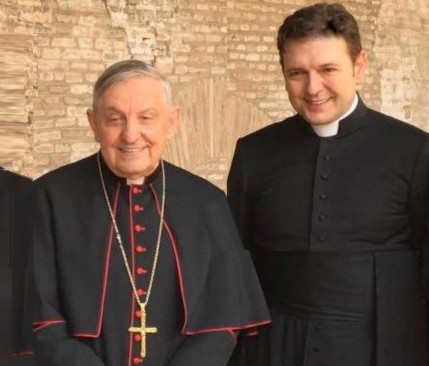
THE ARABIAN STALLION OF THE SUPREME PONTIFF: THOSE WHO WISH TO MOUNT AND THOSE WHO WANT TO BE MOUNTED
The fact that animals are donated to the Roman Pontiff is not at all new. Leo X received a white elephant as a gift from King Manuel I of Portugal, the famous Hanno, who paraded in procession through the streets of Rome, Paul II was offered a pair of peacocks, they even brought a kangaroo from Australia to Pius IX. Benedict XVI occupies a privileged place in the hearts of us felines, having been a Catholic pontiff. Francesco instead received two donkeys: Thea e Noah, in case he hadn't already had plenty of them in the Vatican.
– Briefs from Hypatia's cogitatory –
Author Hypatia Gatta Roman
.
.
.
.
Franca Giansoldati, Vaticanist note from the newspaper The messenger, today gave news of the splendid Arabian stallion donated by a Polish faithful to His Holiness Leo XIV. A magnificent animal that the Holy Father - with that frank elegance of his that hopefully will surprise the courtiers - has expressed the desire to mount personally (cf.. WHO).
May animals be donated to the Roman Pontiff It's not new at all. Leo X received a white elephant as a gift from King Manuel I of Portugal, the famous Hanno, who paraded in procession through the streets of Rome, Paul II was offered a pair of peacocks, they even brought a kangaroo from Australia to Pius IX. Benedict XVI occupies a privileged place in the hearts of us felines, having been a Catholic pontiff. Francesco instead received two donkeys: Thea e Noah, in case he hadn't already had plenty of them in the Vatican. In short, the pontifical bestiary is almost as long as he Ecclesiastical Annalsby Cesare Baronio.
May the Holy Father wish to mount that noble steed it sincerely fills us with joy. Not only because it reveals an authentic love for the creatures of creation, but also because it shows a Pontiff who is still vigorous and full of energy at the dawn of his just turned seventy years old. And God knows how much, in these times, the Church needs Pastors who still know how to ride a horse and lead the flock.
To worry, if anything, it's something else entirely: the very high number of subjects who populate the Roman Curia, who - apparently - instead dream of being ridden by that splendid stallion. And as long as this clerical herd, nourished by ambition and courtliness, she will not be sent back to the stables, no reform, however holy, can succeed. Everything will end, like always, in the usual gallop towards nowhere.
the Island of Patmos, 17 October 2025
.
.
.
______________________
Dear Readers, this magazine requires management costs that we have always faced only with your free offers. Those who wish to support our apostolic work can send us their contribution through the convenient and safe way PayPal by clicking below:
Or if you prefer you can use our Bank account in the name of: Editions The island of Patmos n Agency. 59 From Rome – Vatican
Iban code: IT74R0503403259000000301118
For international bank transfers:
Codice SWIFT: BAPPIT21D21
If you make a bank transfer, send an email to the editorial staff, the bank does not provide your email and we will not be able to send you a thank you message: isoladipatmos@gmail.com
We thank you for the support you wish to offer to our apostolic service.
The Fathers of the Island of Patmos
.
.
.
.
.
.
.
HTTPS://i0.wp.com/isoladipatmos.com/wp-content/uploads/2023/01/ipazia-tondo-piccolo.jpg?fit=150,150&ssl=1150150HypatiaHTTPS://isoladipatmos.com/wp-content/uploads/2022/01/logo724c.pngHypatia2025-10-17 17:20:052025-10-17 17:20:05The Arabian stallion of the Supreme Pontiff: those who want to mount and those who want to be mounted instead
WITH LEO XIV, BISHOP OF ROME, THE TITLE OF ITALIAN PRIMATE RE-emerges
This definition, remained silent for a long time in official texts, now comes back alive in the voice of the Pontiff as a sign of orientation for the Church and for Italy. After years of mostly universal interpretations of the papacy, Leo XIV wanted to renew the original dimension of his ministry: the Supreme Pontiff is Bishop of Rome and, for this, guide and father of the Churches of Italy.
Among the words pronounced by the Supreme Pontiff Leo XIV in his recent speech at the Quirinale, the 14 last October, one in particular resonated with theological force and historical intensity: «As Bishop of Rome and Primate of Italy».
This definition, remained silent for a long time in official texts, now comes back alive in the voice of the Pontiff as a sign of orientation for the Church and for Italy. After years of mostly universal interpretations of the papacy, Leo XIV wanted to renew the original dimension of his ministry: the Supreme Pontiff is Bishop of Rome and, for this, guide and father of the Churches of Italy.
The title of Primate of Italy expresses the ecclesiological truth that unites the universal Church to its concrete roots, tracing the primacy of Peter back to the sacramental source and the communion of the local Churches (cf.. The light, 22; The Eternal Shepherd, cap. (II)). In the vision of the Second Vatican Council, the Petrine function is never separated from the episcopal and collegial dimension: the Bishop of Rome, as successor of Peter, exercises a presidency of charity and unity (The light, 23), which is rooted in its own episcopal see. In this sense,, the title of Primate of Italy does not represent a legal privilege, but a theological and ecclesial sign that manifests the intimate connection between the universal primacy of the Roman Pontiff and his paternity over the Churches of Italy. As Saint John Paul II reminds us, the ministry of the Bishop of Rome "is at the service of the unity of faith and communion of the Church" (To be one, 94), and it is precisely from this communion that the national and local dimension of his pastoral concern arises.
In the Catholic hierarchy of the Latin Church, at the beginning of the second millennium, primate bishops are also envisaged, prelates who with that title - only honorific - are in charge of the oldest and most important dioceses of states or territories, without any prerogative (cf.. Pontifical Yearbook, ed. 2024). The Bishop of Rome is the Primate of Italy: ancient title, implemented over the centuries and still in force today, although with different prerogatives that have occurred over time.
Over the centuries other bishops in the Peninsula have had the honorific title of Primate: the Metropolitan Archbishop of Pisa maintains the title of Primate of the islands of Corsica and Sardinia, the Metropolitan Archbishop of Cagliari bears the title of Primate of Sardinia, the Metropolitan Archbishop of Palermo maintains the title of Primate of Sicily, and the Metropolitan Archbishop of Salerno as Primate of the Kingdom of Naples (cf.. Pontifical Yearbook, sez. “Metropolitan and Primate Headquarters”).
The territorial scope referred to by the term Italy was varied: from suburban Italy of the first Christian centuries, to Gothic and Lombard Italy, until the Kingdom of Italy incorporated into the Roman-German Empire, substantially made up of northern Italy and the Papal State. This primacy did not concern the territories of the former patriarchate of Aquileia, nor the territories forming part of Germanic kingdom — the current Trentino-Alto Adige, Trieste and Istria —, later belonged to the Austrian Empire. Today the primacy of Italy is implemented on a territory corresponding to that of the Italian Republic, of the Republic of San Marino and the Vatican City State (cf.. Pontifical Yearbook, ed. 2024, sez. “Primal Headquarters and Territories”).
The notion of "Italy" applied to ecclesiastical jurisdiction it has never had a political value, but an eminently pastoral and symbolic meaning, connected to the unifying function of the Bishop of Rome as a center of communion between the particular Churches of the Peninsula. Since the late ancient era, indeed, the suburbicaria regio designated the territory that, by ancient custom, recognized the direct dependence on the Roman See (cf.. Pontifical Book, vol. I, ed. Duchesne). Over the centuries, while changing civil constituencies and state structures, the spiritual dimension of primacy has remained constant, as an expression of ecclesial unity and the apostolic tradition of the Peninsula.
In the two thousand years of Christianity, the people of the Peninsula and the episcopate itself have constantly looked to the Roman See, both in the ecclesiastical and civil spheres. In 452 the Bishop of Rome, Leone I, at the request of Emperor Valentinian III, he was part of the embassy that went to northern Italy to meet the king of the Huns Attila, in an attempt to dissuade him from proceeding with his advance towards Rome (cf.. Prosper d'Aquitania, Chronicon, to a year 452).
They are the Popes of Rome who, in centuries, support the Municipalities against the imperial powers: the Guelph party - and in particular Charles of Anjou - becomes the instrument of papal power throughout the Peninsula. The Roman Pontiff will appear as the friend of the Municipalities, the protector of Italian liberties, contributing to dissolving the very idea of Empire understood as the holder of full sovereignty, in favor of widespread and multiple sovereignty.
The concept of jurisdictionwill be expressed clearly by Bartolo da Sassoferrato (1313-1357): it is not understood only as the power of speaking the law, but above all as the complex of powers necessary for the governance of a system that is not centralized in the hands of a single person or body (cf.. Bartolo of Saxoferrato, Treatise on Jurisdiction, in All works, New York, 1588, vol. IX). In this pluralistic vision of law, the Apostolic See represents the principle of balance and justice among the multiple forms of sovereignty that develop in the Peninsula, placing itself as a guarantor of the order and freedom of Christian communities.
Even in the 19th century, Vincenzo Gioberti proposed the neo-Guelph ideal and a confederation of Italian states under the presidency of the Roman Pontiff, outlining a vision in which the spiritual authority of the Pope should have acted as a principle of moral and political unity of the Peninsula (cf.. V. Gioberti, Of the moral and civil primacy of the Italiansi, Bruxelles 1843, lib. (II), cap. 5). In tune, Antonio Rosmini also recognized the Apostolic See as the foundation of the Christian political order, while distinguishing between spiritual power and temporal power, in a perspective that intended to heal the fracture between Church and nation (cf.. A. Rosmini, The Five Wounds of the Holy Church, Lugano 1848, Part II, cap. 1).
The title of Primate of Italy, in the modern age, he was therefore referring to the Bishop of Rome, ruler of a vast territory and head of a sprawling state, like others, in the Peninsula. The territory of primacy, Consequently, it was not identified with that of a single state, but it overlapped with the plurality of political jurisdictions of the time. If he Concordat of Worms(1122) had attributed to the Popes of Rome the power to confirm the appointment of bishops, in Italy — or rather in Kingdom of Italy, including central-northern Italy —, over the centuries the choice of bishops was agreed with the territorial sovereigns, according to the customs of European states: or through backhoe presentations, the first of which was generally the chosen one, or with a single designation by the prince holding the right of patronage, as also happened for the Kingdom of Sicily (cf.. Bullarium Romanum, t. V, Rome 1739).
The involvement of the state authority often determined a substantial balance between State and Church, in which the recognition of the respective spheres of action allowed the Apostolic See to maintain its influence on episcopal appointments, albeit within the boundaries of the concordats and sovereign privileges.
In the midst of the jurisdictionalist era of the 18th century, Episcopalian claims found no space in the episcopate of the Peninsula, nor the Gallican or Germanic ones, despite some Italian princes trying to comply, if not patronize, such theories (cf.. P. Study Program, Jurisdictionalism in the history of Italian political thought, Bologna 1968). In Tuscany, state interference in religious matters reached its full implementation under Grand Duke Peter Leopold (1765-1790). Animated by sincere religious fervor, the Grand Duke believed he was carrying out a work of true devotion and piety when he worked to combat the abuses of ecclesiastical discipline, superstitions, the corruption and ignorance of the clergy.
At first no protest was raised by the Tuscan episcopate, or because he saw the futility of opposing, or because he approved those measures; maybe even why, in the Tuscan episcopate as in the clergy, there was an antipathy towards religious orders and a form of autonomy from the Holy See was willingly accepted. However, in the general synod of Florence of 1787, all the bishops of the State - except Scipione de' Ricci and two others - rejected these reforms, reaffirming fidelity to communion with the Roman Pontiff and defending the integrity of ecclesiastical tradition (cf.. Proceedings of the Synod of Florence, 1787, arch. the court of Florence).
The Catholic Church has always fought the formation of national churches, since such attempts are in open contrast with the very structure of ecclesial communion and with the ancient canonical discipline. Already the dog. XXXIV day Canons of the Apostles — a collection dating back to the 4th century, around the year 380 — prescribed a fundamental principle of episcopal unity:
It is agreed that the bishop should know the individual nations, because he is considered the first among them, whom they regard as their head and bear nothing more than his consent, than those alone, which parishes [in greco τῇ paroiᾳ] proper and the towns that are under it are competent. But neither should he do anything apart from the conscience of all; for thus there will be unanimity and God is glorified through Christ in the Holy Spirit (“The bishops of each nation must know who among them is the first and consider him as their leader, and do not do anything important without his consent; each will only deal with what concerns their own diocese and the territories that depend on it; but he who is first must also do nothing without the consent of all: thus harmony will reign and God will be glorified through Christ in the Holy Spirit.”)
This rule, of an apostolic flavor and synodal matrix, affirms the principle of unity in collegiality, where primacy is not domination, but communion service. This conception, assumed and deepened in the Catholic tradition, found its full expression in the doctrine of Roman primacy. As Pope Leo XIII teaches:
«the Church of Christ is one by nature, and as one is Christ, so one must be one's body, his faith is one, his doctrine is one, and one his head visible, established by the Redeemer in the person of Peter" (Well known, 9).
As a result, any attempt to found particular churches or national independent from the Apostolic See has always been rejected as contrary to a, holy, Catholic and Apostolic Church. The subordination of the episcopal college to the Petrine primacy constitutes in fact the bond of unity that guarantees the catholicity of the Church and preserves the individual particular Churches from the risk of isolation or doctrinal deviation (cf.. The light of the nationm, 22; Christ the Lord, 4).
The title of Primate, attributed to some locations, it was actually a mere honorific, like that of Patriarch conferred on some episcopal sees of the Latin rite (cf.. Code of Canon Law, can. 438). Such dignity, of an exclusively ceremonial nature, it did not carry effective jurisdictional power, nor a direct authority over the other dioceses of a specific ecclesiastical region. The title was intended to honor the age or particular historical relevance of an episcopal seat, according to a practice consolidated in the second millennium.
However, the position is different and above all the prerogatives of the two primate seats of Italy and Hungary, which preserve a singular juridical-ecclesial physiognomy within the Latin Church. According to a centuries-old tradition, the Prince-Primate of Hungary is covered with both ecclesiastical and civil duties. Between these, the privilege of crowning the sovereign — a privilege last exercised on 30 December 1916 for the coronation of King Charles IV of Habsburg by St. E. Mons. János Cernoch, then Archbishop of Esztergom - and to replace him in case of temporary impediment (cf.. Journal of the Holy See, vol. XLIX, 1917).
Hungarian primacy it is attributed to the archiepiscopal seat of Esztergom (today Esztergom-Budapest), whose ancient primacy dignity dates back to the 11th century, when King Stephen I obtained from the Pope the foundation of the Hungarian national Church under the direct protection of the Apostolic See. L'Archivescovo di Esztergom, as Primate of Hungary, enjoys a special position over all Catholics present in the State and a power quasi-governmental on bishops and metropolitans, including the metropolis of Hajdúdorog for the Hungarian faithful of the Byzantine rite. There is a primary court near him, always presided over by him, which judges cases in third instance: a privilege founded on an immemorial custom, rather than on an express legal norm (cf..Code of Canon Law, can. 435; Pontifical YearbookO, sez. “Primary Headquarters”, ed. 2024). He is a Hungarian citizen, resident in the State, and often also holds the position of President of the Hungarian Episcopal Conference, exercising a mediation function between the Apostolic See and the local Church.
Italian primacy, attributed to the Roman See, It has a very particular configuration: its owner, the Bishop of Rome, he can be - and in fact in recent pontificates he has been - a non-Italian citizen. He is sovereign of a foreign state, the Vatican City State, not part of the European Union, and does not belong to the Italian Episcopal Conference, while maintaining direct authority over it. By virtue of his title of Primate of Italy, the Roman Pontiff in fact appoints the President and General Secretary of the Italian Episcopal Conference, as required by the art. 4 §2 of the CEI Statute, which expressly recalls «the particular bond that unites the Church in Italy to the Pope, Bishop of Rome and Primate of Italy" (cf.. Statute of the Italian Episcopal Conference,approved by Paul VI 2 July 1965, updated in 2014).
This singular legal configuration shows how Italian primacy, despite having no autonomous administrative structure, retains a real ecclesiological function, as a visible expression of the organic bond between the universal Church and the Churches of Italy. In this the continuity of the Petrine primacy is manifested in its dual dimension: universal, as a service to the communion of the whole Church, and local, as pastoral paternity exercised on Italian territory (The light, 22–23).
An opening is thus outlined the end of the Churchto international and global problems, something which is also found in some paragraphs of the Catechism of the Catholic Church, dedicated to human rights, to international solidarity, to the right to religious freedom of various peoples, to the protection of emigrants and refugees, to the condemnation of totalitarian regimes and the promotion of peace. What is most relevant is the invitation, incitement, of the Church a to complete the good it is not only anchored to the eternal salvation, to the achievement of the otherworldly goal, but also to the contingent, to the immanent needs of man in need of material help.
Based on the claimed primacy and pursuant to art. 26 the Lateran Treaty, the pastoral action of the Pontiff himself takes place in several regions of Italy, through visits to many cities and sanctuaries, carried out without these presenting themselves as trips to foreign countries. The widespread practice of considering the Pope of Rome as the first Bishop of Italy means that Italian events are often present in his speeches or speeches.. He often visits areas of the Peninsula where painful events have occurred, and the presence of the Pope is seen by the populations as dutiful, requested as a sign of comfort and help. It also comes back, in the broad sense of primacy, receiving delegations from Italian state bodies. In this perspective, the figure of the Roman Pontiff as Primate of Italy takes on the value of a sign of communion between the Church and the Nation, in the line of the universal mission that he exercises as successor of Peter. The national dimension of his pastoral concern is not opposed, but rather it integrates, with the Catholic mission of the Apostolic See, because the Pope is also Bishop of Rome, Father of the Churches of Italy and Pastor of the universal Church (Preach the Gospel, art. 2).
The triple dimension of his ministry — diocesan, national and universal — makes that visible the unity of the Church that faith professes and history bears witness to. Thus the title of Primate of Italy, resurfaced in the voice of Leo XIV, it does not appear as a remnant of past honors, but as a living reminder of the spiritual responsibility of the Papacy towards the Italian people, in continuity with his apostolic mission towards all people.
Velletri of Rome, 16 October 2025
.
.
Visit the pages of our book shop WHO and support our editions by purchasing and distributing our books.
.
______________________
Dear Readers, this magazine requires management costs that we have always faced only with your free offers. Those who wish to support our apostolic work can send us their contribution through the convenient and safe way PayPal by clicking below:
Or if you prefer you can use our Bank account in the name of: Editions The island of Patmos n Agency. 59 of Rome --vatico
Iban code: IT74R0503403259000000301118
For international bank transfers:
Codice SWIFT: BAPPIT21D21
If you make a bank transfer, send an email to the editorial staff, the bank does not provide your email and we will not be able to send you a thank you message: isoladipatmos@gmail.com
We thank you for the support you wish to offer to our apostolic service.
The Fathers of the Island of Patmos
.
.
.
HTTPS://i0.wp.com/isoladipatmos.com/wp-content/uploads/2023/09/padre-Teodoro-foto-piccola.jpg?fit=150,150&ssl=1150150Father TheodoreHTTPS://isoladipatmos.com/wp-content/uploads/2022/01/logo724c.pngFather Theodore2025-10-16 20:57:332026-02-20 12:43:55With Leo XIV Bishop of Rome, the title of Primate of Italy resurfaces
HTTPS://i0.wp.com/isoladipatmos.com/wp-content/uploads/2019/01/Padre-Ivano-piccola.jpg?fit=150,150&ssl=1150150Father IvanoHTTPS://isoladipatmos.com/wp-content/uploads/2022/01/logo724c.pngFather Ivano2025-10-09 11:57:502025-10-09 12:40:31From Professor Alessandro Barbero a Saint Francis "under the crust". when holiness is combined with history
PINK DUES AT THE ALTAR ARE REQUIRED? FROM FEMINIST THEO-IDEOLOGY TO THE PASTORAL WISDOM OF SRI LANKA
The bishop can allow altar girls, but he cannot force parish priests to use them. The non-ordained faithful "do not have a right" to serve at the altar and the obligation remains to promote male groups of altar boys, also for their proven vocational value.
Seeing children around the altar it cheers the heart and spirit. It is a sign of life in a Europe - starting from our Italy - in which the birth rate has been at a standstill for decades and the average age of the population, and the clergy, continues to rise. In such a fragile context, the presence of children in church is already good news, a foretaste of the future.
In the video: S. AND. Rev.ma Mons. Raymond Kingsley Wickramasinghe, Bishop of Galle (Sri Lanka)
When two parents apologized to me at the end of the Holy Mass for the two somewhat noisy children, answered: «As long as children make noise in our churches, it means we are always alive". I didn't add it then, but I'll do it now as an aside in the discussion: when during the sacred liturgies we will no longer hear the voices of children, we will surely hear those of the muezzins who will sing from the bell towers of our churches transformed into mosques, as has already happened in various Northern European countries. The examples are known, I'll just take a few: in Hamburg the former Lutheran Kapernaumkirche was purchased and reopened as the Al-Nour Mosque; in Amsterdam the Fatih Moskee is located in the former Catholic church of Saint Ignatius; in Bristol the Jamia Mosque is located in the former St. Katherine’s Church. As for the call of the muezzin with loudspeakers, the city of Cologne started in 2021 a city project that allows Friday recall, then stabilized in 2024.
In the last decades, in quite a few dioceses the habit of admitting girls to serve at the altar has become established. Practice that many bishops and parish priests, even though I don't love her, they tolerated or maintained so as not to spark controversy. Over the years some of them, having now become adolescents and young people, they continued to serve at the altar, not without embarrassment for some priests, including yours truly, who with extreme politeness has never allowed girls and especially teenage girls to serve. Of course, it's not about preventing women from certain services, but to think with pedagogical pastoral wisdom: how many priestly vocations were born next to the altar, in the group of altar boys? And how do you explain to a little girl who is passionate about liturgy that the ministry of the Order is not, nor can it be a perspective open to her female condition? Because on this point the doctrine is very clear: «Only a baptized man validly receives sacred ordination» (Code of Canon Law 1983, can. 1024); «The Church recognizes itself as bound by the choice made by the Lord himself. For this reason the ordination of women is not possible." (Catechism of the Catholic Church, n. 1577); and the Holy Pontiff John Paul II definitively confirmed that the Church "has no authority" to confer priestly ordination on women (priestly ordination, 22 May 1994, n. 4).
Then there is a socio-pedagogical aspect well known to those who frequent the sacristies: the little girls, often more ready, diligent and mature peers, tend to prevail in small groups; experience shows that, where the number of girls in the presbytery becomes significantly higher, quite a few boys back away perceiving that service as "a thing for girls". The paradoxical result is that precisely the most potentially vocational subjects distance themselves from the heart of the celebration. It would therefore be appropriate to ask: in a West with a high average age of priests, empty seminaries or reduced in number of seminarians to a minimum, with more and more parishes without a parish priest, it makes sense to give up what can favor even a few seeds of vocation to pursue the - worldly and politically correct - logic of "clerical pink quotas"?
To understand "what is possible" and above all "what is best", the starting point is not opinions but liturgical norms. The liturgy is not a field of sociological experimentation: «Absolutely none, not even the priest, add, removes or changes anything on his own initiative" (Holy Council, 22 §3). The functions of the ministers are outlined with precise calls for sobriety, roles and limits (General Missal Traditional, NN. 100; 107; 187-193). On the ministerial side, the Holy Pontiff Paul VI replaced the ancient "minor orders" with the established ministries of reader and acolyte, then reserved for lay men (cf.. Ministries, NN. I-IV). The Supreme Pontiff Francis has modified can. 230 § 1, opening the established ministries of lector and acolyte to women as well, but these are not identified with the service of altar boys, which falls within the temporary deputation foreseen by can. 230 §2 and concerns the help at the altar entrusted from time to time to lay people (crf. The owner of the owner, 2021; CIC 1983, can. 230 §1-2).
Two texts from the Holy See they then set the perimeter with rare clarity. The Circular Letter of the Congregation for Divine Worship, addressed to the Presidents of the Episcopal Conferences for the correct interpretation of can. 230 §2 (15 March 1994, Prot. 2482/93), recognized the possibility - at the discretion of the bishop - of also admitting women to serve at the altar, specifying, however, that "it will always be very appropriate to follow the noble tradition of having altar boys" and that no subjective right to serve arises from admission (cf.. Information30 [1994] 333-335). A few years later, the Letter of the same Congregation (27 July 2001) they further clarified that the bishop can allow altar girls but cannot force parish priests to use them; that the non-ordained faithful "do not have a right" to serve at the altar; that the obligation to promote male groups of altar boys remains, also for their proven vocational value. It is "always very appropriate" - states the document - to follow the noble tradition of boys at the altar (Latin text in Information 37 [2001] 397-399; Trad.. en. inInformation 38 [2002] 46-48).
Inside this picture, the pedagogy of the altar shines again: proximity to the Mystery educates with the power of signs, introduces a filial confidence with the Eucharist e, for many kids, it was a real one “lecture” of discernment. The Church which does not have the power to confer the Order on women (Catechism of the Catholic Church n. 1577; priestly ordination, 4) is called to prudently safeguard those spaces that have historically proven fertile for the emergence of priestly vocations. This does not devalue female presence and charisma; on the contrary, frees the community from the temptation to clericalize the laity and to laicize the clergy - and in particular women - by symbolically pushing them into the presbyterate, as if that were the only place "that matters" (cf.. reminder about clericalism in the gospel of joy, 102-104). There are very rich paths for girls and young people, established and in fact: established readership or, according to the cases, practiced as a reading in the celebration, singing and sacred music, sacristy service, ministries of the Word and charity, catechesis e, today, also the established ministry of catechist (The old ministry, 2021). These are areas in which the "female genius" offers the Church a decisive contribution without generating impossible expectations regarding access to the priesthood (cf.. The old ministry, 2021; Spirit ofi, 2021; can. 230 §1-2).
The experience of other particular Churches sheds further light on the issue. In Sri Lanka, where the average age of the clergy is much lower than Italy and the seminaries are populated with vocations, the Metropolitan Archbishop of Colombo, Cardinal Albert Malcolm Ranjith, indicated the use of altar girls as inappropriate for pastoral and pedagogical reasons: none of them, indeed, as adults they will be able to enter the seminary; it therefore makes sense to preserve typically male educational spaces around the altar, without taking anything away from the rich female participation in other areas? In other contexts, like in the United States, some dioceses and parishes have legitimately maintained all-male groups of altar servers precisely on the basis of the texts of 1994 he was born in 2001. It's not about "excluding", but to enhance a practice that in certain places proves to be more fruitful for vocational pastoral care (cf.. diocesan lines: Diocese of Lincoln – Nebraska; Phoenix – Cathedral Parish; other local realities of the United States of America).
At this point, however, someone calls for pink quotas in the presbytery, as if symmetrical representation were the litmus test of the valorization of women. A logic, that of pink quotas, which however belongs to the sociopolitical; the liturgy is not a parliament to be represented proportionally, it is the action of Christ and the Church. Discernment applies here, not the claim. And discernment asks: in a territory with few priests and few vocations, which concrete choice best promotes the growth of future priests without debasing the presence of women? The Holy See's responses leave no misunderstandings: admitting girls is permitted when appropriate, but it is appropriate and even necessary to promote male groups of altar boys, also in view of vocational pastoral care (cf.. Information30 [1994] 333-335; Information37 [2001] 397-399; Information 38 [2002] 46-48).
The thesis has also been circulating in recent months — taken up by the theologian Marinella Perroni, according to which Columbus' choice would constitute a perfect "syllogism" but "to be rejected", because it would make the group of altar boys impervious to differences and therefore harmful.
Subject, that of this theologian, which confuses social engineering and liturgy in a truly superficial and crude way. The liturgy does not aim to represent all differences but to serve the Mystery according to common norms (cf.. Holy Council22 §3). The official sources, as seen, they remember three elementary things: the ability to admit girls is possible but does not create rights; the bishop can authorize, but do not impose; and "the obligation remains" to promote men's groups for vocational reasons as well (cf.. Information 37 [2001] 397-399; Trad.. en. Information38 [2002] 46-48; the more Circular letter the 15.03.1994, Prot. 2482/93).
In other words: Cardinal Albert Malcom Ranjith does not exclude women: exercises pastoral prudence precisely foreseen by law and practice. Mistaking this prudence for misogyny is pure ideology, not discernment. And if ecclesial vitality really depended on a "pink" censer, then two millennia of female saints, of women doctors and martyrs - without ever claiming the ministerial altar - would be worth less than a share: an unfair conclusion towards women e, Furthermore, irrational for faith (cf.. Marinella Perroni: "Sri Lanka, but because the ban on altar girls would favor priestly vocations?», The Osservatore Romano in Women Church World, 1 February 2025).
Definitely, no quotas are needed at the altar, we need hearts educated in the Mystery. It is legitimate - and sometimes appropriate - for some particular Churches to admit girls to service; and it is equally legitimate - and often wiser - to maintain male groups of altar servers when this benefits the clarity of the signs and the promotion of vocations. It is not a surrender to the “male order”, but an act of pastoral prudence at the service of the entire community.
If we love girls, we offer them great ministries and services according to the Gospel: Word, charity, catechesis, custody and decoration of the church and the altar, musica, singing... without reducing their dignity to a position next to the thurible. Instead, if we love the kids, let us intelligently guard those educational spaces that, for centuries, they helped the Church to recognize and accompany the gift of a priestly life.
A final note as a personal testimony: I was nine years old when at the end of Holy Mass I went home telling my parents that I wanted to become a priest. Which was taken as one of the many typical fantasies of children, capable of saying today that they want to be astronauts, tomorrow the strawberry growers, the doctors the day before tomorrow. but yet, what seemed like a fantasy, it turned out not to be so: thirty-five years later I received the Holy Order of Priests. Yup, mine was an adult vocation, but born as a child, while I was serving as an altar boy at the altar, at the age of nine.
the Island of Patmos, 8 October 2025
.
_____________________________________________
ARE «PINK QUOTAS» AT THE ALTAR NECESSARY? FROM FEMINIST THEO‑IDEOLOGY TO SRI LANKA’S PASTORAL WISDOM
A bishop may permit altar girls, but he cannot require pastors to use them. The non-ordained faithful «have no right» to serve at the altar, and there remains an obligation to promote boys’ altar-server groups, also for their proven vocational value.
Seeing children around the altar gladdens the heart and spirit. It is a sign of life in a Europe — beginning with our Italy — where the birth rate has been flat for decades and the average age of the population, and of the clergy, keeps rising. In such a fragile context, the presence of children in church is already good news, a foretaste of the future.
In the video: His Excellency Msgr. Raymond Kingsley Wickramasinghe, Bishop of Galle (Sri Lanka)
When two parents apologized to me at the end of Holy Mass for their two rather noisy children, I replied: «As long as children make noise in our churches, it means we are still alive». I did not add then — but I do so now in passing — that when we no longer hear the voices of children in our churches, we will surely hear the voices of the muezzins singing from the bell towers of our churches turned into mosques, as has already happened in various countries of Northern Europe.
The examples are well known, I will mention only a few: in Hamburg the former Lutheran Kapernaumkirche was purchased and reopened as the Al‑Nour Mosque; in Amsterdam the Fatih Moskee occupies the former Catholic Church of St Ignatius («The Sower»); in Bristol the Jamia Mosque stands in the former St. Katherine’s Church. As for the amplified call of the muezzin, the city of Cologne launched in 2021 a municipal pilot allowing the Friday call, which was then stabilized in 2024.
In recent decades, in not a few dioceses it has become customary to admit girls as well to service at the altar. Many bishops and pastors, though not fond of the practice, have tolerated or maintained it to avoid controversy. Over the years, some of those girls became adolescents and young women and continued serving, not without embarrassment for certain priests — including the undersigned — who, with the greatest courtesy, have never allowed girls, and especially adolescent young women, to serve.
To be clear, this is not about forbidding women certain services, least of all young girls. It is about thinking with pedagogical and pastoral wisdom: how many priestly vocations have been born at the altar, within a group of altar boys? And how does one explain to a girl who loves the liturgy that the sacrament of Orders is not, and cannot be, a path open to her as a woman? The doctrine is crystal‑clear: «A baptized male alone receives sacred ordination validly» (cf. Code of Canon Law, can. 1024); «The Church recognizes herself to be bound by the choice made by the Lord himself. For this reason the ordination of women is not possible» cf. Catechism of the Catholic Church, 1577); and Saint John Paul II definitively confirmed that the Church «has no authority whatsoever» to confer priestly ordination on women (cf. priestly ordination(1994), n. 4; CDF, The answer to the problem(1995).
There is also a socio‑pedagogical aspect known to those who frequent sacristies: girls — often readier, more diligent and mature than their peers — tend to take the lead in small groups; experience shows that where the number of girls in the sanctuary clearly exceeds that of boys, not a few boys withdraw, perceiving the service as a «girls’ thing». The paradoxical result is that those most potentially receptive to a vocation drift away from the heart of the celebration. In a West where the average age of priests is high, seminaries are empty or reduced and parishes are without pastors, does it make sense to give up what may foster even a few vocations in order to pursue the worldly logic of “clerical pink quotas”?
To understand not only «what is allowed» but above all «what is fitting», we must start from the liturgical norms. The liturgy is not a field for sociological experiments: «Therefore no other person, even if he be a priest, may add, remove, or change anything in the liturgy on his own authority» (cf. Holy Council, 22 §3). The functions of ministers are laid out with sober precision (cf. General Instruction of the Roman Missal). As for ministries, Saint Paul VI replaced the former “minor orders” with the instituted ministries of lector and acolyte, then reserved to lay men cf. Ministries, 1972). Pope Francis modified can. 230 § 1, opening the instituted ministries of lector and acolyte also to women, but these are not to be identified with altar‑server service, which belongs to the temporary deputation of can. 230 §2 and concerns assistance at the altar entrusted case by case to lay faithful (cf. Spirit of, 2021).
Two texts of the Holy See clarified the matter with unusual precision. The Circular Letter of the Congregation for Divine Worship to the Presidents of Bishops’ Conferences on the correct interpretation of can. 230 §2 (15 March 1994, Prot. 2482/93) recognized the possibility — at the bishop’s discretion — of admitting girls to service at the altar, while stressing that it is “always very appropriate” to maintain the noble tradition of boys as altar servers, and that such admission does not create any subjective “right” to serve (Information30 (1994) 333–335). A few years later, the Letterof the same Congregation (27 July 2001) clarified further: the bishop may permit altar girls but cannot oblige pastors to use them; the non‑ordained faithful «have no right» to serve; and there remains the obligation to promote male groups also for their vocational value (cf. Information 37 (2001) 397–399; .Information 38 (2002) 46–48).
The experience of other local Churches also sheds light. In Sri Lanka — where the average age of diocesan clergy is much lower than in Italy and the seminaries are well populated — the Metropolitan Archbishop of Colombo, Cardinal Albert Malcolm Ranjith, indicated the inopportuneness of altar girls for pastoral and pedagogical reasons: none of them, as adults, can enter the seminary; it therefore makes sense to preserve characteristically male formative spaces around the altar, without in any way diminishing the rich female participation elsewhere (see his pastoral indication cited here: The Rudder).
In other contexts, such as the United States, some dioceses and parishes have legitimately maintained boys‑only altar‑server groups precisely on the basis of the 1994 and 2001 texts. This is not “exclusion”, but the promotion of a practice that in certain places proves more fruitful for vocational ministry (cf. Diocese of Lincoln (policy explanation; and the 2011 decision at the Cathedral of Sts. Simon & Jude, Phoenix — news report).
In recent months, this thesis has been taken up by the italian theologian Mrss Marinella Perroni, who argues that the choice made in Colombo follows a «syllogism» that may be logically neat but should nonetheless be rejected.
In doing so, however, her argument slides from liturgy into social engineering. The liturgy is not a proportional mirror of social constituencies; it is the Church’s worship of God according to norms that safeguard the clarity of signs and the freedom of grace (cf. Holy Council 22 §3). The Holy See’s documents, as shown above, recall three elementary points: the faculty to admit girls is possible but does not create subjective rights; the diocesan bishop may authorize but not impose it on pastors; and there remains the obligation to promote boys’ altar‑server groups also for vocational reasons (cf. Information30 (1994) 333–335; Information 37 (2001) 397–399; Information 38 (2002) 46–48). To mistake this prudence for misogyny is ideology, not discernment (See Perroni’s article: "Sri Lanka, but why would the ban on altar girls encourage priestly vocations?» — L’Osservatore Romano, the official organ of the Holy SeeItalian original — English version).
In short, the altar does not need quotas; it needs hearts formed by the Mystery. It is legitimate — and at times opportune — for some particular Churches to admit girls to service; and it is equally legitimate — and often wiser — to maintain male altar‑server groups where this serves the clarity of signs and the promotion of vocations. This is not a capitulation to a “male order”, but an act of pastoral prudence in service of the whole community.
A concluding personal note: I was nine years old when, after Holy Mass, I went home and told my parents I wanted to become a priest. They took it as one of the many fantasies typical of children, who today want to be astronauts, tomorrow strawberry growers, and the day after doctors. And yet, what seemed a fantasy proved otherwise: thirty‑five years later I received sacred priestly ordination. Yes, mine was an adult vocation — but born as a child, while serving as an altar boy at the altar.
from the Island of Patmos, October 8, 2025
.
_______________________________________________
ARE THE “PINK FEES” NECESSARY AT THE ALTAR? FROM FEMINIST THEO‑IDEOLOGY TO THE PASTORAL WISDOM OF SRI LANKA
The bishop may allow the altar girls, but cannot force parish priests to use them. Non-ordained faithful "have no right" to serve at the altar and the obligation to promote male groups of altar servers remains., also for its proven vocational value.
See children around the altar cheers the heart and spirit. It is a sign of life in a Europe — starting with our Italy — in which the birth rate has been stagnant for decades and the average age of the population, and of the clergy, it doesn't stop increasing. In such a fragile context, The presence of children in the church is already good news, a preview of the future.
In the video: His Excellency Monsignor Raymond Kingsley Wickramasinghe, Obispo de bilal (Sri Lanka)
When, at the end of the Holy Mass, Two parents apologized to me for their two noisy children., I reassured them by saying: «As long as children make noise in our churches, It means we're still alive.". I didn't add it then — but I do it now as an aside —: when we no longer hear the voices of children in our churches, surely we will hear the muezzins singing from the bell towers of our churches converted into mosques, as has already happened in several Northern European countries. The examples are known; I quote only a few: in Hamburg, the former Lutheran Kapernaumkirche was acquired and reopened as Al-Nour Mosque; in Amsterdam, The Fatih Moskee has its headquarters in the former Catholic church of Saint Ignatius; A Bristol, The Jamia Mosque stands on the old St. Katherine’s Church. Regarding the muezzin's call on loudspeaker, the city of Cologne began in 2021 a municipal project that allows the call on Fridays, subsequently stabilized in 2024.
In recent decades, Many dioceses have also admitted girls to the service of the altar.. Many bishops and parish priests, still not appreciating it, have tolerated or maintained the practice to avoid controversy. As the years go by, some have continued as adolescents and young people, not without a certain embarrassment for some priests, including who writes, who with utmost courtesy has never allowed girls — and especially adolescents — to serve at the altar. It is worth clarifying this: It is not about denying women certain services, but to think with pastoral and pedagogical wisdom. How many priestly vocations were born next to the altar, in the group of altar boys? And how do you explain to a girl who is enthusiastic about the liturgy that the sacrament of Holy Orders is not — and cannot be — a perspective open to her feminine condition?? The doctrine is very clear: «Only the baptized male validly receives sacred ordination» (cf. CIC 1983, can. 1024); «The Church recognizes itself as bound by the election made by the Lord himself. For this reason, "The ordination of women is not possible." (cf. CEC n.1577); and Saint John Paul II definitively confirmed that the Church "does not in any way have the power" to confer priestly ordination on women (cf. priestly ordination, 22 May 1994, n. 4).
There is also a socio-pedagogical aspect well known by those who frequent the sacristies: the girls, often sooner, diligent and mature than their contemporaries, tend to prevail in small groups; experience shows that, where the number of girls in the presbytery becomes clearly higher, not a few boys withdraw, perceiving that service as “a girl thing”. The paradoxical result is that precisely the subjects with the greatest vocational potential move away from the heart of the celebration.. Does it make sense, so, in a West with a high average priestly age, empty or reduced seminaries and parishes without a priest, renouncing what can favor even a few germs of vocation to pursue the logic — but politically correct — of the “pink clerical quotas”?
To understand not only what “can be”, but above all what is “convenient”, the starting point is the liturgical norms, not the opinions. The liturgy is not a field for sociological experiments: "In no way does it allow anyone, not even the priest, add, remove or change anything on one's own initiative" (cf. Holy Council 22 §3). The functions of the ministers are outlined soberly, with roles and limits (cf. General Missal Traditional [IGMR], NN. 100; 107; 187–193).
In the field of ministries, Saint Paul VI replaced the old “minor orders” with the instituted ministries of reader and acolyte, then reserved for lay men (cf. Ministries, NN. I -IV). Pope Francis later modified the can. 230 § 1, opening these instituted ministries also to women, but they do not identify with the altar boy service, which belongs to the temporary deputation provided for by can. 230 §2 (cf. Spirit of, 2021; CIC 1983, can. 230 §1–2).
Two texts from the Holy See They then established the perimeter with rare clarity. The Circular Letter of the Congregation for Divine Worship to the Presidents of the Episcopal Conferences on the correct interpretation of the canon. 230 §2 (15 March 1994, Prot. 2482/93) recognized the possibility — at the discretion of the bishop — of also admitting girls to the altar service, specifying at the same time that "it is always very appropriate" to maintain the noble tradition of altar boy children and that such admission does not create any subjective "right" to serve (cf. Information 30 (1994) 333–335). After a few years, las Letter from the same Congregation (27 July of 2001) they clarified even more: the bishop may allow the altar girls, but you cannot force parish priests to use them; non-ordained faithful "have no right" to serve; and the obligation to promote male groups also remains due to their proven vocational value. (cf. Information 37 (2001) 397–399; see also the Italian translation: Information38 (2002) 46–48).
The experience of other particular Churches further illuminates the issue. In Sri Lanka — where the average age of the diocesan clergy is much lower than in Italy and the seminaries are well populated —, the metropolitan archbishop of Colombo, Cardinal Albert Malcolm Ranjith, pointed out the inappropriateness of altar girls for pastoral and pedagogical reasons: none of them, already adult, you will be able to enter the seminar; therefore, it makes sense to preserve typically masculine educational spaces around the altar, without taking anything away from the rich female participation in other areas (see this pastoral indication cited here: The Rudder).
In other contexts, like in the United States, Some dioceses and parishes have legitimately maintained all-male altar boy groups precisely on the basis of the texts of 1994 and 2001. This is not "exclusion", but the promotion of a praxis that in certain places appears more fruitful for vocational ministry (see the Diocese of Lincoln (policy explanation); and the decision of 2011 in the Cathedral of Saints Simon and Jude, Phoenix — journalistic chronicle).
In these months, This thesis has been taken up by the theologian Marinella Perroni, who maintains that Colombo's option responds to an impeccable but, in your opinion, rejectable. However, His argument confuses liturgy with social engineering. The liturgy is not a proportional mirror of social belongings; It is the Church's worship of God according to norms that safeguard the clarity of the signs and the freedom of grace. (cf. Holy Council 22 §3). The documents of the Holy See, as we have seen, remember three basic points: girls can be admitted, but this does not create subjective rights; the diocesan bishop can authorize it, do not impose it on the parish priests; and the obligation to promote male groups of altar boys also for vocational reasons remains. (cf. Information 30 (1994) 333–335; Information37 (2001) 397–399; Information38 (2002) 46–48). Taking this caution for misogyny is ideology, non-discernment. See Perroni's article: "Sri Lanka, but because the ban on altar girls would favor priestly vocations?» — Italian original — english version.
Ultimately, at the altar there is no need for fees, but hearts educated by the Mystery. It is legitimate — and sometimes appropriate — for some particular Churches to admit girls to service; and it is equally legitimate — and often more prudent — to maintain male groups of altar servers when this serves the clarity of the signs and the promotion of vocations.. It is not a surrender to the “masculine order”, but an act of pastoral prudence at the service of the entire community.
A personal note as a testimony: I was nine years old when, at the end of the Holy Mass, I came home telling my parents that I wanted to be a priest.. They took it as one of many children's fantasies., able to say today that they want to be astronauts, Strawberry growers tomorrow and doctors tomorrow. Y, however, what seemed like a fantasy was not: thirty-five years later I received sacred priestly ordination. Yeah, mine was an adult vocation, but born as a boy, while serving as an altar boy.
From the island of Patmos, 8 October 2025
.
______________________
Dear Readers, this magazine requires management costs that we have always faced only with your free offers. Those who wish to support our apostolic work can send us their contribution through the convenient and safe way PayPal by clicking below:
Or if you prefer you can use our Bank account in the name of:
Editions The island of Patmos
n Agency. 59 From Rome – Vatican
Iban code: IT74R0503403259000000301118
For international bank transfers:
Codice SWIFT: BAPPIT21D21
If you make a bank transfer, send an email to the editorial staff,
the bank does not provide your email and we will not be able to send you a thank you message: isoladipatmos@gmail.com
We thank you for the support you wish to offer to our apostolic service.
The Fathers of the Island of Patmos
.
.
.
.
.
.
.
.
.
HTTPS://i0.wp.com/isoladipatmos.com/wp-content/uploads/2025/08/Padre-Ariel-foto-2025-piccola.jpg?fit=150,150&ssl=1150150father arielHTTPS://isoladipatmos.com/wp-content/uploads/2022/01/logo724c.pngfather ariel2025-10-08 17:40:522026-02-20 12:45:16Pink quotas are required at the altar? From feminist teo-ideology to the pastoral wisdom of Sri Lanka – Are «pink quotas» at the altar necessary? From feminist theo-ideology to Sri Lanka’s pastoral wisdom – Are "pink quotas" necessary on the altar? From feminist theo -ideology to the pastoral prudence of Sri Lanka
The authentic disciple of the Lord, after having done his service well, he must however recognize himself as useless because his work does not necessarily guarantee him salvation, as grace will always be a gift and not a boast for having done something.
The Gospel of Luke today reports two sayings of Jesus. The first concerns faith, in response to a question from the apostles.
The second which is presented in extended form, almost a small parable, refers to the service that "useless servants" provide. The context is still that of Jesus' great journey to Jerusalem which began in LC 9,51 and will end in LC 19,45. Today's Gospel closes the second section of this pilgrimage of Jesus which is characterized by the invitation to enter the Kingdom by following certain conditions. What follows is the Gospel text:
"During that time, the apostles said to the Lord: «Increase our faith!». The Lord replied: «If you had faith as much as a mustard seed, you might say to this mulberry tree: «Uproot yourself and go and plant yourself in the sea, and it would obey you. Who among you, if he has a servant to plow or graze the flock, he will tell him, when he returns from the field: «Come quickly and sit at the table?» He won't tell him instead: «Prepare something to eat, stringiti le vesti ai fianchi e sérvimi, until I have eaten and drunk, and afterward you will eat and drink?» Perhaps he will be grateful to that servant, because he followed the orders he received? So do you, when you have done everything you were told to do, said: «We are useless servants. We did what we had to do" (LC 17,5-10).
After having discussed the use of material goods, of relationships with others and of the Church with community instructions, for the first time in the Gospel of Luke the Lord speaks on the theme of faith in response to an intervention by the apostles: «Increase our faith» (LC 17,5). The question of the latter refers to a similar situation recalled by the Gospel of Mark. There, after the story of the transfiguration, the father of a possessed boy turns to Jesus to ask for his son's liberation, and tells him: «Credo; help my unbelief" (MC 9,24). The Lord answers him not in words, but with a gesture of power, exorcising the impure spirit. The gospel of Matthew tells the same episode but amplifies it, adding the reaction of the disciples not handed down by Saint Mark and recording however the same words of Jesus that we hear today: «Then the disciples approached Jesus, on the sidelines, and they asked him: «Because we couldn't drive him away?». And he answered them: «For your little faith. Verily I say unto you: if you have faith equal to a mustard seed, you will say to this mountain: «Move from here to there, and it will move, and nothing will be impossible for you" (Mt 17,19-20).
Actually Marco too preserves the same saying of Jesus in Luke, but in a different context, that of the fruitless fig tree: «Jesus answered them: «Have faith in God! Verily I say unto you: if one were to say to this mountain: Get up and throw yourself into the sea, without doubting in his heart, but believing that what he says happens, this will happen to him" (MC 11,22-23).
Are, as Archimedes said, to lift the world you need a point of support, this is undoubtedly faith for Jesus. Jesus has just spoken of the inevitability of scandals occurring in the Christian community and invited those who sin to be corrected and those who repent and openly recognize their sin to be infinitely forgiven. (LC 17,1-4). In this context we understand the prayer of the disciples to see their faith increased. How to hold up, indeed, the weight of scandals, of obstacles to the life of communion, of the stumbling block placed on the smallest or simplest in the ecclesial space? How to exercise fraternal correction that does not crush the brother but frees him? How to forgive again and always those who repent every time? Only through faith. Let it be, by way of example, to move a mulberry tree as in today's page of Luke or a mountain, as in the gospels of Mark and Matthew, the aforementioned "lever" to do this is faith, as big as a mustard seed, in fact what matters is quality and not quantity. In the evangelical miracles it is presupposed in the needy that Jesus encounters, allows us to avoid spectacularisation or idolatry, Jesus normally asks for faith before his intervention, since after that it is no longer guaranteed, as in the case of the ten healed lepers in next Sunday's Gospel: only one returned to say thank you (cf.. LC 17,11-19).
In the second part of the song a similarity is reported, almost a parable, which presents a situation that, Fortunately, today it is very difficult to trace, since slavery has been abolished and those who perform a service do so because they are competent and gratified and not simply because they are qualified as servants. However in the Bible these terms, net of social situations different from ours, are used to define a religious condition, often positive. For instance, in the Gospel of Luke, Mary herself proclaims herself the "servant" of the Lord (cf.. LC 1,38). How typical of Jesus, the parable places us before a paradoxical situation, as an invitation to look at reality from another point of view, which is that of God. In this case the paradox corresponds to the fact that the servant, having done his duty, it was necessary to his master. But the authentic disciple of the Lord, after having done his service well, he must however recognize himself as useless because his work does not necessarily guarantee him salvation, as grace will always be a gift and not a boast for having done something. The Greek term, used by Luca, acreios (achreioi), which has the original meaning of "worthless", applied to the people mentioned by Jesus it indicates any servants, to whom nothing is owed. It's a strong feeling, which could offend modern sensibilities, yet it hides a religious and salvific meaning that, eg, the apostle Paul captures it when speaking about faith in the Letter to the Romans: «Where then is the boasting?? He was excluded! By what law? From that of the works? No, but by the law of faith. For we hold that man is justified by faith, independently of the works of the Law" (Rom 3,27-28). And again in the Letter to the Ephesians: “For by grace you are saved through faith; and that doesn't come from you, but it is a gift from God; nor does it come from works, so that no one can boast about it" (Ef 2,8-9).
Therefore for the disciple and in the Christian community, faith is required for service and they walk together; this is the link that we can trace between the simile that Jesus makes and the exhortation to faith, although the size of a mustard seed. Jesus is instructing those who follow him and great faith is required of the disciple, which can only be continually asked of God. The effort and commitment that Christians must have to do what they do, often at the risk of their lives in some situations and parts of the world, he must also be able to recognize that one is saved not because one was good or achieved results, but because it is God who saves. All credit, even those legitimately obtained, they must be brought back to the merciful and savior God.
From the Hermitage, 5 October 2025
.
______________________________
THE SAVING JOY OF BEING ONLY UNWORTHY SERVANTS
The disciple of the Lord, after having carried out his service well, must still recognise himself as unprofitable, because his work does not of itself guarantee salvation; grace will always be a gift and never a boast for having done something.
The Gospel of Luke today reports two sayings of Jesus. The first concerns faith, in response to a request from the apostles.
The second, presented at greater length as a short parable, refers to the service rendered by the «unprofitable servants». The setting is still that of the great journey of Jesus to Jerusalem which began at Page 9:51 and will end at Page 19:45. With today’s Gospel we come to the close of the second section of this pilgrimage of Jesus, which is marked by the invitation to enter the Kingdom by following certain conditions. What follows is the Gospel text:
«And the apostles said to the Lord, “Increase our faith.” The Lord replied, “If you have faith the size of a mustard seed, you would say to [this] mulberry tree, ‘Be uprooted and planted in the sea,’ and it would obey you. “Who among you would say to your servant who has just come in from plowing or tending sheep in the field, ‘Come here immediately and take your place at table’? Would he not rather say to him, ‘Prepare something for me to eat. Put on your apron and wait on me while I eat and drink. You may eat and drink when I am finished’? Is he grateful to that servant because he did what was commanded? So should it be with you. When you have done all you have been commanded, say, ‘We are unprofitable servants; we have done what we were obliged to do.’” (Luke 17:5–10)».
After speaking about the use of material goods, relations with one’s neighbour and the life of the Church with her communal instructions, for the first time in Luke’s Gospel the Lord speaks about the theme of faith in response to a request from the apostles: «Increase our faith» (Page 17:5). Their plea recalls a similar situation noted by Mark. There, after the account of the Transfiguration, the father of a possessed boy turns to Jesus to ask for his son’s liberation and says to him: «I do believe, help my unbelief!» (Mk 9:24). The Lord answers him not with words but with a deed of power, by casting out the unclean spirit. Matthew recounts the same episode but expands it, adding the disciples’ reaction (which Mark does not record) and preserving the same words of Jesus that we hear today: «Then the disciples approached Jesus in private and said, “Why could we not drive it out?” He said to them, “Because of your little faith. Amen, I say to you, if you have faith the size of a mustard seed, you will say to this mountain, ‘Move from here to there,’ and it will move; nothing will be impossible for you”» (Mt 17:19–20).
Mark also preserves the same saying of Jesus as Luke, but in a different context, that of the barren fig tree: «Jesus said to them in reply, “Have faith in God. Amen, I say to you, whoever says to this mountain, ‘Be lifted up and thrown into the sea,’ and does not doubt in his heart but believes that what he says will happen, it shall be done for him”» (Mk 11:22–23).
If, as Archimedes said, to lift the world one needs a fixed point, for Jesus that point is undoubtedly faith. He has just spoken about the inevitability that scandals occur within the Christian community and has urged that the sinner be corrected and that the one who repents be forgiven without limit (Page 17:1-4). In this context one understands the disciples’ prayer to have their faith increased. How, indeed, can one bear the weight of scandals, of obstacles to communion, of stumbling blocks placed before the little ones in the Church’s life? How can one exercise fraternal correction that does not crush a brother but frees him? How can one forgive again and again those who repent each time? Only by means of faith. Whether, by way of example, it is a matter of moving a mulberry tree as in Luke, or a mountain as in Mark and Matthew, the “lever” to do so is faith — great even if only like a mustard seed — for what counts is its quality rather than its quantity. In the Gospel miracles faith is presupposed in those in need whom Jesus meets; it allows one to avoid spectacle or idolatry. Jesus normally asks for faith before he intervenes, because afterwards it is no longer guaranteed, as in the case of the ten lepers of next Sunday’s Gospel: only one returned to give thanks (cf. Page 17:11–19).
In the second part of the passage a comparison is reported, almost a parable, presenting a situation which, thankfully, is very hard to find today, since slavery has been abolished and those who perform a service do so because they are competent and fulfilled, not simply because they are labelled as servants. Nevertheless, in the Bible such terms, quite apart from social situations different from our own, are used to define a religious condition, often a positive one. For example, in Luke’s Gospel Mary herself proclaims herself the «handmaid» of the Lord (cf. Page 1:38). As is typical of Jesus, the parable sets before us a paradoxical situation that invites us to look at reality from another point of view, that of God. The paradox here is that the servant, having done his duty, has in fact been necessary to his master. But the true disciple of the Lord, after having carried out his service well, must still recognise himself as unprofitable, because his work does not of itself guarantee salvation; grace will always be a gift and never a boast for having done something. The Greek word used by Luke, acreios (achreioi), whose primary sense is “without claim,” applied to the persons in Jesus’ example indicates ordinary servants to whom nothing is owed. It is a strong expression that can jar modern sensibilities, yet it conceals a religious and saving meaning which, for example, the Apostle Paul brings out when he speaks about faith in the Letter to the Romans: «What occasion is there then for boasting? It is ruled out. On what principle, that of works? No, rather on the principle of faith. For we consider that a person is justified by faith apart from works of the law» (Rom 3:27–28). And again in the Letter to the Ephesians: «For by grace you have been saved through faith, and this is not from you; it is the gift of God; it is not from works, so no one may boast» (Eph 2:8–9).
For the disciple, then, and within the Christian community, faith is required for service and the two walk together. This is the link we can trace between the comparison that Jesus makes and the exhortation to a faith even the size of a mustard seed. Jesus is instructing those who follow him, and the disciple is asked for a great faith which can only be continually begged from God. The hard work and commitment Christians must put into what they do — often at the risk of their very lives in certain situations and parts of the world — must also be joined to the recognition that we are saved not because we have been good or have achieved results, but because it is God who saves. All merits, even those legitimately obtained, must be referred back to the merciful and saving God.
From the Hermitage October 5, 2025
.
______________________________
THE SALVIFIC JOY OF BEING ONLY USELESS SERVANTS
The true disciple of the Lord, after having performed your service well, must also be recognized as useless, because his work does not by itself guarantee his salvation; grace will always be a gift and not a reason to boast for having done something.
The Gospel of Luke today collects two sayings of Jesus. The first refers to faith, in response to a request from the apostles.
The second, presented more extensively as a small parable, refers to the service provided by "useless servants". The context remains that of Jesus' great journey to Jerusalem that began in LC 9,51and will conclude in LC 19,45. With today's Gospel the second section of this pilgrimage of Jesus closes., which is characterized by the invitation to enter the Kingdom following certain conditions. Next, the evangelical text:
«At that time, the apostles said to the Lord: “Increase our faith!”. The Lord responded: “If you had faith like a mustard seed, would you say to this mulberry tree: 'Be uprooted and planted in the sea', and I would obey you. Which of you, If you have a servant plowing or shepherding the flock, will tell you, when he comes back from the field: 'Come right away and sit at the table'? Won't you rather tell him: 'Prepare me to eat; Gird yourself and serve me while I eat and drink, and then you will eat and drink? Do you thank the servant because he did what he was told?? So do you, when you have done everything that has been ordered of you, DECIDED: 'We are useless servants. “We have done what we had to do.” (LC 17,5–10).
After having tried of the use of material goods, of relationships with neighbors and the life of the Church with its community instructions, For the first time in the Gospel of Luke the Lord speaks on the topic of faith in response to a request from the apostles: «Increase our faith!» (LC 17,5). The plea refers to a similar situation remembered by the Gospel of Mark. Over there, after the story of the Transfiguration, The father of a possessed boy goes to Jesus to ask for his son's release and tells him: "Believe; help my disbelief!» (MC 9,24). The Lord answers him not with words, but with a gesture of power, expelling the impure spirit. Mateo narrates the same episode but expands it, adding the reaction of the disciples (that Marcos does not register) and preserving the same words of Jesus that we hear today: "Then the disciples came to Jesus apart and said to him: “Why couldn't we expel him??”. He told them: “Because of your little faith. Truly I tell you: If you have faith like a mustard seed, you will say to this mountain: 'Move from here to there', and it will move; and nothing will be impossible for you” (Mt 17,19–20).
Actually, Mark also preserves the same saying of Jesus as Luke, but in a different context, the one with the barren fig tree: «Jesus answered them: “Have faith in God. Truly I tell you: whoever says to this mountain: 'Take off and throw yourself into the sea', without doubt in the heart, but believing that what he says will happen, It will happen to him." (Mc 11,22–23).
And, as Archimedes said, To move the world you need a support point, For Jesus that point is undoubtedly faith. He has just spoken about the inevitability of scandals in the Christian community and has invited people to correct those who sin and forgive without limit those who repent. (Lc 17,1–4). In this context the prayer of the disciples to increase their faith is understood.. How to endure, indeed, the weight of the scandals, of obstacles to communion, of the stumbling block placed on the little ones in ecclesial life? How to exercise a fraternal correction that does not crush the brother but rather frees him? How to forgive again and again someone who repents every time? Only through faith. Whether it is, as an example, to move a mulberry tree, like on today's page of Lucas, or a mountain, as in Mark and Matthew, the aforementioned “lever” to do so is faith, large even if it is the size of a mustard seed: quality matters, not the amount. Faith in the needy that Jesus encounters is presupposed in evangelical miracles.; allows you to escape from spectacle or idolatry. Jesus usually asks for faith before intervening, because after that it is no longer guaranteed, as in the case of the ten lepers of next Sunday's Gospel: only one returned to give thanks (cf. Lc 17,11–19).
In the second part The passage contains a comparison, almost a parable, which presents a situation that, fortunately, today it is very difficult to find, because slavery has been abolished and whoever provides a service does so because he is competent and performs, not simply by being qualified as a servant. However, In the Bible these terms—regardless of social situations different from ours—are used to define a religious condition., often positive. For example, in the Gospel of Luke, Mary herself proclaims herself a “servant” of the Lord (cf. LC 1,38). As is typical of Jesus, The parable places us before a paradoxical situation that invites us to look at reality from another point of view.: God's. The paradox here is that the servant, having fulfilled his duty, has been necessary to his lord. But the true disciple of the Lord, after having performed your service well, must also be recognized as useless, because his work does not by itself guarantee his salvation; grace will always be a gift and not a reason to boast for having done something. The Greek term used by Luke, acreios (achreioi), whose primary meaning is "without right", applied to the people of Jesus' example indicates ordinary servants to whom nothing is owed. It's a strong expression, that can shock modern sensibilities, but it contains a religious and salvific meaning that, For example, the apostle Paul captures when speaking about faith in the Letter to the Romans: "Where is, well, the reason to glory? is excluded. why law? For the works? No, by the law of faith. For we hold that man is justified by faith, without the works of the law" (Rom 3,27–28). And also in the Letter to the Ephesians: "For by grace you have been saved through faith; and this does not come from you, but it is a gift from God; It doesn't come from the works, so that no one can boast." (Ef 2,8–9).
For the disciple, well, and within the Christian community, faith is required for service and both walk together; This is the link that we can trace between the comparison that Jesus makes and the exhortation to a faith, even if it's the size of a mustard seed. Jesus is instructing those who follow him, and great faith is asked of the disciple, that can only be asked of God continually. The effort and commitment that Christians must put into what they do—many times at the risk of their own lives in certain situations and places in the world—must be linked to the recognition that we are saved not because we have been good or achieved results., but because it is God who saves. All the merits, even those legitimately obtained, They must refer to the merciful and savior God.
From the Hermitage, 5 October 2025
.
.
Sant'Angelo Cave in Ripe (Civitella del Tronto)
.
Visit the pages of our book shop WHO and support our editions by purchasing and distributing our books.
.
______________________
Dear Readers, this magazine requires management costs that we have always faced only with your free offers. Those who wish to support our apostolic work can send us their contribution through the convenient and safe way PayPal by clicking below:
Or if you prefer you can use our Bank account in the name of: Editions The island of Patmos n Agency. 59 From Rome – Vatican
Iban code: IT74R0503403259000000301118
For international bank transfers:
Codice SWIFT: BAPPIT21D21
If you make a bank transfer, send an email to the editorial staff, the bank does not provide your email and we will not be able to send you a thank you message: isoladipatmos@gmail.com
We thank you for the support you wish to offer to our apostolic service.
The Fathers of the Island of Patmos
.
.
.
.
.
HTTPS://i0.wp.com/isoladipatmos.com/wp-content/uploads/2023/06/monaco-eremita-piccolo-.jpg?fit=150,150&ssl=1150150Hermit MonkHTTPS://isoladipatmos.com/wp-content/uploads/2022/01/logo724c.pngHermit Monk2025-10-05 13:02:442025-10-27 13:17:52The saving joy of being only useless servants – The saving joy of being only unworthy servants – The salvific joy of being only useless servants
THE PROVOCATOR LODE OF JESUS TO THE DISHONEST ADMINISTRATOR
Who is faithful in small things, it is also faithful in important things; and who is dishonest in little things, It is also dishonest in important things. So if you have not been faithful in dishonest wealth, who will entrust the real one? And if you have not been faithful in the wealth of others, who will give you yours?
the Gospel of this XXXV Sunday of Ordinary Time offers us the parable of the unfaithful administrator. A story that, at first sight, seems full of contradictions: an administrator, that he should have acted justly, he is praised for his cunning and dishonest behavior.
How can we reconcile this praise with Christian teaching on justice and honesty? Here is the text:
"During that time, Jesus said to the disciples: a rich man had a manager, and he was accused before him of squandering his possessions. He called him and told him: “What do I hear about you? Account for your stewardship, because you will no longer be able to manage". The administrator said to himself: “What will I do, now that my master takes away the administration from me? Hoeing, I don't have the strength; beg, I am ashamed. I know what I'll do because, when I have been removed from the administration, there is someone who will welcome me into his home". He called his master's debtors one by one and told the first one: “How much do you owe my master?”. He replied: “One hundred barrels of oil”. He told him: “Take your receipt, sit down right now and write fifty”. Then he said to another: “How much you owe?”. Answered: “One hundred measures of wheat”. He told him: “Take your receipt and write eighty”. The master praised that dishonest administrator, because he acted shrewdly. The children of this world, indeed, they are more cunning towards their peers than the children of light. Well, I tell you: make friends for yourselves with dishonest wealth, Why, when it fails, may they welcome you into eternal homes. Who is faithful in small things, it is also faithful in important things; and who is dishonest in little things, It is also dishonest in important things. So if you have not been faithful in dishonest wealth, who will entrust the real one? And if you have not been faithful in the wealth of others, who will give you yours? No servant can serve two masters, because either he will hate the one and love the other, or he will become fond of one and despise the other. You cannot serve God and wealth.". (LC 16, 1-13).
This administrator, that he should act with justice and loyalty towards his master, he ends up being praised precisely for his cunning and dishonest behavior. How can we reconcile this praise with the Christian virtue of honesty and justice? If the Gospel invites us to "give an account" of our actions and to live in justice (Mt 12,36), how we can read, but above all explain that the administrator's dishonest behavior occurs, in a sense, appreciated and even praised? The answer lies in the nature of the wisdom that Jesus intends to communicate. The parable, indeed, it does not glorify dishonesty itself, but the ability to look to the future and make wise choices, even if carried out in a fallacious context. Who is faithful in small things, it is also faithful in important things; and who is dishonest in little things, It is also dishonest in important things. So if you have not been faithful in dishonest wealth, who will entrust the real one? And if you have not been faithful in the wealth of others, who will give you yours?
Jesus teaches us “where your treasure is, your heart will also be there" (Mt 6,21), so, it is not the illicit behavior that is praised, but the awareness that we must live wisely and responsibly, administering not only earthly goods, but above all the spiritual ones, with the intention of building a treasure that does not fade. As the Psalmist reminds us:
“The wicked man borrows and does not pay back, but the just is merciful and generous" (Shall 37,21).
Here we see the contrast between the unfaithful and the righteous it is also a comparison between two completely different visions of life: someone selfish and dishonest, the other charitable and just, oriented towards the common good.
What Jesus wants to teach us through this complex parable that is not easy to understand, at least on first listen, in which we talk about "dishonest wealth" and wisdom in daily actions? To understand it, it is first necessary to clarify that the Unfaithful Administrator is the plastic image of a deliberately ambiguous figure on whom lies the accusation of squandering his master's assets.. When the boss fires him, he finds himself in a desperate situation: he is unable to do manual labor and does not intend to end up begging. He therefore decides to reduce the debts of his master's creditors to create useful friendships who can guarantee his future when he is no longer employed.. Morally questionable behavior, that of the Administrator, which however Jesus does not condemn, at least in a clear and open way. The same Master, albeit damaged by his dishonesty, he praises him for the astuteness and promptness with which he has demonstrated his ability to think about the future.
The Master's admiring reaction, strange in itself and also unfair, constitutes the central point of the parable: Jesus does not approve of dishonesty, but recognizes the wisdom in acting with foresight and promptness of spirit. It does not glorify the illicit behavior of the administrator, but it invites us to reflect on our attitude towards the resources that God has entrusted to us, both material and spiritual. To guide us to a correct understanding of the passage, Saint John Chrysostom highlights that «this praise is not for dishonesty, but for the promptness with which the administrator used what he had in view of the future" (Commentary on Luke, Homily114,5). It is therefore his ability to look forward and act wisely that is appreciated, even if this occurs in a morally ambiguous context, not his dishonesty.
The parable teaches us that, how clever the administrator was in preparing for a material future, so we too must be wise and far-sighted regarding our future projected towards the eternal. The wisdom Jesus speaks of is not about material cunning, but the spiritual one: we must learn to use the resources God has given us, not for selfish or temporary purposes, but to build our way towards his kingdom that will have no end, as we say in our Profession of Faith. The complex theme of spiritual wealth is also taken up by the holy bishop and doctor Augustine in where he states:
"So, what it means to lay up treasures in heaven? It is nothing other than love towards others. Indeed, the only heavenly treasure is charity, which sanctifies men" (Of the Lord's speech on the mountain, In conversation 19,3).
The heavenly riches that Jesus speaks of it is that which accumulates through disinterested love towards others and the charity that transforms life through sequela Christiof the Word of God made man who is away, Truth and the Life (cf.. GV 14,6).
One of Jesus' most provocative statements in this passage it is that "the children of this world are more cunning than the children of light". Jesus does not invite us to imitate the cunning of the children of this world, but to learn foresight and determination from them. We must be equally careful and far-sighted in our spiritual journey, orienting our actions towards eternal good. The Holy Bishop and Doctor Cyril of Alexandria explains:
«Jesus does not invite us to become cunning like the children of this world, but to be vigilant and far-sighted in the care of our soul, just like they are in taking care of their own affairs" (Commentary on the Gospel of Luke, 10, 33).
The wisdom that Jesus speaks of it is not about cunning for worldly gains, but spiritual wisdom, the one that leads us to use our time and resources not for selfish purposes, but to build the Kingdom of God, which has no end. It is a wisdom that looks beyond the temporary, projecting us towards eternity. The Holy Gospel reminds us that we are not owners of what we possess: we are just administrators. «Give account of your administration», says the master to the unfaithful administrator. This makes us think: how we are managing our lives, our resources? And here it is enclosed, incidentally, an implicit reference to the narrative contained in the Parable of the Talents (cf.. Mt 25, 14-30), as in fact the administrator has the task of accounting for his master's goods, we too are called to account for how we administer the gifts that God has given us: not just material wealth, but also our life, our capabilities, our love. It is an administration that, if lived faithfully, will lead us to salvation.
In a context of apparent dishonesty and cunning, such as to make this passage almost incomprehensible, the phrase of the Evangelist Luke «He who is faithful in small things, he is faithful even in the big ones" (LC 16,10) becomes clear after it has been grasped and clarified. These two elements are used as a paradigm, the holy bishop and doctor Basil the Great clarifies this by underlining how every small act of justice is a step towards the great faithfulness that we are called to live:
«If you are not faithful in small things, how can you be faithful in great times? The administration of what has been given to us by God is a test of fidelity to his love and his will" (Of the Holy Spirit, Par. 30).
When Jesus talks about “dishonest wealth” (in Greek: mammon of injustice), the term “dishonesty” it does not simply refer to wealth itself, but it highlights the deceptive and corrupt nature of this wealth, which can easily become the aim of dishonest or selfish actions. Wealth, in its most common form, it is easily linked to the accumulation of material and earthly goods, which can distract the human heart from the true purpose of life: the search for eternal good.
Jesus is not praising wealth itself, but it warns us against the distorted and idolatrous use of material goods, which can easily lead us to neglect the search for eternal good. The word "dishonest" (in Greek, injustice, adikia) refers to wealth acquired through unjust means, but also more generally to that wealth which, if not well managed, tends to separate man from the true purpose of his life, who is God. Indeed, as Saint Gregory the Great states, wealth is often a "false good", capable of deceiving the human soul and leading it away from virtue (cf.. Morals in Job).
When Jesus says «Make friends with dishonest wealth», he does not mean that we should use wealth dishonestly, nor does it invite us to make wealth the object of our love. Rather he urges us to use temporal goods wisely and generously, in order to create friendships, and more widely, of charity. Who, the central idea, is that we must manage material goods with a view to eternal good, because the wealth we accumulate in this life is not an end in itself, but a means that can be used to do good and prepare for the future life.
Saint John Chrysostom in his Commentary on Luke, observes that the praise is not aimed at the dishonest behavior of the administrator, but to his ability to use what he had for his own future good (cf.. Homily 114,5). In the same way, Jesus, he invites us to use material goods with a spiritual vision, that is, to build relationships of justice and charity that will accompany us towards eternity; as if Jesus invited us to use wealth not to accumulate for ourselves, but to help others, to do good, to prepare for the Kingdom of God.
Wealth can be the means to a greater end, that of salvation, if we use it to alleviate the suffering of others, to help those in need, to build a friendship that transcends time. Saint Cyprian of Carthage teaches us that «He who gives what he has in this world receives for himself an eternal reward» (On work and alms, 14), underlining that the right use of material goods is a way to "store up treasures" in heaven, where "neither rust nor the sickle can corrupt them" (Mt 6,19-20). When Jesus speaks of "eternal dwellings" (LC 16,9) invites us to reflect on what we will build during our lives. True wealth is not what is accumulated on this earth, but one that is based on love for God and neighbor, that transcends time and remains for eternity. The eternal home is our heart prepared to welcome God, which finds its place in the Kingdom of Heaven, where the treasure we have built with charity and faith will be our joyful reward.
This reflection leads us to understand that wealth can become an instrument of salvation if used correctly, until it becomes a means to accumulate "treasures in heaven" (Mt 6,20), in a spiritual investment that remains beyond time and space.
Jesus' final message in the parable is that «dishonest wealth» can therefore become, paradoxically, an opportunity to accumulate eternal goods. This is not a blessing of wealth for its own sake, much less, as explained, a blessing of dishonesty, but of the invitation to use it wisely and generously:
«He who uses wealth with justice, accumulate for himself a treasure that will never be stolen" (St. Augustine, Of the Lord's speech on the mountain, 19,4).
The use of earthly resources, if oriented towards charity and the common good, it becomes a means to grow in God's grace and prepare to enter the Kingdom of Heaven. This concept runs through the teaching of Jesus in the parables of the Good Samaritan (LC 10,25-37) and the final judgement (Mt 25,31-46), where love for others and the right use of resources constitute the criteria for being welcomed into the Kingdom of God:
«true wealth is that which we cannot retain on earth, but who will follow us into eternal life, where charity is the treasure that never perishes" (St. Augustine, Of the Lord's speech on the mountain, 2,4).
This complex parable of the unfaithful administrator invites us to reflect on how we manage our goods and resources, the talents that God has given us, asking ourselves if we are willing to live wisely, not only towards material things, but above all in our spiritual life. We are storing up treasures in heaven, using what God has given us to help others, to do good, to build our eternal future? Because this is the real cunning that Jesus, with this provocative story, invites us to follow, at the same time giving us a precise warning:
"Enter through the narrow gate, for wide is the gate and broad the way that leads to destruction, and there are many who enter it. How narrow is the door and narrow the way that leads to life, and few are those who find it!» (Mt 7, 13-14).
It is the price you pay for true wealth, the eternal one, which comes from heaven and which takes us to heaven into the eternal bliss of Him who for our salvation came down from heaven and became man, but which does not fall at all and like nothing from the sky.
From the island of Patmos, 21 September 2025
.
.
______________________
Dear Readers, this magazine requires management costs that we have always faced only with your free offers. Those who wish to support our apostolic work can send us their contribution through the convenient and safe way PayPal by clicking below:
Or if you prefer you can use our Bank account in the name of:
Editions The island of Patmos
n Agency. 59 From Rome – Vatican
Iban code: IT74R0503403259000000301118
For international bank transfers:
Codice SWIFT: BAPPIT21D21
If you make a bank transfer, send an email to the editorial staff,
the bank does not provide your email and we will not be able to send you a thank you message: isoladipatmos@gmail.com
We thank you for the support you wish to offer to our apostolic service.
The Fathers of the Island of Patmos
.
.
.
.
.
.
.
.
.
HTTPS://i0.wp.com/isoladipatmos.com/wp-content/uploads/2025/08/Padre-Ariel-foto-2025-piccola.jpg?fit=150,150&ssl=1150150father arielHTTPS://isoladipatmos.com/wp-content/uploads/2022/01/logo724c.pngfather ariel2025-09-21 01:21:362026-02-20 12:46:36The provocative praise of Jesus to the dishonest administrator
Funeral funeral of the apostolic nuncio Adriano Bernardini. Homily pronounced by Father Ariel S. LEVI GUALDO
Diocese of San Marino-Montefeltro, Church of Monastery of Piandimeleto, 15 September 2025 hours 15:00. Exequine of S.E. Mons. Adriano Bernardini, Archbishop the owner of Faleri and apostolic nuncio.
During that time, Jesus told his disciples: “Your heart is not troubled. Have faith in God and have faith in me too. In the house of my Father there are many places. if not, I would have told you. I go to prepare a place; When I am gone and I will have prepared you a place, I'll come back and take you with me, Why be you where I am. And the place where I go, You know the way ". Tommaso told him: "Man, we do not know where you are going and how can we know the way?». Jesus told him: «I am the way, the truth and the life. No one comes to the Father except through me. Your heart is not troubled. Have faith in God and have faith in me too. In the house of my Father there are many homes. if not, I would have ever told you: I'm going to prepare a place? When I am gone and I will have prepared you a place, I will come again and take you with me, Because where I am you too. And the place where I go, You know the way ". Tommaso told him: “man, We don't know where you go; How can we know the way?». Jesus told him: “I am the way, the truth and the life. No one comes to the Father except through me”».
.
Esteemed BishopsDomenico, shepherd of this ours Particular church e Andrea, emeritus, Confreres friends and all of you dear present here:«Grace to you and peace from God, our father, and by the Lord Jesus Christ ".
Receiving the 30 August the sacred anointing of the sickAdriano Bernardini Archbishop the owner of Miss and apostolic nuncio, The words of the Gospel of John whispered to me: "Dad, The time has come " (GV 17, 1-2). This is why I chose to greet him with a homily taken from this fourth Gospel, where the apostle Peter asks Jesus: "Man, where are you going?». Jesus responds to Pietro who was not yet ready: "Where I go, You can't follow me for now; You will follow me later ". The same had said just before all the disciples: «Where I'm going, You cannot come " (GV 13, 33-34).
In the picture: S.E.R. Mons. Adriano Bernardini (13.08.1942 – †11.09.2025) and Father Ariel S. Levi di Gualdo, his private secretary (2017-2025)
They are fragments which reveal the emotion for the imminent detachment from the divine Master. Perhaps this is why the words of the newly proclaimed Gospel open up with an invitation of Jesus who becomes, In addition to being promised also Balsamo: “Your heart is not troubled. Have faith in God and have faith in me too. In the house of my Father there are many homes ".
With his words Jesus is making his departure and emptiness that leaves an opportunity for rebirth for his disciples. Asking for faith, He pushes them to transform the fear of the new and the terror of abandonment in the courage to give themselves, leaning on the Lord who promises to go to prepare a place for them. He lives his departure in relation to those who stay and show that he is not abandoning them, But a different phase of relationship with them is inaugurating. The detachment is in view of a new reception based on a precise promise: "I'll take you with me" (GV 14,2-3).
In a difficult circumstance like this it's nice to go back to the beginning, When the disciples, the future of the Apostle, they had the first contact with Jesus and asked him: "Rabbi, Maestro, where you live?». He told them: «Come and see».
"Staying" or "dwelling", "Coming" and "see" They are the verbs that especially in the Gospel of John describe the path of faith, The arrival of the disciple and the answer to Pietro's question: "Where are you going, where we can meet and find you again?». Jesus will say one day: “Stay in my love, how the branch remains in the vine, Because I observed the commandments of my Father and I remain in his love. That is the place where I live, I remain and live " (GV 15,9-10).
Here is the goal of the disciple for which it will not be necessary to wait for the transit of death, because it is here, Now, Available for everyone, Because Jesus got away. It is not a future reality that will prove to be beyond this life through death, hard pass for those who have to go beyond it and a painful legacy for those who have to live with memory, But it is a gift present for those who "believe in him" (GV 14,12).
It is therefore not even troubled our heart in the face of detachment, rather, let's get ready to recognize the place that each of us is responsible for the eternal home that awaits us. Similar in place of the beloved disciple who reclined his head on the chest of Jesus in the last dinner. He was placed in the breast of Jesus (GV 13,25), who, As the prologue Giovanneo says "he returned to his father's breast and opened the way" (GV 1,18), Now "he came his hour to go from this world to his father (GV 13,1) tells us: "Nobody comes to the Father except by means of me".
To try to propose the not easy reasons, but pursuable and feasible of the Holy Gospel, the Church has always used many means, including diplomacy. This is the apostolic nuncio: a bearer and announcer of the Holy Gospel called to create the Peace of Christ in the world. But let's try to depict everything with a concrete example: in October 1962 The world touched the third world war with the "Cuba crisis". By now the two interlocutors, Nikita Kruscev and John Fitzgerald Kennedy could no longer speak or treat, because neither was willing to take a step back. It was at that tragic moment that the Holy Pope John XXIII intervened that, good to remember, It was not properly that simple farmer who is affected in certain popular iconographies, it came from the world of diplomacy and had been a diplomat also refined, Especially in his mandate as an apostolic nuncio in France. The two interlocutors accepted the appeal both simultaneously and the missile heads on the course of Cuba returned back. A few months later, in April 1963, The Holy Pontiff published his encyclical Peace on Earth. The peace message of the Gospel prevailed thanks to pontifical diplomacy. Today, The books of contemporary history, They narrate that that diplomatic intervention saved humanity from the risk of a third world war.
Instead of reciting the litanies of its virtues I will mention one of its flaws, To demonstrate how a servant of the Church and the Papacy can change a defect by virtue through the three virtues of faith, hope and charity (cf.. The Cor 13, 1-13), who do not stand on emotions, worse on visceral ideologies, but on reason. Faith seeking understandingand by reverseunderstanding seeking faith, or: faith requires reason and by reverse the reason requires faith, As the father of the school classical Sant'Anselmo d’Aosta enunciated, in turn renovated at the thought of the Holy Father and Doctor of the Agostino Church Bishop of Hippona: I believe in order to understandand by reverse I understand that you can trust, or, I believe to understand, I understand to believe. Until to reach the Holy Pontiff John Paul II who summarized this relationship between reason and faith in the encyclical Faith and Reason, faith and reason.
Resolved by temperament, he was capable of becoming unwatchable. In the last months of life it has been weakened by the disease, but keeping its peculiar character. A day, During his last hospitalization in the Roman nursing home Villa del Rosario - where incidentally he was accurately cared for by doctors, from paramedics and nuns -, He began to consider just a wrong thing that could have been harmful to him. I said to him and, on the first ones, Almost angry, But I subsided him reminding him of the page of the Gospel in which the speech in which Jesus tells Pietro is told: "" In truth, I say to you: when you were younger, you used to dress yourself, and walked where you; but when you are old you will stretch out your hands, and someone else will dress you and lead you where you do not want ' (GV 21, 18). He smiled and replied ironic: that is fine, I will follow you, But try to take me where I want to go ".
People with a resolved character Christianity owes a lot, Just think of the passage of the acts of the apostles where it is told of the blessed apostle Paul who "discussed with the Greeks" (translation: argued with them); "But these tried to kill him" (translation: because they didn't stand it). «The Brothers, knowing it, They led him to Caesarea and from there they sent him to Tarsus " (translation: We try to save his life in the name of the newborn Christian charity). And in closing the diplomatic conclusion of this chronicle: «So the Church, Throughout Judea, at Galilea is at Samaria, he had peace " (which translated means: Luckily he left) (At 9, 29-31). but yet, What we owe to the resolute and not very angular character of the blessed apostle Paul?
I honored his will avoiding beatifications by means of epic tales and triumphal biographies, as sometimes it is used to the funeral, Things from him detestates, Also because none of us know the judgment of God, But we all know how big his reward is for his faithful servants, Because only the men of faith forged by the authentic virtues manage to change their apparent defects in precious service to the Church; and in this sense, From San Paolo to Sant’Agostino, The list of these extraordinary men is very long. To damage the Church are not the men made resolved by their strength of character, But those who don't know how to say yes when it is yes and no when it's no (See. Mt 5, 37); They are the weak proud of their veiled weakness of spiritualisms and mysticisms, unaware that we, in the following of Christ, We are called to be salt, no sugar land (cf.. Mt 5, 13-16). Indeed, When we were consecrated priests, we were not given a sweet thought, The consecrating bishop told us: "Understand what you do, imitate what you celebrate, conform your life to the mystery of the cross of Christ the Lord ". All based on the words of the divine master who warned us: “If someone wants to come behind me deny himself, Take his cross and follow me " (Mt 16, 24-25).
All this he tried to understand it, live it and transmit it through a particular way to announce and bring the Gospel: Ecclesiastical diplomacy at the service of the Church of Christ and the Apostolic See.
The source of true ecclesiastical diplomacy It is all enclosed on the lines, inside the lines and beyond the lines of the Gospel that, from century to century, until the return of Christ at the end of the time, will not cease to highlight our miseries and our human wealth, our limits and our sizes, our sins and our Christian virtues. And these days, Perhaps more than ever comes to say with the blessed apostle Paolo: «I fought the good fight, I finished my race, I kept faith " (II Tm 4,6). Because it is not easy to keep faith, Not even within that human society that is the visible Church, defined as "holy and sinner" by the Holy Bishop Ambrogio, followed centuries later by Cardinal Joseph Ratzinger who mediating in 2005 The ninth station of the Via Crucis complained: "How much dirt is in the church, and precisely also among those who, in the priesthood, they should belong completely to him!».
Who is this priest climbed on the pulpit To preach in memory of Adriano Bishop? I am a useless servant. As the Lord Jesus says in fact: “When you have done everything you have been ordered, said: “We are useless servants. We did what we had to do "" (LC 17, 10). What was my intimate relationship with him? I reply saying that in the Lucanian Gospel we speak of the great confidentiality of the Blessed Virgin Mary that "for her part, he took all these things by meditating in his heart " (LC 2, 19).
The apostle writes to the inhabitants of Corinth: "Where, death, your victory?» (The Cor 15, 55). Reflecting on this step at the end of his life, The Supreme Pontiff Benedict XVI commented: «I do not prepare in the end but to a meeting since death opens to life, to the eternal one, which is not an infinite duplication of the present time, But something completely new ".
Have a nice trip to the "new" good trip "in the eternal", Adriano Bishop, you did how much you had to do, like all of us "useless servants", I witness it as a child, friend and brother. Every 11 September, until I can physically, I will be in this place at the particular church of San Marino-Montefeltro, to which I belong as a presbyter - although it was not lived in Montefeltro but in Rome with you -, To celebrate in your birthplace, Today also your burial place, A Holy Mass for the immortal soul of the Father, of the friend and brother you have been for me.
Funeral Mass for Apostolic Nuncio Adriano Bernardini. HOMILY DELIVERED BY FATHER ARIEL S. LEVI GUALDO
Diocese of San Marino-Montefeltro, Monastery Church of Piandimeleto, September 15, 2025, 3:00 PM. Esequial Mass for His Excellency Msgr. Adriano Bernardini, Holder Archbishop of Federi and Apostolic Nuncio.
«”Do not let your hearts be troubled. You have faith in God; have faith also in me. In my Father’s house there are many dwelling places. If there were not, would I have told you that I am going to prepare a place for you? And if I go and prepare a place for you, I will come back again and take you to myself, so that where I am you also may be. Where [I] am going you know the way”. Thomas said to him, “Master, we do not know where you are going; how can we know the way?” Jesus said to him, “I am the way and the truth and the life. No one comes to the Father except through me”».
Venerable Bishops Dominic, shepard of this particular Church, and Andrew, Bishops emeritus, Brother friends, and all of you dearly beloved present here: «Grace to you and peace from God our Father and the Lord Jesus Christ!».
Receiving the sacred anointing of the sick on August 30, Adriano Bernardini, Holder Archbishop of Federi and Apostolic Nuncio, whispered to me the words of the Gospel of John: «Father, the hour has come» (Jn 17:1-2). For this reason, I chose to greet him with a homily taken from this Fourth Gospel, where the Apostle Peter asks Jesus: «Lord, where are you going? Jesus responds to Peter, who was not yet ready: “Where I am going, you cannot follow me now; you will follow me later”. He had said the same thing shortly before to all the disciples: “Where I am going, you cannot come”» (Jn 13:33-34).
These fragments reveal the emotion of the imminent separation from the Divine Master. Perhaps this is why the words of the Gospel just proclaimed open with an invitation from Jesus that becomes not only a promise but also a balm: «Do not let your hearts be troubled. Believe in God, believe also in me. In my Father’s house are many rooms».
With his words, Jesus is making his departure and the void it leaves an opportunity for rebirth for his disciples. By asking them for faith, he pushes them to transform their fear of the new and the terror of abandonment into the courage to give themselves, relying on the Lord who promises to go and prepare a place for them. He experiences his departure in relationship with those who remain and shows that he is not abandoning them, but is inaugurating a different phase of relationship with them. This separation is in preparation for a new welcome based on a specific promise: «I will take you to myself» (Jn 14:2-3).
In a difficult circumstance like this, it’s beautiful to return to the beginning, when the disciples, future apostles, first encountered Jesus and asked him: «Rabbi, Master, where are you staying?». He said to them: «Come and see».
«To remain» or «to abide», «to come» and «to see» are the verbs that, especially in the Gospel of John, describe the journey of faith, the disciple’s arrival, and the answer to Peter’s question: «Where are you going? Where can we meet you and find you again?» Jesus will one day say: «Remain in my love, as the branch remains in the vine, for I have kept my Father’s commandments and remain in his love. There is my dwelling place, where I remain and dwell» (Jn 15:9-10).
This is the disciple’s goal, for which there is no need to wait for the passing of death, because it is here, now, available to all, because Jesus has become the way. It is not a future reality that will be revealed beyond this life through death, a difficult passage for those who must cross it and a painful legacy for those who will have to live with the memory, but it is a present gift for those who «believe in him» (Jn 14:12).
Let not our hearts, then, be troubled by separation; rather, let us prepare ourselves from now to recognize the place that belongs to each of us in the eternal home that awaits us. Similar to the place of the beloved disciple who leaned his head on Jesus’ chest at the Last Supper. He was reclining in Jesus’ bosom (Jn 13:25), who, as the John prologue says, «has returned to the bosom of the Father and has opened the way» (Jn 1:18), now «when his hour has come to pass from this world to the Father» (Jn 13:1), he tells us: «No one comes to the Father except through me».
To try to propose the difficult, yet attainable and achievable, reasons for the Holy Gospel, the Church has always used many means, including diplomacy. This is the Apostolic Nuncio: a bearer and proclaimer of the Holy Gospel called to establish the Peace of Christin the world. But let’s try to illustrate this with a concrete example: in October 1962, the world came close to World War III with the “Cuban crisis”. By then, the two interlocutors, Nikita Khrushchev and John Fitzgerald Kennedy, could no longer speak or negotiate, because neither was willing to take a step back. It was at that tragic moment that the Holy Pontiff John XXIII intervened. It is worth remembering that he was not exactly the simpleton depicted in certain popular iconography; he came from the world of diplomacy and had been a refined diplomat, especially during his tenure as Apostolic Nuncio to France. Both sides simultaneously accepted the appeal, and the missile warheads headed toward Cuba were turned back. A few months later, in April 1963, the Holy Pontiff published his encyclical Pacem in Terris. The Gospel’s message of peace prevailed thanks to papal diplomacy. Today, contemporary history books tell us that this diplomatic intervention saved humanity from the risk of a Third World War.
Rather than reciting the litany of his virtues, I will mention one of his defects, to demonstrate how a servant of the Church and the Papacy can transform a defect into a virtue through the three virtues of faith, hope, and charity (cf. 1 Color 13:1-13), which are not based on emotions, or worse, on visceral ideologies, but on reason. Faith seeking understanding and and vice versa understanding seeking faith, or faith requires reason, and conversely, reason requires faith, as the father of classical scholasticism, Saint Anselm of Aosta, stated, in turn drawing on the thought of the Holy Father and Doctor of the Church, Augustine, Bishop of Hippo: I believe in order to understand and vice versa I understand that you can trust, or I believe in order to understand, I understand in order to believe. This culminated in the Holy Pontiff John Paul II, who summarized this relationship between reason and faith in the encyclical Faith and Reason, Faith and Reason.
Resolute by temperament, he was capable of becoming immovable. In the last months of his life, he was weakened by illness, but retained his peculiar character. One day, during his final stay at the Roman nursing home Villa del Rosario — where, incidentally, he was excellently cared for by doctors, paramedics, and nuns — he began to consider a wrong thing that could have been harmful to him as right. I told him this, and at first he almost became angry, but I calmed him by reminding him of the Gospel passage recounting Jesus speech to Peter: «Truly, truly, I say to you, when you were younger, you girded yourself and walked where you wished; but when you grow old, you will stretch out your hands, and another will gird you and carry you where you do not wish to go» (Jn 21:18). He smiled and replied ironically: «All right, I will follow you, but try to take me where I want to go».
Christianity owes much to people of resolute character. Just think of the passage in the Acts of the Apostles where the Blessed Apostle Paul is described as «arguing with the Greeks» (translation: he argued with them); «but they sought to kill him» (translation: because they could not stand him). «When the brothers learned of this, they took him to Caesarea, and from there they sent him to Tarsus» (translation: we tried to save his life in the name of the nascent Christian charity). And finally, the diplomatic conclusion to this chronicle: «So the church throughout all Judea, Galilee, and Samaria had peace» (which translated means: thank goodness he left) (Acts 9:29-31). And yet, how much do we owe to the resolute and not a little rough-edged character of the Blessed Apostle Paul?
I have honored his will by avoiding beatifications through epic tales and triumphal biographies, as is sometimes customary at funerals, things he detested, also because none of us know God’s judgment, but we all know how great his reward is for his faithful servants, because only men of faith forged by authentic virtues are able to transform even their apparent defects into precious service to the Church; and in this sense, from Saint Paul to Saint Augustine, the list of these extraordinary men is very long. Those who harm the Church are not men made resolute by their strength of character, but those who cannot say yes when it is yes and no when it is no (cf. Mt 5:37); they are the weak, proud of their own weakness veiled in spiritualism and mysticism, unaware that we, in following Christ, are called to be the salt, not the sugar, of the earth (cf. Mt 5:13-16). In fact, when we were consecrated priests, we weren’t given a sentimental thought; the consecrating Bishop told us: «Realize what you will do, imitate what you will celebrate, conform your life to the mystery of the cross of Christ the Lord». All of this was based on the words of the Divine Master who admonished us: «If anyone would come after me, let him deny himself, take up his cross, and follow me» (Mt 16:24-25).
He sought to understand, live, and transmit all of this through a particular way of announcing and bringing the Gospel: ecclesiastical diplomacy in the service of the Church of Christ and the Apostolic See.
The source of true ecclesiastical diplomacy lies entirely inside and beyond the written lines of the Gospel, which, from century to century, until Christ’s return at the end of time, will never cease to highlight our human miseries and riches, our limitations and our greatness, our sins and our Christian virtues. And in these times, perhaps more than ever, we can say with the Blessed Apostle Paul: «have competed well; I have finished the race;f I have kept the faith» (2 Tim 4:7). Because it is not easy to maintain the faith, not even within that human society which is the visible Church, defined as “holy and sinful” by the Holy Bishop Ambrose, followed centuries later by Cardinal Joseph Ratzinger who, meditating on the ninth station of the Way of the Cross in 2005, lamented: «How much filth there is in the Church, and even among those who, in the priesthood, should belong completely to him!»
Who is this priest who ascended the pulpit to preach in memory of Bishop Hadrian? I am an unprofitable servant. As the Lord Jesus says: «When you have done all that you were commanded, say, “So should it be with you. When you have done all you have been commanded, say, “We are unprofitable servants; we have done what we were obliged to do”» (Page 17:10). What was my intimate relationship with him? I answer by saying that the Gospel of Luke speaks of the great reserve of the Blessed Virgin Mary, who «And Mary kept all these things, reflecting on them in her heart» (Page 2:19).
The Apostle writes to the people of Corinth: « Where, O death, is your victory?» (1 Color 15:55). Reflecting on this passage at the end of his life, the Roman Pontiff Benedict XVI commented: «I am not preparing for the end but for an encounter, since death opens the way to life, to eternal life, which is not an infinite duplicate of the present time, but something completely new».
Have a good journey into the «new» world, and a good journey into the «eternal», Bishop Adriano. You have done what you had to do, like all of us «unprofitable servants». I bear witness to this as a son, friend, and brother. Every September 11th, as long as I am physically able, I will come to this place, to the particular Church of San Marino-Montefeltro, to which I belong as a priest — although I did not live in Montefeltro but in Rome with you — to celebrate in your birthplace, now also your burial place, a Holy Mass for the immortal soul of the father, friend, and brother you were to me.
Funeral funerals of the Apostolic Nuncio Adriano Bernardini. Homily pronounced by Father Ariel S. LEVI GUALDO
Diócesis de San Marino-Montefeltro, PIANDIMELETO MONASTERIO CHURCH, 15 September of 2025. Funeral Exequises of S.E. Mons. Adriano Bernardini, Archbishop holder of Fallei and Apostolic Nuncio.
«At that time, Jesus said to his disciples: “Do not worry. They believe in God and also create in me. In my father's house there are many rooms; If so, I would have told you. I'm going to prepare a place. And when I went and prepared a place, I will return again to take them with me, so that where I am, You are too. They already know the path of the place where I'm going”. Tomás told him: “Señor, We do not know where you go. How are we going to know the way?”.Jesus replied: “I am the way, The truth and life. No one goes to the father, but for me”».
.
Venerable Bishops Domenico, pastor of this Particular church and Andreaemeritus, Cohermans priests, friends and all estimated present: "Grace and peace to you from God our Father and the Lord Jesus Christ".
Receiving the 30 August the anointing of the sick Adriano Bernardini, Archbishop holder of Fallei and Apostolic Nuncio, I was whispered by the words of the Gospel of John: "Dad, The time has come » (Jn 17, 1-2). That is why I have chosen to fire him with a homily extracted from this fourth gospel, where the apostle Peter asks Jesus: «Señor, Where are you going?». Jesus responds to Peter that he was not yet prepared: «Where I go, You can't follow me now; You will follow me later ». The same had said shortly before all the disciples: «Where I go, You can't come » (Jn 13, 33-34)
They are fragments that reveal the emotion for the imminent separation of the divine teacher. Perhaps that is why the words of the newly proclaimed Gospel open with an invitation from Jesus that becomes, In addition to promise, In balm: «Your heart is not turned. HAVE FAITH IN GOD AND HAVE FAITH IN ME. In my father's house there are many dwellings ».
With his words Jesus is doing his departure and the vacuum that leaves an occasion of rebirth for his disciples. Asking for faith, It drives them to transform fear towards the new and terror to abandonment into value to surrender, leaning on the Lord who promises to prepare a place for them. He lives his departure in relation to who stays and shows that he is not leaving him, but it is inaugurating a different phase of relationship with them. The separation is in view of a new reception based on a precise promise: "I'll take you with me" (Jn 14, 2-3).
In a difficult circumstance like this It is good to return to the beginning, When the disciples, future apostles, They had the first contact with Jesus and asked him: "Rabbi, Maestro, Where Moras?». He told them: "Come and you will see".
"Stay" the "living", "Come" and "see" They are the verbs that above all in the Gospel of John describe the path of faith, The arrival of the disciple and the answer to Pedro's question: «Where are you going, Where can we find and find you again?». Jesus will say one day: «Remove in my love, As the Sarmiento remains in the vine, Because I have kept my father's commandments and remain in his love. That is the place where I live, I remain and Moor » (Jn 15, 9-10).
Here is the goal of the disciple for which there is no need to wait for the transit of death, Because it's here, now, Available for everyone, Because Jesus has made his way. It is not a future reality that will be revealed beyond this life through death, A difficult step for those who must carry it and a painful legacy for those who must live with the memory, but a present gift for those who "believe in him" (Jn 14, 12).
That is not disturbed our heart before the separation, but let's prepare from now on to recognize the place that corresponds to each of us in the eternal abode that awaits us. Which is similar to the place of the beloved disciple who reclined his head in Jesus's chest at the last dinner. This was reclined in Jesus' bosom (Jn 13, 25), which, As the Joan prologue says "he has returned to the father's bosom and opened the way" (Jn 1,18), Now «having arrived his time to move from this world to the father (Jn 13, 1) He tells us: "No one goes to the father but for me".
To try to propose the reasons not easy, But attainable and realizable of the Holy Gospel, The Church is always served as many media, including diplomacy. This is the Apostolic Nuncio: a bearer and announcer of the Holy Gospel called to make the Peace of ChristIn the world. But let's try to represent all this with a specific example: In October of 1962 The world touched the third world war with the "crisis of Cuba". Already the two interlocutors, Nikita Jrushchov and John Fitzgerald Kennedy could not speak or negotiate, Because neither was willing to step back. It was at that tragic moment when the Holy Pontiff John XXIII intervened that, It is good to remember it, It was not properly that simple peasant represented in certain popular iconographies. He came from the world of diplomacy and had been a refined diplomat, especially in its function as Apostolic Nuncio in France. The two interlocutors welcomed the call simultaneously and the missile heads en route to Cuba. A few months later, In April of 1963, The Holy Pontiff published his encyclical Peace on Earth.The peace message of the Gospel prevailed thanks to the pontifical diplomacy. Hoy, Contemporary history books tell that this diplomatic intervention saved humanity from the risk of a third world war.
Instead of reciting the litanies of the virtues I will refer to a defect of yours, To demonstrate how a server of the Church and the papacy can mutate a defect under the three virtues of faith, hope and charity (cf..The Cor 13, 1-13), which do not support emotions, or worse about visceral ideologies, but about reason. Faith seeking understandingand conversely understanding seeking faith, that is to say: Faith requires reason and inversely reason requires faith, As the father of the classic scholasticic San Anselmo de Aosta stated in turn to the thought of the Holy Father and Doctor of the Agustín Bishop's Church of Hipona:I believe in order to understand and conversely I understand that you can trust, I mean, I think to understand, I understand to believe. And finally, the Holy Pontiff John Paul is reached that summarized this relationship between reason and faith in the encyclical Faith and Reason, Faith and reason.
Decided by temperament, was able to become immovable. In recent months of life it was weakened by the disease, But it retained its peculiar character. One day, During his last stay at the house of Cura Romana Villa del Rosario - where, by the way, He was treated excellently by doctors, paramedics and religious -, It began to consider correct a wrong thing that could have been harmful to him. I told him and, at first, He almost got angry, But I calmed him by reminding him of the Gospel page in which the speech in which Jesus says to Peter is narrated: ""Actually, I really tell you: When you were younger, You gave up and you were where you wanted; But when you are old, You will extend your hands, And another will stick to you and take you wherever you want ”» (Jn 21, 18). Smiled and replied ironic: Alright, I will follow you, But try to take me where I want to go ».
To people of a determined nature, Christianity must a lot, It is enough to think about the passage of the Acts of the Apostles where it is told that the Blessed Apostle Paul "argued with the Greeks" (translation: He rejected with them); "But these sought to kill him" (translation: because they didn't support him). «The brothers, Knowing it, They led him to Cesarea and from there they sent him to Tarso » (translation: Let's try to save his life on behalf of the nascent Christian charity). And at the end of the diplomatic conclusion of this chronaca: «Thus the Church, all over, Gather was the Samaritan, had peace » (which translated means: Luckily he left) (Hch 9, 29-31). And yet, How much should we owe to the determined and not little spiny character of the Blessed Apostle Paul?
I have honored his will avoiding beatifications through epic stories and triumphal biographies, as sometimes it is usually done in funerals, things held by him, Also because none of us know God's judgment, But we all know how big is his reward for his faithful servants, because only the men of faith forged by the authentic virtues manage to mutate in precious service for the Church even their apparent defects; And in that sense, From San Pablo to San Agustín, The list of these extraordinary men is very long. It is not the men determined by their strength of nature that damage the Church, but those who do not know how to say when it is yes and not when it is not (See. Mt 5, 37); They are proud of their evening weakness in spiritualisms and mysticisms, unconscious that we, In the sequel of Christ, We have been called to be salt and not the sugar of the earth (cf.. Mt 5, 13-16). In fact, When we were consecrated priests, we were not given an cloy, The consecrating bishop told us: «Realize what you will do, imitates what you will celebrate, Conform your life to the mystery of the Cross of Christ Lord ». All this, based on the words of the divine teacher who has warned us: «If anyone wants to come after me, Note yourself, Take your cross and follow me » (Mt 16, 24-25).
All this he has sought to understand it, live and transmit it through a particular way of announcing and carrying the gospel: Ecclesiastical diplomacy at the service of the Church of Christ and the Apostolic Headquarters.
The source of true ecclesiastical diplomacy All contained in the lines, within the lines and beyond the lines of the Gospel that, from century to century, Until the return of Christ at the end of time, It will not cease to highlight our miseries and our human wealth, our limits and our greatness, our sins and our Christian virtues. And in these times, Maybe more than ever, We can say with the Blessed Apostle Paul: «I have fought the good combat, I've finished my career, I have kept faith » (2 Tim 4, 6). Because it is not easy to conserve faith, Not even within that human society that is the visible church, defined "holy and sinner" by the Holy Bishop Ambrosio, Or centuries later, by Cardinal Joseph Ratzinger who meditating on 2005 The ninth station of Crucis lamented: «How much dirt is in church, and precisely among those who, In the priesthood, They should belong completely!».
Who is this priest uploaded to the pulpit to preach in memory of Adriano Bishop? I am a useless servant. As the Lord Jesus says in fact: «“ When you have done everything that has been sent to you, DECIDED: “We are useless servants. We have done what we should do ”” » (LC 17, 10). What was my intimate relationship with him? I respond by saying that in the Lucan gospel there is talk of the Gran Reserva of the Blessed Virgin Mary who «for her part, He kept all these things by meditating them in his heart » (LC 2, 19).
The Apostle writes to the inhabitants of Corinth: "Where is, oh death, Your victory?» (The Cor 15, 55). Reflecting on this step at the end of your life, The high pontiff Benedict XVI commented: «I do not prepare for the end but for an encounter because death opens to life, to eternal life, which is not an infinite duplicate of the present time, but something completely new ».
Good trip to the "new" good trip "to the eternal", Adriano Obispo, You have done how much you should do, Like all of us "useless servants", I am witness as a child, Friend and brother. Each 11 September, While physically possible to me, I will come to this place under the jurisdiction of the particular church of San Marino-Montefeltro, to which I belong as a presbyter - although I have not lived in Montefeltro but in Rome with you -, To celebrate in your native place, Already today your burial place, A Holy Mass for the immortal soul of the Father, of the friend and brother that you have been for me.
Dear Readers, this magazine requires management costs that we have always faced only with your free offers. Those who wish to support our apostolic work can send us their contribution through the convenient and safe way PayPal by clicking below:
Or if you prefer you can use our Bank account in the name of:
Editions The island of Patmos
n Agency. 59 From Rome – Vatican
Iban code: IT74R0503403259000000301118
For international bank transfers:
Codice SWIFT: BAPPIT21D21
If you make a bank transfer, send an email to the editorial staff,
the bank does not provide your email and we will not be able to send you a thank you message: isoladipatmos@gmail.com
We thank you for the support you wish to offer to our apostolic service.
The Fathers of the Island of Patmos
.
.
.
.
.
.
.
.
.
HTTPS://i0.wp.com/isoladipatmos.com/wp-content/uploads/2025/08/Padre-Ariel-foto-2025-piccola.jpg?fit=150,150&ssl=1150150father arielHTTPS://isoladipatmos.com/wp-content/uploads/2022/01/logo724c.pngfather ariel2025-09-15 22:48:372026-02-13 20:06:25Funeral funeral of the apostolic nuncio Adriano Bernardini. Homily pronounced by Father Ariel S. Levi di Gualdo - Funeral Mass for Apostolic Nuncio Adriano Bernardini. Homily delivered by Father Ariel S. Levi di Gualdo -
Between Prozan and Prozac. THOSE PRIESTS WHO DERAIL AND HOLY MARY OF EQUILIBRIUM
For days we have been witnessing the case of some priests who have abandoned their ministry, believing that the cause is also due to a question of imbalance of that human virtue of temperance and faith. This essentially leads to the implementation of two possible scenarios: there are those who push on the accelerator of tradition and the romantic retro past with the hope of finding a panacea for the ills of the Church and those who dive into extreme progressivism which dangerously borders on heresy and manifest and full-blown schism.
– The briefs of the Fathers of the Isle of Patmos –
Author Editors of The Island of Patmos
.
Among the many Marian devotions — real or presumed — that crowd the Orbe catholica There is a very nice one which in our opinion is decidedly original and significant. We're talking about the Alma Aequilibri Materwhich was renamed with the name of Santa Maria dell'Equilibrio, of whose feast there is no date, because from morning to evening, will be invoked. Anyone who would like to know more about the history of this Marian devotion will easily be able to find various news on the web and in other sources, for us, however, it is an opportunity for some scattered reflections.
In everyday life there is a need for balance which is that human quality that pertains to the virtue of temperance. Balance tempers intelligence and strengthens it, making it more witty and effective. In spiritual life itself, balance is equally fundamental because a faith without balance, that is, unbalanced, it is a chaotic faith capable of all kinds of aberrations and exaggerations.
The intelligence of reasonable faith cannot do without balance just as a minister of God cannot but desire in the exercise of his office to be balanced in doctrine and pastoral practice, avoiding the antipodes of fiery emotionality and dry rationalism.
Why do we say this? Why are we having witnessed for days the case of some priests who have abandoned their ministry, believing that the cause is also due to a question of imbalance of that human virtue of temperance and faith. This essentially leads to the implementation of two possible scenarios that are different in fact but common in error: there are those who push on the accelerator of tradition and the romantic retro past with the hope of finding a panacea for the ills of the Church and those who dive into extreme progressivism which dangerously borders on heresy and manifest and full-blown schism.
We believe that determining whether a man is out of balance is not a matter for a lawsuit, as well as taking note and, if necessary, reporting that a minister in sacredis involved in practice and form in heterodox positions and separation from the ecclesial body of the Church does not constitute a matter under the Code of Criminal Law, if anything canonical and of matter that pertains to the internal forum.
This methodology is sadly notorious in the colorful rainbow lobbies where the trial of intentions and thoughts is equivalent to a violent repression of those who "don't think like me". Of those who want to strut their stuff in tolerance, wisdom and intellectual or theological acumen but in fact it is ensnared by ideology and the pride of the self which is the very denial of any healthy balance and the ability to go inside things.
As Fathers of the Island of Patmos we believe and reaffirm the freedom to use free will as we see fit - knowing that the Creator himself is the first to leave his creatures free - even at the cost of denying faith and the Church and falling into error and sin. However, we are equally convinced that by virtue of this freedom and assumption of responsibility in one's own positions - theological or otherwise - everyone must leave the freedom of criticism and dissent to others, certainly not by sending intimidating messages, or fearing unlikely complaints following the consolidated style of certain rainbow lobbies now specialized in asking for sentences of life imprisonment and harsh imprisonment of 41bis for those who dare to exercise freedom of thought and opinion. Theme this to which, our fathers Ariel S. Levi di Gualdo and Ivano Liguori dedicated a book that has not lost its relevance, indeed he acquired it over time: From Prozan to Prozac.
From the island of Patmos, 9 September 2025
.
______________________
Dear Readers, this magazine requires management costs that we have always faced only with your free offers. Those who wish to support our apostolic work can send us their contribution through the convenient and safe way PayPal by clicking below:
Or if you prefer you can use our Bank account in the name of: Editions The island of Patmos n Agency. 59 Rome – Vatican
Iban code: IT74R0503403259000000301118
For international bank transfers:
Codice SWIFT: BAPPIT21D21
If you make a bank transfer, send an email to the editorial staff, the bank does not provide your email and we will not be able to send you a thank you message: isoladipatmos@gmail.com
We thank you for the support you wish to offer to our apostolic service.
The Fathers of the Island of Patmos
.
.
HTTPS://i0.wp.com/isoladipatmos.com/wp-content/uploads/2022/01/faviconbianco150.jpg?fit=150,150&ssl=1150150DraftingHTTPS://isoladipatmos.com/wp-content/uploads/2022/01/logo724c.pngDrafting2025-09-09 14:41:572025-09-09 14:41:57Between Prozan and Prozac. Those priests who deragliano and Santa Maria of balance
The Giubigay of those updated Jesuits that were until yesterday affected by moralphobia
Among the new generation Jesuits tolerance, The inclusive spirit and the various rainbows will soon come to such a level that will be forbidden to make any reflection within the church to intelligent and Catholic people so as not to offend the Jesuit imbeciles.
— The Briefs of the Fathers of The Island of Patmos —
Having been a pupil formed by the Jesuits of the old and now extinct Ignazian school, at due respect to distinguish the meritorious company of Jesus who was, that is, that of my masters (see WHO), by the current Indie Company, inside which everything and more, including electrocuted and skidded.
Caused enormous pain in those who live, like us fathers of the island of Patmos, A deep and deep -rooted Eucharistic faith, witnessing the Festival of SacrileGherans in the Church-Simbolo of the Jesuits: The historic Roman Church of the Jesus (see video WHO e WHO). Yet these are the Jesuits themselves that in their male schools, until not many decades ago, They made teenagers sleep with their hands out of the sheets, always keeping a soft light on in the dormitories to avoid “Turpin” sins against purity. Because there was the entire mystery of evil there, inside the underwear, then, out of everything else, It could also be mentioned above, Starting from the most serious sins against charity. And we fly over the model of absolute purity of San Luigi Gonzaga, sometimes the psychological terrorism; model impossible to reach, for as it was presented, Perhaps to the perverse purpose of making the poor teenagers feel in the sempartial sin and forcing them to weekly confessions?
Needless to say, But I say it the same because in doing so I enjoy like Dante Alighieri on the lines of the XXXIIII Canto del Paradiso: because it does not impose certain Jesuit models of forced purity, as well as absolute, To Father James Martin and his rainbow friendly friendly? A little’ of old and healthy absolute purity at San Luigi Gonzaga, he would not hurt him, or not?
It is an extreme punishment See the members of today's Indie company to make public scandal giving sacrilegiously the body of Christ to the couples of happy and proud gays that are handful in the hand at the Eucharistic canteen with their boyfriend convinced that in error they are not theirs, but the Church. Because that's the problem, I go by repeating unnecessarily for years: Within our poor and disastrous Church there are subjects who have a distorted sense and purposes, not welcoming the sinner anymore, which must always be accepted, forgiven and blessed precisely for the mission entrusted to us by Christ, but they welcome the sin that they bless together with the sinner who lives proud in sin, thus leading armies of souls towards perdition. This did yesterday the members of the Indie Company in the Church of the Jesus, The same who until yesterday made psychological terrorism through the image of St. Luigi Gonzaga towards teenagers guilty of exciting themselves at the sight of a beautiful girl.
But then it is known: Among the new generation Jesuits tolerance, The inclusive spirit and the various rainbows will soon come to such a level that will be forbidden to make any reflection within the church to intelligent and Catholic people so as not to offend the Jesuit imbeciles.
From the island of Patmos, 7 September 2025
.
.
______________________
Dear Readers, this magazine requires management costs that we have always faced only with your free offers. Those who wish to support our apostolic work can send us their contribution through the convenient and safe way PayPal by clicking below:
Or if you prefer you can use our Bank account in the name of:
Editions The island of Patmos
n Agency. 59 From Rome – Vatican
Iban code: IT74R0503403259000000301118
For international bank transfers:
Codice SWIFT: BAPPIT21D21
If you make a bank transfer, send an email to the editorial staff,
the bank does not provide your email and we will not be able to send you a thank you message: isoladipatmos@gmail.com
We thank you for the support you wish to offer to our apostolic service.
The Fathers of the Island of Patmos
.
.
.
.
.
.
.
.
.
HTTPS://i0.wp.com/isoladipatmos.com/wp-content/uploads/2025/08/Padre-Ariel-foto-2025-piccola.jpg?fit=150,150&ssl=1150150father arielHTTPS://isoladipatmos.com/wp-content/uploads/2022/01/logo724c.pngfather ariel2025-09-07 22:23:232025-09-07 23:48:27The updated Jesuit Giubigay that were until yesterday affected by Moralphobia
The disciple is called not only to start, BUT ALSO TO COMPLETE
It should be, also in the disciple, freedom and lightness to complete the path of life traveled as a sequence of Christ. Love is called to become responsibility and freedom perseverance: there lies the necessary renunciation, purification, stripping.
The prevailing image is that of Jesus the Gospels have transmitted to us is that of an itinerant charismatic who imposes on those who intend to follow him a break withethos traditional exclusively by virtue of its word, the requests must have seemed and still seem extreme to us, as in the case of this one: «Let the dead bury their dead; you go instead’ and announces the kingdom of God" (LC 9,60).
But the ethics of Jesus is the ethics of waiting, incompatible with the modern ethics of progress or with the ethics of values. This Sunday's Gospel passage measures the quality of Jesus' relationship with his disciples, as well as the distance that separates us from his religious feeling as soon as we seriously look beyond the thick curtain of theological elaboration. Let's read it:
«A large crowd went with Jesus. He turned and told them: “If anyone comes to me and does not love me more than he loves his father, Mother, the wife, children, the brothers, sisters and even his own life, he cannot be my disciple. He who does not carry his cross and does not come after me, he cannot be my disciple. Who among you, wanting to build a tower, he doesn't sit down first to calculate the expense and see if he has the means to carry it out? To avoid that, if he lays the foundation and is unable to finish the job, everyone who sees it begins to mock him, saying: 'This man started building, but he wasn't able to finish the job'. Or which king, going to war against another king, he does not sit down first to examine whether he can confront with ten thousand men whoever comes to meet him with twenty thousand? if not, while the other is still far away, he sends him messengers to ask for peace. So whoever of you does not give up all his possessions, he cannot be my disciple”» (LC 14,25-33).
The occasion for the short sayings of Jesus preserved from today's evangelical page is narrated in the opening verse: «A large crowd went with Jesus. He turned and said". People were goingand Jesus turns: In this way the reader understands that the journey has resumed. So long as, previously, the Lord was caught at table with his disciples, invited by a leader of the Pharisees (LC 14,1). And we also remember the situation in last Sunday's Gospel regarding the choice of places and guests, while now the evangelist draws attention to the journey that Jesus has undertaken and which will come to completion in Jerusalem. The previous context of the banquet ended with words of invitation for all, so that the house would be filled: “Go out into the streets and along the hedges and force them in, so that my house may be filled" (LC 14,23); now, however, Jesus' words add something and clarify how to enter that house. These are demanding conditions to be able to follow Jesus, some rules, indeed, to be disciples, they are necessary. E, Once again, these words are for all those who want to call themselves Christians. The invitation to love Jesus more than your parents, to carry the cross, and giving up possessions is not something reserved for a select few, but it applies to every disciple who wants to be of Christ.
Words about family relationships we also find them in the Gospel of Matthew, almost identical, but the two short parables are missing in the first evangelist, the one about the tower and the one about the king going to war, which are therefore properly Lucanian material, drawn from a specific source of this evangelist. These are indeed striking words, modern sensibility perceives the contrast of loving and hating as very harsh when referring to one's family members or even to one's own life: «If anyone comes to me and does not love me more than he loves his father, Mother, the wife, children, the brothers, sisters and even his own life, he cannot be my disciple" (v.26). Jesus is really calling for a rejection of human relationships, a rigidity with others, even with those of your own family? Without weakening the eschatological tension that animated the preaching of Jesus we can affirm that here we are faced with a typical Judaism, where the verb hate means: «put it later, overshadow". We find this type of occurrence in the Old Testament, as well as in the Gospels, for example in the passage from Matthew: «No one can serve two masters, because either he will hate the one and love the other, or he will become fond of one and despise the other. You cannot serve God and wealth." (Mt 6,24). Matthew himself helps us to better understand the demanding words of Jesus, because it brings them back in an attenuated form, that is, without using the verb to hate, but a comparative one: «Who loves father or mother more than me, It is not worthy of me; who loves son or daughter more than me, not worthy of me " (Mt 10,37). It deals with, in conclusion, to subordinate all love to that of the Lord, without ceasing to love those whom the law itself commands to love, like their parents. It means that being a disciple is a serious thing, even more so in the time that has become short, and these are valid indications for all believers in Christ, we have already said it, and for every moment of life.
They follow, then, Jesus' words about carrying the cross, already met in LC 9,23, and finally two short parables. As said at the beginning of this comment, this is where we must start to understand what being a disciple entails. These parables have in common the denominator of struggle and perseverance. Following Jesus is equivalent tobuild a tower, commitment and perseverance are needed, like building a house on the rock (cf.. Mt 7,24); is equivalent togo to war, knowing how to measure one's strengths well.
The following is demanding also because the disciple is called not only to initiate, but also to complete (vv. 28.29.30), and indispensable for following is the willingness to lose everything, also "one's life" (v.26). The good to be possessed is the renunciation of goods, learn the art of loss, of decreasing, of not falling into the trap of possession or the logic of having. Jesus, says Paul, "he emptied himself" (Fil 2,7) and «as rich as he was, he became poor" (2Color 8,9). It should be, also in the disciple, freedom and lightness to complete the path of life traveled as a sequence of Christ. Love is called to become responsibility and freedom perseverance: there lies the necessary renunciation, purification, stripping. The demands of discipleship therefore have to do with the whole of the person - his heart - and with the whole of his time, for the duration of his life. And they warn us against the risk of leaving the work undertaken halfway.
Clement of Alexandria (ProtrepticX,39) he spoke of faith as "a big risk" (calos kíndynos). For the first Christians often adhere to Christ, in a context with a pagan majority, it involved persecution and even martyrdom. Today, in our countries of old and tired Christianity, the price of conversion is not felt and even less paid. We are looking for insurance that eliminates insecurity and risks, also with regard to faith and its testimony, When, instead, Jesus, invites you to lose everything to follow Him. We do not hide the fact that we experience difficulties when faced with the harsh and demanding words of Jesus, forgetting that the radicality of the Gospel has first of all a value of revelation, reveal, that is, perspectives that would otherwise remain inaccessible to us. Pope Leo XIV also remembered this in a recent Angelus:
«Brothers and sisters, The provocation that comes to us from today's Gospel is beautiful: while sometimes we happen to judge those who are far from the faith, Jesus puts in crisis “the safety of believers”. They, indeed, tells us that it is not enough to profess faith with words, eat and drink with Him celebrating the Eucharist or know Christian teachings well. Our faith is authentic when it embraces our entire life, when it becomes a criterion for our choices, when it makes us women and men who are committed to doing good and taking risks in love just like Jesus did; He did not choose the easy path of success or power but, just to save ourselves, he loved us until we crossed the “narrow door” of the Cross. He is the measure of our faith, He is the door we must walk through to be saved (See GV 10,9), living his own love and becoming, with our life, workers of justice and peace" (WHO).
From the Hermitage, 7 September 2025
.
.
Sant'Angelo Cave in Ripe (Civitella del Tronto)
.
Visit the pages of our book shop WHO and support our editions by purchasing and distributing our books.
.
______________________
Dear Readers, this magazine requires management costs that we have always faced only with your free offers. Those who wish to support our apostolic work can send us their contribution through the convenient and safe way PayPal by clicking below:
Or if you prefer you can use our Bank account in the name of: Editions The island of Patmos n Agency. 59 From Rome – Vatican
Iban code: IT74R0503403259000000301118
For international bank transfers:
Codice SWIFT: BAPPIT21D21
If you make a bank transfer, send an email to the editorial staff, the bank does not provide your email and we will not be able to send you a thank you message: isoladipatmos@gmail.com
We thank you for the support you wish to offer to our apostolic service.
The Fathers of the Island of Patmos
.
.
.
.
.
HTTPS://i0.wp.com/isoladipatmos.com/wp-content/uploads/2023/06/monaco-eremita-piccolo-.jpg?fit=150,150&ssl=1150150Hermit MonkHTTPS://isoladipatmos.com/wp-content/uploads/2022/01/logo724c.pngHermit Monk2025-09-07 15:22:332025-09-07 15:22:33The disciple is called not only to start, but also to complete
I had a half-sister after my father got married for the second time. download porn My new sister is a slacker watch porn He neither goes to school nor studies. sex story He skips school every chance he gets free porn That's why his family members are so angry at him brazzers porn Today, while there was no one at home, I thought I would do some exercise in the garden. sex stories Luckily I saw my sister, she didn't go to school and was hiding in her room. rokettube I shouted at him and forced him to go to school turkish porn When I left home, I started exercising in the garden. porno Shortly after, I received a notification on my phone that the alarm at home was disabled. incest stories He persuaded me to have sex by standing in front of me naked and with his provocative speeches..
Manage consent
Privacy Overview
This website uses cookies to improve your experience while you navigate through the website. Out of these, the cookies that are categorized as necessary are stored on your browser as they are essential for the working of basic functionalities of the website. We also use third-party cookies that help us analyze and understand how you use this website. These cookies will be stored in your browser only with your consent. You also have the option to opt-out of these cookies. But opting out of some of these cookies may affect your browsing experience.
Necessary cookies are absolutely essential for the website to function properly. These cookies ensure basic functionalities and security features of the website, anonymously.
Cookie
Duration
Description
cookielawinfo-checkbox-analytics
11 months
This cookie is set by GDPR Cookie Consent plugin. The cookie is used to store the user consent for the cookies in the category "Analytics".
cookielawinfo-checkbox-functional
11 months
The cookie is set by GDPR cookie consent to record the user consent for the cookies in the category "Functional".
cookielawinfo-checkbox-necessary
11 months
This cookie is set by GDPR Cookie Consent plugin. The cookies is used to store the user consent for the cookies in the category "Necessary".
cookielawinfo-checkbox-others
11 months
This cookie is set by GDPR Cookie Consent plugin. The cookie is used to store the user consent for the cookies in the category "Other.
cookielawinfo-checkbox-performance
11 months
This cookie is set by GDPR Cookie Consent plugin. The cookie is used to store the user consent for the cookies in the category "Performance".
viewed_cookie_policy
11 months
The cookie is set by the GDPR Cookie Consent plugin and is used to store whether or not user has consented to the use of cookies. It does not store any personal data.
Functional cookies help to perform certain functionalities like sharing the content of the website on social media platforms, collect feedbacks, and other third-party features.
Performance cookies are used to understand and analyze the key performance indexes of the website which helps in delivering a better user experience for the visitors.
Analytical cookies are used to understand how visitors interact with the website. These cookies help provide information on metrics the number of visitors, bounce rate, traffic source, etc.
Advertisement cookies are used to provide visitors with relevant ads and marketing campaigns. These cookies track visitors across websites and collect information to provide customized ads.