THE PROVOCATOR LODE OF JESUS TO THE DISHONEST ADMINISTRATOR
Who is faithful in small things, it is also faithful in important things; and who is dishonest in little things, It is also dishonest in important things. So if you have not been faithful in dishonest wealth, who will entrust the real one? And if you have not been faithful in the wealth of others, who will give you yours?
the Gospel of this XXXV Sunday of Ordinary Time offers us the parable of the unfaithful administrator. A story that, at first sight, seems full of contradictions: an administrator, that he should have acted justly, he is praised for his cunning and dishonest behavior.
How can we reconcile this praise with Christian teaching on justice and honesty? Here is the text:
"During that time, Jesus said to the disciples: a rich man had a manager, and he was accused before him of squandering his possessions. He called him and told him: “What do I hear about you? Account for your stewardship, because you will no longer be able to manage". The administrator said to himself: “What will I do, now that my master takes away the administration from me? Hoeing, I don't have the strength; beg, I am ashamed. I know what I'll do because, when I have been removed from the administration, there is someone who will welcome me into his home". He called his master's debtors one by one and told the first one: “How much do you owe my master?”. He replied: “One hundred barrels of oil”. He told him: “Take your receipt, sit down right now and write fifty”. Then he said to another: “How much you owe?”. Answered: “One hundred measures of wheat”. He told him: “Take your receipt and write eighty”. The master praised that dishonest administrator, because he acted shrewdly. The children of this world, indeed, they are more cunning towards their peers than the children of light. Well, I tell you: make friends for yourselves with dishonest wealth, Why, when it fails, may they welcome you into eternal homes. Who is faithful in small things, it is also faithful in important things; and who is dishonest in little things, It is also dishonest in important things. So if you have not been faithful in dishonest wealth, who will entrust the real one? And if you have not been faithful in the wealth of others, who will give you yours? No servant can serve two masters, because either he will hate the one and love the other, or he will become fond of one and despise the other. You cannot serve God and wealth.". (LC 16, 1-13).
This administrator, that he should act with justice and loyalty towards his master, he ends up being praised precisely for his cunning and dishonest behavior. How can we reconcile this praise with the Christian virtue of honesty and justice? If the Gospel invites us to "give an account" of our actions and to live in justice (Mt 12,36), how we can read, but above all explain that the administrator's dishonest behavior occurs, in a sense, appreciated and even praised? The answer lies in the nature of the wisdom that Jesus intends to communicate. The parable, indeed, it does not glorify dishonesty itself, but the ability to look to the future and make wise choices, even if carried out in a fallacious context. Who is faithful in small things, it is also faithful in important things; and who is dishonest in little things, It is also dishonest in important things. So if you have not been faithful in dishonest wealth, who will entrust the real one? And if you have not been faithful in the wealth of others, who will give you yours?
Jesus teaches us “where your treasure is, your heart will also be there" (Mt 6,21), so, it is not the illicit behavior that is praised, but the awareness that we must live wisely and responsibly, administering not only earthly goods, but above all the spiritual ones, with the intention of building a treasure that does not fade. As the Psalmist reminds us:
“The wicked man borrows and does not pay back, but the just is merciful and generous" (Shall 37,21).
Here we see the contrast between the unfaithful and the righteous it is also a comparison between two completely different visions of life: someone selfish and dishonest, the other charitable and just, oriented towards the common good.
What Jesus wants to teach us through this complex parable that is not easy to understand, at least on first listen, in which we talk about "dishonest wealth" and wisdom in daily actions? To understand it, it is first necessary to clarify that the Unfaithful Administrator is the plastic image of a deliberately ambiguous figure on whom lies the accusation of squandering his master's assets.. When the boss fires him, he finds himself in a desperate situation: he is unable to do manual labor and does not intend to end up begging. He therefore decides to reduce the debts of his master's creditors to create useful friendships who can guarantee his future when he is no longer employed.. Morally questionable behavior, that of the Administrator, which however Jesus does not condemn, at least in a clear and open way. The same Master, albeit damaged by his dishonesty, he praises him for the astuteness and promptness with which he has demonstrated his ability to think about the future.
The Master's admiring reaction, strange in itself and also unfair, constitutes the central point of the parable: Jesus does not approve of dishonesty, but recognizes the wisdom in acting with foresight and promptness of spirit. It does not glorify the illicit behavior of the administrator, but it invites us to reflect on our attitude towards the resources that God has entrusted to us, both material and spiritual. To guide us to a correct understanding of the passage, Saint John Chrysostom highlights that «this praise is not for dishonesty, but for the promptness with which the administrator used what he had in view of the future" (Commentary on Luke, Homily114,5). It is therefore his ability to look forward and act wisely that is appreciated, even if this occurs in a morally ambiguous context, not his dishonesty.
The parable teaches us that, how clever the administrator was in preparing for a material future, so we too must be wise and far-sighted regarding our future projected towards the eternal. The wisdom Jesus speaks of is not about material cunning, but the spiritual one: we must learn to use the resources God has given us, not for selfish or temporary purposes, but to build our way towards his kingdom that will have no end, as we say in our Profession of Faith. The complex theme of spiritual wealth is also taken up by the holy bishop and doctor Augustine in where he states:
"So, what it means to lay up treasures in heaven? It is nothing other than love towards others. Indeed, the only heavenly treasure is charity, which sanctifies men" (Of the Lord's speech on the mountain, In conversation 19,3).
The heavenly riches that Jesus speaks of it is that which accumulates through disinterested love towards others and the charity that transforms life through sequela Christiof the Word of God made man who is away, Truth and the Life (cf.. GV 14,6).
One of Jesus' most provocative statements in this passage it is that "the children of this world are more cunning than the children of light". Jesus does not invite us to imitate the cunning of the children of this world, but to learn foresight and determination from them. We must be equally careful and far-sighted in our spiritual journey, orienting our actions towards eternal good. The Holy Bishop and Doctor Cyril of Alexandria explains:
«Jesus does not invite us to become cunning like the children of this world, but to be vigilant and far-sighted in the care of our soul, just like they are in taking care of their own affairs" (Commentary on the Gospel of Luke, 10, 33).
The wisdom that Jesus speaks of it is not about cunning for worldly gains, but spiritual wisdom, the one that leads us to use our time and resources not for selfish purposes, but to build the Kingdom of God, which has no end. It is a wisdom that looks beyond the temporary, projecting us towards eternity. The Holy Gospel reminds us that we are not owners of what we possess: we are just administrators. «Give account of your administration», says the master to the unfaithful administrator. This makes us think: how we are managing our lives, our resources? And here it is enclosed, incidentally, an implicit reference to the narrative contained in the Parable of the Talents (cf.. Mt 25, 14-30), as in fact the administrator has the task of accounting for his master's goods, we too are called to account for how we administer the gifts that God has given us: not just material wealth, but also our life, our capabilities, our love. It is an administration that, if lived faithfully, will lead us to salvation.
In a context of apparent dishonesty and cunning, such as to make this passage almost incomprehensible, the phrase of the Evangelist Luke «He who is faithful in small things, he is faithful even in the big ones" (LC 16,10) becomes clear after it has been grasped and clarified. These two elements are used as a paradigm, the holy bishop and doctor Basil the Great clarifies this by underlining how every small act of justice is a step towards the great faithfulness that we are called to live:
«If you are not faithful in small things, how can you be faithful in great times? The administration of what has been given to us by God is a test of fidelity to his love and his will" (Of the Holy Spirit, Par. 30).
When Jesus talks about “dishonest wealth” (in Greek: mammon of injustice), the term “dishonesty” it does not simply refer to wealth itself, but it highlights the deceptive and corrupt nature of this wealth, which can easily become the aim of dishonest or selfish actions. Wealth, in its most common form, it is easily linked to the accumulation of material and earthly goods, which can distract the human heart from the true purpose of life: the search for eternal good.
Jesus is not praising wealth itself, but it warns us against the distorted and idolatrous use of material goods, which can easily lead us to neglect the search for eternal good. The word "dishonest" (in Greek, injustice, adikia) refers to wealth acquired through unjust means, but also more generally to that wealth which, if not well managed, tends to separate man from the true purpose of his life, who is God. Indeed, as Saint Gregory the Great states, wealth is often a "false good", capable of deceiving the human soul and leading it away from virtue (cf.. Morals in Job).
When Jesus says «Make friends with dishonest wealth», he does not mean that we should use wealth dishonestly, nor does it invite us to make wealth the object of our love. Rather he urges us to use temporal goods wisely and generously, in order to create friendships, and more widely, of charity. Who, the central idea, is that we must manage material goods with a view to eternal good, because the wealth we accumulate in this life is not an end in itself, but a means that can be used to do good and prepare for the future life.
Saint John Chrysostom in his Commentary on Luke, observes that the praise is not aimed at the dishonest behavior of the administrator, but to his ability to use what he had for his own future good (cf.. Homily 114,5). In the same way, Jesus, he invites us to use material goods with a spiritual vision, that is, to build relationships of justice and charity that will accompany us towards eternity; as if Jesus invited us to use wealth not to accumulate for ourselves, but to help others, to do good, to prepare for the Kingdom of God.
Wealth can be the means to a greater end, that of salvation, if we use it to alleviate the suffering of others, to help those in need, to build a friendship that transcends time. Saint Cyprian of Carthage teaches us that «He who gives what he has in this world receives for himself an eternal reward» (On work and alms, 14), underlining that the right use of material goods is a way to "store up treasures" in heaven, where "neither rust nor the sickle can corrupt them" (Mt 6,19-20). When Jesus speaks of "eternal dwellings" (LC 16,9) invites us to reflect on what we will build during our lives. True wealth is not what is accumulated on this earth, but one that is based on love for God and neighbor, that transcends time and remains for eternity. The eternal home is our heart prepared to welcome God, which finds its place in the Kingdom of Heaven, where the treasure we have built with charity and faith will be our joyful reward.
This reflection leads us to understand that wealth can become an instrument of salvation if used correctly, until it becomes a means to accumulate "treasures in heaven" (Mt 6,20), in a spiritual investment that remains beyond time and space.
Jesus' final message in the parable is that «dishonest wealth» can therefore become, paradoxically, an opportunity to accumulate eternal goods. This is not a blessing of wealth for its own sake, much less, as explained, a blessing of dishonesty, but of the invitation to use it wisely and generously:
«He who uses wealth with justice, accumulate for himself a treasure that will never be stolen" (St. Augustine, Of the Lord's speech on the mountain, 19,4).
The use of earthly resources, if oriented towards charity and the common good, it becomes a means to grow in God's grace and prepare to enter the Kingdom of Heaven. This concept runs through the teaching of Jesus in the parables of the Good Samaritan (LC 10,25-37) and the final judgement (Mt 25,31-46), where love for others and the right use of resources constitute the criteria for being welcomed into the Kingdom of God:
«true wealth is that which we cannot retain on earth, but who will follow us into eternal life, where charity is the treasure that never perishes" (St. Augustine, Of the Lord's speech on the mountain, 2,4).
This complex parable of the unfaithful administrator invites us to reflect on how we manage our goods and resources, the talents that God has given us, asking ourselves if we are willing to live wisely, not only towards material things, but above all in our spiritual life. We are storing up treasures in heaven, using what God has given us to help others, to do good, to build our eternal future? Because this is the real cunning that Jesus, with this provocative story, invites us to follow, at the same time giving us a precise warning:
"Enter through the narrow gate, for wide is the gate and broad the way that leads to destruction, and there are many who enter it. How narrow is the door and narrow the way that leads to life, and few are those who find it!» (Mt 7, 13-14).
It is the price you pay for true wealth, the eternal one, which comes from heaven and which takes us to heaven into the eternal bliss of Him who for our salvation came down from heaven and became man, but which does not fall at all and like nothing from the sky.
From the island of Patmos, 21 September 2025
.
.
______________________
Dear Readers, this magazine requires management costs that we have always faced only with your free offers. Those who wish to support our apostolic work can send us their contribution through the convenient and safe way PayPal by clicking below:
Or if you prefer you can use our Bank account in the name of:
Editions The island of Patmos
n Agency. 59 From Rome – Vatican
Iban code: IT74R0503403259000000301118
For international bank transfers:
Codice SWIFT: BAPPIT21D21
If you make a bank transfer, send an email to the editorial staff,
the bank does not provide your email and we will not be able to send you a thank you message: isoladipatmos@gmail.com
We thank you for the support you wish to offer to our apostolic service.
The Fathers of the Island of Patmos
.
.
.
.
.
.
.
.
.
HTTPS://i0.wp.com/isoladipatmos.com/wp-content/uploads/2025/08/Padre-Ariel-foto-2025-piccola.jpg?fit=150,150&ssl=1150150father arielHTTPS://isoladipatmos.com/wp-content/uploads/2022/01/logo724c.pngfather ariel2025-09-21 01:21:362026-02-20 12:46:36The provocative praise of Jesus to the dishonest administrator
Funeral funeral of the apostolic nuncio Adriano Bernardini. Homily pronounced by Father Ariel S. LEVI GUALDO
Diocese of San Marino-Montefeltro, Church of Monastery of Piandimeleto, 15 September 2025 hours 15:00. Exequine of S.E. Mons. Adriano Bernardini, Archbishop the owner of Faleri and apostolic nuncio.
During that time, Jesus told his disciples: “Your heart is not troubled. Have faith in God and have faith in me too. In the house of my Father there are many places. if not, I would have told you. I go to prepare a place; When I am gone and I will have prepared you a place, I'll come back and take you with me, Why be you where I am. And the place where I go, You know the way ". Tommaso told him: "Man, we do not know where you are going and how can we know the way?». Jesus told him: «I am the way, the truth and the life. No one comes to the Father except through me. Your heart is not troubled. Have faith in God and have faith in me too. In the house of my Father there are many homes. if not, I would have ever told you: I'm going to prepare a place? When I am gone and I will have prepared you a place, I will come again and take you with me, Because where I am you too. And the place where I go, You know the way ". Tommaso told him: “man, We don't know where you go; How can we know the way?». Jesus told him: “I am the way, the truth and the life. No one comes to the Father except through me”».
.
Esteemed BishopsDomenico, shepherd of this ours Particular church e Andrea, emeritus, Confreres friends and all of you dear present here:«Grace to you and peace from God, our father, and by the Lord Jesus Christ ".
Receiving the 30 August the sacred anointing of the sickAdriano Bernardini Archbishop the owner of Miss and apostolic nuncio, The words of the Gospel of John whispered to me: "Dad, The time has come " (GV 17, 1-2). This is why I chose to greet him with a homily taken from this fourth Gospel, where the apostle Peter asks Jesus: "Man, where are you going?». Jesus responds to Pietro who was not yet ready: "Where I go, You can't follow me for now; You will follow me later ". The same had said just before all the disciples: «Where I'm going, You cannot come " (GV 13, 33-34).
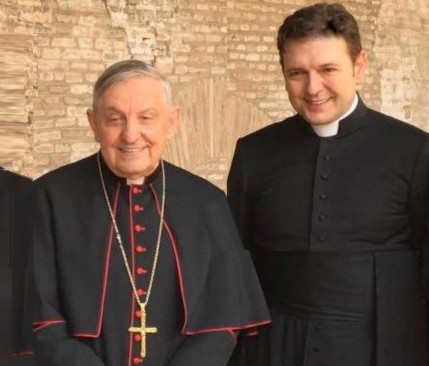
In the picture: S.E.R. Mons. Adriano Bernardini (13.08.1942 – †11.09.2025) and Father Ariel S. Levi di Gualdo, his private secretary (2017-2025)
They are fragments which reveal the emotion for the imminent detachment from the divine Master. Perhaps this is why the words of the newly proclaimed Gospel open up with an invitation of Jesus who becomes, In addition to being promised also Balsamo: “Your heart is not troubled. Have faith in God and have faith in me too. In the house of my Father there are many homes ".
With his words Jesus is making his departure and emptiness that leaves an opportunity for rebirth for his disciples. Asking for faith, He pushes them to transform the fear of the new and the terror of abandonment in the courage to give themselves, leaning on the Lord who promises to go to prepare a place for them. He lives his departure in relation to those who stay and show that he is not abandoning them, But a different phase of relationship with them is inaugurating. The detachment is in view of a new reception based on a precise promise: "I'll take you with me" (GV 14,2-3).
In a difficult circumstance like this it's nice to go back to the beginning, When the disciples, the future of the Apostle, they had the first contact with Jesus and asked him: "Rabbi, Maestro, where you live?». He told them: «Come and see».
"Staying" or "dwelling", "Coming" and "see" They are the verbs that especially in the Gospel of John describe the path of faith, The arrival of the disciple and the answer to Pietro's question: "Where are you going, where we can meet and find you again?». Jesus will say one day: “Stay in my love, how the branch remains in the vine, Because I observed the commandments of my Father and I remain in his love. That is the place where I live, I remain and live " (GV 15,9-10).
Here is the goal of the disciple for which it will not be necessary to wait for the transit of death, because it is here, Now, Available for everyone, Because Jesus got away. It is not a future reality that will prove to be beyond this life through death, hard pass for those who have to go beyond it and a painful legacy for those who have to live with memory, But it is a gift present for those who "believe in him" (GV 14,12).
It is therefore not even troubled our heart in the face of detachment, rather, let's get ready to recognize the place that each of us is responsible for the eternal home that awaits us. Similar in place of the beloved disciple who reclined his head on the chest of Jesus in the last dinner. He was placed in the breast of Jesus (GV 13,25), who, As the prologue Giovanneo says "he returned to his father's breast and opened the way" (GV 1,18), Now "he came his hour to go from this world to his father (GV 13,1) tells us: "Nobody comes to the Father except by means of me".
To try to propose the not easy reasons, but pursuable and feasible of the Holy Gospel, the Church has always used many means, including diplomacy. This is the apostolic nuncio: a bearer and announcer of the Holy Gospel called to create the Peace of Christ in the world. But let's try to depict everything with a concrete example: in October 1962 The world touched the third world war with the "Cuba crisis". By now the two interlocutors, Nikita Kruscev and John Fitzgerald Kennedy could no longer speak or treat, because neither was willing to take a step back. It was at that tragic moment that the Holy Pope John XXIII intervened that, good to remember, It was not properly that simple farmer who is affected in certain popular iconographies, it came from the world of diplomacy and had been a diplomat also refined, Especially in his mandate as an apostolic nuncio in France. The two interlocutors accepted the appeal both simultaneously and the missile heads on the course of Cuba returned back. A few months later, in April 1963, The Holy Pontiff published his encyclical Peace on Earth. The peace message of the Gospel prevailed thanks to pontifical diplomacy. Today, The books of contemporary history, They narrate that that diplomatic intervention saved humanity from the risk of a third world war.
Instead of reciting the litanies of its virtues I will mention one of its flaws, To demonstrate how a servant of the Church and the Papacy can change a defect by virtue through the three virtues of faith, hope and charity (cf.. The Cor 13, 1-13), who do not stand on emotions, worse on visceral ideologies, but on reason. Faith seeking understandingand by reverseunderstanding seeking faith, or: faith requires reason and by reverse the reason requires faith, As the father of the school classical Sant'Anselmo d’Aosta enunciated, in turn renovated at the thought of the Holy Father and Doctor of the Agostino Church Bishop of Hippona: I believe in order to understandand by reverse I understand that you can trust, or, I believe to understand, I understand to believe. Until to reach the Holy Pontiff John Paul II who summarized this relationship between reason and faith in the encyclical Faith and Reason, faith and reason.
Resolved by temperament, he was capable of becoming unwatchable. In the last months of life it has been weakened by the disease, but keeping its peculiar character. A day, During his last hospitalization in the Roman nursing home Villa del Rosario - where incidentally he was accurately cared for by doctors, from paramedics and nuns -, He began to consider just a wrong thing that could have been harmful to him. I said to him and, on the first ones, Almost angry, But I subsided him reminding him of the page of the Gospel in which the speech in which Jesus tells Pietro is told: "" In truth, I say to you: when you were younger, you used to dress yourself, and walked where you; but when you are old you will stretch out your hands, and someone else will dress you and lead you where you do not want ' (GV 21, 18). He smiled and replied ironic: that is fine, I will follow you, But try to take me where I want to go ".
People with a resolved character Christianity owes a lot, Just think of the passage of the acts of the apostles where it is told of the blessed apostle Paul who "discussed with the Greeks" (translation: argued with them); "But these tried to kill him" (translation: because they didn't stand it). «The Brothers, knowing it, They led him to Caesarea and from there they sent him to Tarsus " (translation: We try to save his life in the name of the newborn Christian charity). And in closing the diplomatic conclusion of this chronicle: «So the Church, Throughout Judea, at Galilea is at Samaria, he had peace " (which translated means: Luckily he left) (At 9, 29-31). but yet, What we owe to the resolute and not very angular character of the blessed apostle Paul?
I honored his will avoiding beatifications by means of epic tales and triumphal biographies, as sometimes it is used to the funeral, Things from him detestates, Also because none of us know the judgment of God, But we all know how big his reward is for his faithful servants, Because only the men of faith forged by the authentic virtues manage to change their apparent defects in precious service to the Church; and in this sense, From San Paolo to Sant’Agostino, The list of these extraordinary men is very long. To damage the Church are not the men made resolved by their strength of character, But those who don't know how to say yes when it is yes and no when it's no (See. Mt 5, 37); They are the weak proud of their veiled weakness of spiritualisms and mysticisms, unaware that we, in the following of Christ, We are called to be salt, no sugar land (cf.. Mt 5, 13-16). Indeed, When we were consecrated priests, we were not given a sweet thought, The consecrating bishop told us: "Understand what you do, imitate what you celebrate, conform your life to the mystery of the cross of Christ the Lord ". All based on the words of the divine master who warned us: “If someone wants to come behind me deny himself, Take his cross and follow me " (Mt 16, 24-25).
All this he tried to understand it, live it and transmit it through a particular way to announce and bring the Gospel: Ecclesiastical diplomacy at the service of the Church of Christ and the Apostolic See.
The source of true ecclesiastical diplomacy It is all enclosed on the lines, inside the lines and beyond the lines of the Gospel that, from century to century, until the return of Christ at the end of the time, will not cease to highlight our miseries and our human wealth, our limits and our sizes, our sins and our Christian virtues. And these days, Perhaps more than ever comes to say with the blessed apostle Paolo: «I fought the good fight, I finished my race, I kept faith " (II Tm 4,6). Because it is not easy to keep faith, Not even within that human society that is the visible Church, defined as "holy and sinner" by the Holy Bishop Ambrogio, followed centuries later by Cardinal Joseph Ratzinger who mediating in 2005 The ninth station of the Via Crucis complained: "How much dirt is in the church, and precisely also among those who, in the priesthood, they should belong completely to him!».
Who is this priest climbed on the pulpit To preach in memory of Adriano Bishop? I am a useless servant. As the Lord Jesus says in fact: “When you have done everything you have been ordered, said: “We are useless servants. We did what we had to do "" (LC 17, 10). What was my intimate relationship with him? I reply saying that in the Lucanian Gospel we speak of the great confidentiality of the Blessed Virgin Mary that "for her part, he took all these things by meditating in his heart " (LC 2, 19).
The apostle writes to the inhabitants of Corinth: "Where, death, your victory?» (The Cor 15, 55). Reflecting on this step at the end of his life, The Supreme Pontiff Benedict XVI commented: «I do not prepare in the end but to a meeting since death opens to life, to the eternal one, which is not an infinite duplication of the present time, But something completely new ".
Have a nice trip to the "new" good trip "in the eternal", Adriano Bishop, you did how much you had to do, like all of us "useless servants", I witness it as a child, friend and brother. Every 11 September, until I can physically, I will be in this place at the particular church of San Marino-Montefeltro, to which I belong as a presbyter - although it was not lived in Montefeltro but in Rome with you -, To celebrate in your birthplace, Today also your burial place, A Holy Mass for the immortal soul of the Father, of the friend and brother you have been for me.
Funeral Mass for Apostolic Nuncio Adriano Bernardini. HOMILY DELIVERED BY FATHER ARIEL S. LEVI GUALDO
Diocese of San Marino-Montefeltro, Monastery Church of Piandimeleto, September 15, 2025, 3:00 PM. Esequial Mass for His Excellency Msgr. Adriano Bernardini, Holder Archbishop of Federi and Apostolic Nuncio.
«”Do not let your hearts be troubled. You have faith in God; have faith also in me. In my Father’s house there are many dwelling places. If there were not, would I have told you that I am going to prepare a place for you? And if I go and prepare a place for you, I will come back again and take you to myself, so that where I am you also may be. Where [I] am going you know the way”. Thomas said to him, “Master, we do not know where you are going; how can we know the way?” Jesus said to him, “I am the way and the truth and the life. No one comes to the Father except through me”».
Venerable Bishops Dominic, shepard of this particular Church, and Andrew, Bishops emeritus, Brother friends, and all of you dearly beloved present here: «Grace to you and peace from God our Father and the Lord Jesus Christ!».
Receiving the sacred anointing of the sick on August 30, Adriano Bernardini, Holder Archbishop of Federi and Apostolic Nuncio, whispered to me the words of the Gospel of John: «Father, the hour has come» (Jn 17:1-2). For this reason, I chose to greet him with a homily taken from this Fourth Gospel, where the Apostle Peter asks Jesus: «Lord, where are you going? Jesus responds to Peter, who was not yet ready: “Where I am going, you cannot follow me now; you will follow me later”. He had said the same thing shortly before to all the disciples: “Where I am going, you cannot come”» (Jn 13:33-34).
These fragments reveal the emotion of the imminent separation from the Divine Master. Perhaps this is why the words of the Gospel just proclaimed open with an invitation from Jesus that becomes not only a promise but also a balm: «Do not let your hearts be troubled. Believe in God, believe also in me. In my Father’s house are many rooms».
With his words, Jesus is making his departure and the void it leaves an opportunity for rebirth for his disciples. By asking them for faith, he pushes them to transform their fear of the new and the terror of abandonment into the courage to give themselves, relying on the Lord who promises to go and prepare a place for them. He experiences his departure in relationship with those who remain and shows that he is not abandoning them, but is inaugurating a different phase of relationship with them. This separation is in preparation for a new welcome based on a specific promise: «I will take you to myself» (Jn 14:2-3).
In a difficult circumstance like this, it’s beautiful to return to the beginning, when the disciples, future apostles, first encountered Jesus and asked him: «Rabbi, Master, where are you staying?». He said to them: «Come and see».
«To remain» or «to abide», «to come» and «to see» are the verbs that, especially in the Gospel of John, describe the journey of faith, the disciple’s arrival, and the answer to Peter’s question: «Where are you going? Where can we meet you and find you again?» Jesus will one day say: «Remain in my love, as the branch remains in the vine, for I have kept my Father’s commandments and remain in his love. There is my dwelling place, where I remain and dwell» (Jn 15:9-10).
This is the disciple’s goal, for which there is no need to wait for the passing of death, because it is here, now, available to all, because Jesus has become the way. It is not a future reality that will be revealed beyond this life through death, a difficult passage for those who must cross it and a painful legacy for those who will have to live with the memory, but it is a present gift for those who «believe in him» (Jn 14:12).
Let not our hearts, then, be troubled by separation; rather, let us prepare ourselves from now to recognize the place that belongs to each of us in the eternal home that awaits us. Similar to the place of the beloved disciple who leaned his head on Jesus’ chest at the Last Supper. He was reclining in Jesus’ bosom (Jn 13:25), who, as the John prologue says, «has returned to the bosom of the Father and has opened the way» (Jn 1:18), now «when his hour has come to pass from this world to the Father» (Jn 13:1), he tells us: «No one comes to the Father except through me».
To try to propose the difficult, yet attainable and achievable, reasons for the Holy Gospel, the Church has always used many means, including diplomacy. This is the Apostolic Nuncio: a bearer and proclaimer of the Holy Gospel called to establish the Peace of Christin the world. But let’s try to illustrate this with a concrete example: in October 1962, the world came close to World War III with the “Cuban crisis”. By then, the two interlocutors, Nikita Khrushchev and John Fitzgerald Kennedy, could no longer speak or negotiate, because neither was willing to take a step back. It was at that tragic moment that the Holy Pontiff John XXIII intervened. It is worth remembering that he was not exactly the simpleton depicted in certain popular iconography; he came from the world of diplomacy and had been a refined diplomat, especially during his tenure as Apostolic Nuncio to France. Both sides simultaneously accepted the appeal, and the missile warheads headed toward Cuba were turned back. A few months later, in April 1963, the Holy Pontiff published his encyclical Pacem in Terris. The Gospel’s message of peace prevailed thanks to papal diplomacy. Today, contemporary history books tell us that this diplomatic intervention saved humanity from the risk of a Third World War.
Rather than reciting the litany of his virtues, I will mention one of his defects, to demonstrate how a servant of the Church and the Papacy can transform a defect into a virtue through the three virtues of faith, hope, and charity (cf. 1 Color 13:1-13), which are not based on emotions, or worse, on visceral ideologies, but on reason. Faith seeking understanding and and vice versa understanding seeking faith, or faith requires reason, and conversely, reason requires faith, as the father of classical scholasticism, Saint Anselm of Aosta, stated, in turn drawing on the thought of the Holy Father and Doctor of the Church, Augustine, Bishop of Hippo: I believe in order to understand and vice versa I understand that you can trust, or I believe in order to understand, I understand in order to believe. This culminated in the Holy Pontiff John Paul II, who summarized this relationship between reason and faith in the encyclical Faith and Reason, Faith and Reason.
Resolute by temperament, he was capable of becoming immovable. In the last months of his life, he was weakened by illness, but retained his peculiar character. One day, during his final stay at the Roman nursing home Villa del Rosario — where, incidentally, he was excellently cared for by doctors, paramedics, and nuns — he began to consider a wrong thing that could have been harmful to him as right. I told him this, and at first he almost became angry, but I calmed him by reminding him of the Gospel passage recounting Jesus speech to Peter: «Truly, truly, I say to you, when you were younger, you girded yourself and walked where you wished; but when you grow old, you will stretch out your hands, and another will gird you and carry you where you do not wish to go» (Jn 21:18). He smiled and replied ironically: «All right, I will follow you, but try to take me where I want to go».
Christianity owes much to people of resolute character. Just think of the passage in the Acts of the Apostles where the Blessed Apostle Paul is described as «arguing with the Greeks» (translation: he argued with them); «but they sought to kill him» (translation: because they could not stand him). «When the brothers learned of this, they took him to Caesarea, and from there they sent him to Tarsus» (translation: we tried to save his life in the name of the nascent Christian charity). And finally, the diplomatic conclusion to this chronicle: «So the church throughout all Judea, Galilee, and Samaria had peace» (which translated means: thank goodness he left) (Acts 9:29-31). And yet, how much do we owe to the resolute and not a little rough-edged character of the Blessed Apostle Paul?
I have honored his will by avoiding beatifications through epic tales and triumphal biographies, as is sometimes customary at funerals, things he detested, also because none of us know God’s judgment, but we all know how great his reward is for his faithful servants, because only men of faith forged by authentic virtues are able to transform even their apparent defects into precious service to the Church; and in this sense, from Saint Paul to Saint Augustine, the list of these extraordinary men is very long. Those who harm the Church are not men made resolute by their strength of character, but those who cannot say yes when it is yes and no when it is no (cf. Mt 5:37); they are the weak, proud of their own weakness veiled in spiritualism and mysticism, unaware that we, in following Christ, are called to be the salt, not the sugar, of the earth (cf. Mt 5:13-16). In fact, when we were consecrated priests, we weren’t given a sentimental thought; the consecrating Bishop told us: «Realize what you will do, imitate what you will celebrate, conform your life to the mystery of the cross of Christ the Lord». All of this was based on the words of the Divine Master who admonished us: «If anyone would come after me, let him deny himself, take up his cross, and follow me» (Mt 16:24-25).
He sought to understand, live, and transmit all of this through a particular way of announcing and bringing the Gospel: ecclesiastical diplomacy in the service of the Church of Christ and the Apostolic See.
The source of true ecclesiastical diplomacy lies entirely inside and beyond the written lines of the Gospel, which, from century to century, until Christ’s return at the end of time, will never cease to highlight our human miseries and riches, our limitations and our greatness, our sins and our Christian virtues. And in these times, perhaps more than ever, we can say with the Blessed Apostle Paul: «have competed well; I have finished the race;f I have kept the faith» (2 Tim 4:7). Because it is not easy to maintain the faith, not even within that human society which is the visible Church, defined as “holy and sinful” by the Holy Bishop Ambrose, followed centuries later by Cardinal Joseph Ratzinger who, meditating on the ninth station of the Way of the Cross in 2005, lamented: «How much filth there is in the Church, and even among those who, in the priesthood, should belong completely to him!»
Who is this priest who ascended the pulpit to preach in memory of Bishop Hadrian? I am an unprofitable servant. As the Lord Jesus says: «When you have done all that you were commanded, say, “So should it be with you. When you have done all you have been commanded, say, “We are unprofitable servants; we have done what we were obliged to do”» (Page 17:10). What was my intimate relationship with him? I answer by saying that the Gospel of Luke speaks of the great reserve of the Blessed Virgin Mary, who «And Mary kept all these things, reflecting on them in her heart» (Page 2:19).
The Apostle writes to the people of Corinth: « Where, O death, is your victory?» (1 Color 15:55). Reflecting on this passage at the end of his life, the Roman Pontiff Benedict XVI commented: «I am not preparing for the end but for an encounter, since death opens the way to life, to eternal life, which is not an infinite duplicate of the present time, but something completely new».
Have a good journey into the «new» world, and a good journey into the «eternal», Bishop Adriano. You have done what you had to do, like all of us «unprofitable servants». I bear witness to this as a son, friend, and brother. Every September 11th, as long as I am physically able, I will come to this place, to the particular Church of San Marino-Montefeltro, to which I belong as a priest — although I did not live in Montefeltro but in Rome with you — to celebrate in your birthplace, now also your burial place, a Holy Mass for the immortal soul of the father, friend, and brother you were to me.
Funeral funerals of the Apostolic Nuncio Adriano Bernardini. Homily pronounced by Father Ariel S. LEVI GUALDO
Diócesis de San Marino-Montefeltro, PIANDIMELETO MONASTERIO CHURCH, 15 September of 2025. Funeral Exequises of S.E. Mons. Adriano Bernardini, Archbishop holder of Fallei and Apostolic Nuncio.
«At that time, Jesus said to his disciples: “Do not worry. They believe in God and also create in me. In my father's house there are many rooms; If so, I would have told you. I'm going to prepare a place. And when I went and prepared a place, I will return again to take them with me, so that where I am, You are too. They already know the path of the place where I'm going”. Tomás told him: “Señor, We do not know where you go. How are we going to know the way?”.Jesus replied: “I am the way, The truth and life. No one goes to the father, but for me”».
.
Venerable Bishops Domenico, pastor of this Particular church and Andreaemeritus, Cohermans priests, friends and all estimated present: "Grace and peace to you from God our Father and the Lord Jesus Christ".
Receiving the 30 August the anointing of the sick Adriano Bernardini, Archbishop holder of Fallei and Apostolic Nuncio, I was whispered by the words of the Gospel of John: "Dad, The time has come » (Jn 17, 1-2). That is why I have chosen to fire him with a homily extracted from this fourth gospel, where the apostle Peter asks Jesus: «Señor, Where are you going?». Jesus responds to Peter that he was not yet prepared: «Where I go, You can't follow me now; You will follow me later ». The same had said shortly before all the disciples: «Where I go, You can't come » (Jn 13, 33-34)
They are fragments that reveal the emotion for the imminent separation of the divine teacher. Perhaps that is why the words of the newly proclaimed Gospel open with an invitation from Jesus that becomes, In addition to promise, In balm: «Your heart is not turned. HAVE FAITH IN GOD AND HAVE FAITH IN ME. In my father's house there are many dwellings ».
With his words Jesus is doing his departure and the vacuum that leaves an occasion of rebirth for his disciples. Asking for faith, It drives them to transform fear towards the new and terror to abandonment into value to surrender, leaning on the Lord who promises to prepare a place for them. He lives his departure in relation to who stays and shows that he is not leaving him, but it is inaugurating a different phase of relationship with them. The separation is in view of a new reception based on a precise promise: "I'll take you with me" (Jn 14, 2-3).
In a difficult circumstance like this It is good to return to the beginning, When the disciples, future apostles, They had the first contact with Jesus and asked him: "Rabbi, Maestro, Where Moras?». He told them: "Come and you will see".
"Stay" the "living", "Come" and "see" They are the verbs that above all in the Gospel of John describe the path of faith, The arrival of the disciple and the answer to Pedro's question: «Where are you going, Where can we find and find you again?». Jesus will say one day: «Remove in my love, As the Sarmiento remains in the vine, Because I have kept my father's commandments and remain in his love. That is the place where I live, I remain and Moor » (Jn 15, 9-10).
Here is the goal of the disciple for which there is no need to wait for the transit of death, Because it's here, now, Available for everyone, Because Jesus has made his way. It is not a future reality that will be revealed beyond this life through death, A difficult step for those who must carry it and a painful legacy for those who must live with the memory, but a present gift for those who "believe in him" (Jn 14, 12).
That is not disturbed our heart before the separation, but let's prepare from now on to recognize the place that corresponds to each of us in the eternal abode that awaits us. Which is similar to the place of the beloved disciple who reclined his head in Jesus's chest at the last dinner. This was reclined in Jesus' bosom (Jn 13, 25), which, As the Joan prologue says "he has returned to the father's bosom and opened the way" (Jn 1,18), Now «having arrived his time to move from this world to the father (Jn 13, 1) He tells us: "No one goes to the father but for me".
To try to propose the reasons not easy, But attainable and realizable of the Holy Gospel, The Church is always served as many media, including diplomacy. This is the Apostolic Nuncio: a bearer and announcer of the Holy Gospel called to make the Peace of ChristIn the world. But let's try to represent all this with a specific example: In October of 1962 The world touched the third world war with the "crisis of Cuba". Already the two interlocutors, Nikita Jrushchov and John Fitzgerald Kennedy could not speak or negotiate, Because neither was willing to step back. It was at that tragic moment when the Holy Pontiff John XXIII intervened that, It is good to remember it, It was not properly that simple peasant represented in certain popular iconographies. He came from the world of diplomacy and had been a refined diplomat, especially in its function as Apostolic Nuncio in France. The two interlocutors welcomed the call simultaneously and the missile heads en route to Cuba. A few months later, In April of 1963, The Holy Pontiff published his encyclical Peace on Earth.The peace message of the Gospel prevailed thanks to the pontifical diplomacy. Hoy, Contemporary history books tell that this diplomatic intervention saved humanity from the risk of a third world war.
Instead of reciting the litanies of the virtues I will refer to a defect of yours, To demonstrate how a server of the Church and the papacy can mutate a defect under the three virtues of faith, hope and charity (cf..The Cor 13, 1-13), which do not support emotions, or worse about visceral ideologies, but about reason. Faith seeking understandingand conversely understanding seeking faith, that is to say: Faith requires reason and inversely reason requires faith, As the father of the classic scholasticic San Anselmo de Aosta stated in turn to the thought of the Holy Father and Doctor of the Agustín Bishop's Church of Hipona:I believe in order to understand and conversely I understand that you can trust, I mean, I think to understand, I understand to believe. And finally, the Holy Pontiff John Paul is reached that summarized this relationship between reason and faith in the encyclical Faith and Reason, Faith and reason.
Decided by temperament, was able to become immovable. In recent months of life it was weakened by the disease, But it retained its peculiar character. One day, During his last stay at the house of Cura Romana Villa del Rosario - where, by the way, He was treated excellently by doctors, paramedics and religious -, It began to consider correct a wrong thing that could have been harmful to him. I told him and, at first, He almost got angry, But I calmed him by reminding him of the Gospel page in which the speech in which Jesus says to Peter is narrated: ""Actually, I really tell you: When you were younger, You gave up and you were where you wanted; But when you are old, You will extend your hands, And another will stick to you and take you wherever you want ”» (Jn 21, 18). Smiled and replied ironic: Alright, I will follow you, But try to take me where I want to go ».
To people of a determined nature, Christianity must a lot, It is enough to think about the passage of the Acts of the Apostles where it is told that the Blessed Apostle Paul "argued with the Greeks" (translation: He rejected with them); "But these sought to kill him" (translation: because they didn't support him). «The brothers, Knowing it, They led him to Cesarea and from there they sent him to Tarso » (translation: Let's try to save his life on behalf of the nascent Christian charity). And at the end of the diplomatic conclusion of this chronaca: «Thus the Church, all over, Gather was the Samaritan, had peace » (which translated means: Luckily he left) (Hch 9, 29-31). And yet, How much should we owe to the determined and not little spiny character of the Blessed Apostle Paul?
I have honored his will avoiding beatifications through epic stories and triumphal biographies, as sometimes it is usually done in funerals, things held by him, Also because none of us know God's judgment, But we all know how big is his reward for his faithful servants, because only the men of faith forged by the authentic virtues manage to mutate in precious service for the Church even their apparent defects; And in that sense, From San Pablo to San Agustín, The list of these extraordinary men is very long. It is not the men determined by their strength of nature that damage the Church, but those who do not know how to say when it is yes and not when it is not (See. Mt 5, 37); They are proud of their evening weakness in spiritualisms and mysticisms, unconscious that we, In the sequel of Christ, We have been called to be salt and not the sugar of the earth (cf.. Mt 5, 13-16). In fact, When we were consecrated priests, we were not given an cloy, The consecrating bishop told us: «Realize what you will do, imitates what you will celebrate, Conform your life to the mystery of the Cross of Christ Lord ». All this, based on the words of the divine teacher who has warned us: «If anyone wants to come after me, Note yourself, Take your cross and follow me » (Mt 16, 24-25).
All this he has sought to understand it, live and transmit it through a particular way of announcing and carrying the gospel: Ecclesiastical diplomacy at the service of the Church of Christ and the Apostolic Headquarters.
The source of true ecclesiastical diplomacy All contained in the lines, within the lines and beyond the lines of the Gospel that, from century to century, Until the return of Christ at the end of time, It will not cease to highlight our miseries and our human wealth, our limits and our greatness, our sins and our Christian virtues. And in these times, Maybe more than ever, We can say with the Blessed Apostle Paul: «I have fought the good combat, I've finished my career, I have kept faith » (2 Tim 4, 6). Because it is not easy to conserve faith, Not even within that human society that is the visible church, defined "holy and sinner" by the Holy Bishop Ambrosio, Or centuries later, by Cardinal Joseph Ratzinger who meditating on 2005 The ninth station of Crucis lamented: «How much dirt is in church, and precisely among those who, In the priesthood, They should belong completely!».
Who is this priest uploaded to the pulpit to preach in memory of Adriano Bishop? I am a useless servant. As the Lord Jesus says in fact: «“ When you have done everything that has been sent to you, DECIDED: “We are useless servants. We have done what we should do ”” » (LC 17, 10). What was my intimate relationship with him? I respond by saying that in the Lucan gospel there is talk of the Gran Reserva of the Blessed Virgin Mary who «for her part, He kept all these things by meditating them in his heart » (LC 2, 19).
The Apostle writes to the inhabitants of Corinth: "Where is, oh death, Your victory?» (The Cor 15, 55). Reflecting on this step at the end of your life, The high pontiff Benedict XVI commented: «I do not prepare for the end but for an encounter because death opens to life, to eternal life, which is not an infinite duplicate of the present time, but something completely new ».
Good trip to the "new" good trip "to the eternal", Adriano Obispo, You have done how much you should do, Like all of us "useless servants", I am witness as a child, Friend and brother. Each 11 September, While physically possible to me, I will come to this place under the jurisdiction of the particular church of San Marino-Montefeltro, to which I belong as a presbyter - although I have not lived in Montefeltro but in Rome with you -, To celebrate in your native place, Already today your burial place, A Holy Mass for the immortal soul of the Father, of the friend and brother that you have been for me.
Dear Readers, this magazine requires management costs that we have always faced only with your free offers. Those who wish to support our apostolic work can send us their contribution through the convenient and safe way PayPal by clicking below:
Or if you prefer you can use our Bank account in the name of:
Editions The island of Patmos
n Agency. 59 From Rome – Vatican
Iban code: IT74R0503403259000000301118
For international bank transfers:
Codice SWIFT: BAPPIT21D21
If you make a bank transfer, send an email to the editorial staff,
the bank does not provide your email and we will not be able to send you a thank you message: isoladipatmos@gmail.com
We thank you for the support you wish to offer to our apostolic service.
The Fathers of the Island of Patmos
.
.
.
.
.
.
.
.
.
HTTPS://i0.wp.com/isoladipatmos.com/wp-content/uploads/2025/08/Padre-Ariel-foto-2025-piccola.jpg?fit=150,150&ssl=1150150father arielHTTPS://isoladipatmos.com/wp-content/uploads/2022/01/logo724c.pngfather ariel2025-09-15 22:48:372026-02-13 20:06:25Funeral funeral of the apostolic nuncio Adriano Bernardini. Homily pronounced by Father Ariel S. Levi di Gualdo - Funeral Mass for Apostolic Nuncio Adriano Bernardini. Homily delivered by Father Ariel S. Levi di Gualdo -
Between Prozan and Prozac. THOSE PRIESTS WHO DERAIL AND HOLY MARY OF EQUILIBRIUM
For days we have been witnessing the case of some priests who have abandoned their ministry, believing that the cause is also due to a question of imbalance of that human virtue of temperance and faith. This essentially leads to the implementation of two possible scenarios: there are those who push on the accelerator of tradition and the romantic retro past with the hope of finding a panacea for the ills of the Church and those who dive into extreme progressivism which dangerously borders on heresy and manifest and full-blown schism.
– The briefs of the Fathers of the Isle of Patmos –
Author Editors of The Island of Patmos
.
Among the many Marian devotions — real or presumed — that crowd the Orbe catholica There is a very nice one which in our opinion is decidedly original and significant. We're talking about the Alma Aequilibri Materwhich was renamed with the name of Santa Maria dell'Equilibrio, of whose feast there is no date, because from morning to evening, will be invoked. Anyone who would like to know more about the history of this Marian devotion will easily be able to find various news on the web and in other sources, for us, however, it is an opportunity for some scattered reflections.
In everyday life there is a need for balance which is that human quality that pertains to the virtue of temperance. Balance tempers intelligence and strengthens it, making it more witty and effective. In spiritual life itself, balance is equally fundamental because a faith without balance, that is, unbalanced, it is a chaotic faith capable of all kinds of aberrations and exaggerations.
The intelligence of reasonable faith cannot do without balance just as a minister of God cannot but desire in the exercise of his office to be balanced in doctrine and pastoral practice, avoiding the antipodes of fiery emotionality and dry rationalism.
Why do we say this? Why are we having witnessed for days the case of some priests who have abandoned their ministry, believing that the cause is also due to a question of imbalance of that human virtue of temperance and faith. This essentially leads to the implementation of two possible scenarios that are different in fact but common in error: there are those who push on the accelerator of tradition and the romantic retro past with the hope of finding a panacea for the ills of the Church and those who dive into extreme progressivism which dangerously borders on heresy and manifest and full-blown schism.
We believe that determining whether a man is out of balance is not a matter for a lawsuit, as well as taking note and, if necessary, reporting that a minister in sacredis involved in practice and form in heterodox positions and separation from the ecclesial body of the Church does not constitute a matter under the Code of Criminal Law, if anything canonical and of matter that pertains to the internal forum.
This methodology is sadly notorious in the colorful rainbow lobbies where the trial of intentions and thoughts is equivalent to a violent repression of those who "don't think like me". Of those who want to strut their stuff in tolerance, wisdom and intellectual or theological acumen but in fact it is ensnared by ideology and the pride of the self which is the very denial of any healthy balance and the ability to go inside things.
As Fathers of the Island of Patmos we believe and reaffirm the freedom to use free will as we see fit - knowing that the Creator himself is the first to leave his creatures free - even at the cost of denying faith and the Church and falling into error and sin. However, we are equally convinced that by virtue of this freedom and assumption of responsibility in one's own positions - theological or otherwise - everyone must leave the freedom of criticism and dissent to others, certainly not by sending intimidating messages, or fearing unlikely complaints following the consolidated style of certain rainbow lobbies now specialized in asking for sentences of life imprisonment and harsh imprisonment of 41bis for those who dare to exercise freedom of thought and opinion. Theme this to which, our fathers Ariel S. Levi di Gualdo and Ivano Liguori dedicated a book that has not lost its relevance, indeed he acquired it over time: From Prozan to Prozac.
From the island of Patmos, 9 September 2025
.
______________________
Dear Readers, this magazine requires management costs that we have always faced only with your free offers. Those who wish to support our apostolic work can send us their contribution through the convenient and safe way PayPal by clicking below:
Or if you prefer you can use our Bank account in the name of: Editions The island of Patmos n Agency. 59 Rome – Vatican
Iban code: IT74R0503403259000000301118
For international bank transfers:
Codice SWIFT: BAPPIT21D21
If you make a bank transfer, send an email to the editorial staff, the bank does not provide your email and we will not be able to send you a thank you message: isoladipatmos@gmail.com
We thank you for the support you wish to offer to our apostolic service.
The Fathers of the Island of Patmos
.
.
HTTPS://i0.wp.com/isoladipatmos.com/wp-content/uploads/2022/01/faviconbianco150.jpg?fit=150,150&ssl=1150150DraftingHTTPS://isoladipatmos.com/wp-content/uploads/2022/01/logo724c.pngDrafting2025-09-09 14:41:572025-09-09 14:41:57Between Prozan and Prozac. Those priests who deragliano and Santa Maria of balance
The Giubigay of those updated Jesuits that were until yesterday affected by moralphobia
Among the new generation Jesuits tolerance, The inclusive spirit and the various rainbows will soon come to such a level that will be forbidden to make any reflection within the church to intelligent and Catholic people so as not to offend the Jesuit imbeciles.
— The Briefs of the Fathers of The Island of Patmos —
Having been a pupil formed by the Jesuits of the old and now extinct Ignazian school, at due respect to distinguish the meritorious company of Jesus who was, that is, that of my masters (see WHO), by the current Indie Company, inside which everything and more, including electrocuted and skidded.
Caused enormous pain in those who live, like us fathers of the island of Patmos, A deep and deep -rooted Eucharistic faith, witnessing the Festival of SacrileGherans in the Church-Simbolo of the Jesuits: The historic Roman Church of the Jesus (see video WHO e WHO). Yet these are the Jesuits themselves that in their male schools, until not many decades ago, They made teenagers sleep with their hands out of the sheets, always keeping a soft light on in the dormitories to avoid “Turpin” sins against purity. Because there was the entire mystery of evil there, inside the underwear, then, out of everything else, It could also be mentioned above, Starting from the most serious sins against charity. And we fly over the model of absolute purity of San Luigi Gonzaga, sometimes the psychological terrorism; model impossible to reach, for as it was presented, Perhaps to the perverse purpose of making the poor teenagers feel in the sempartial sin and forcing them to weekly confessions?
Needless to say, But I say it the same because in doing so I enjoy like Dante Alighieri on the lines of the XXXIIII Canto del Paradiso: because it does not impose certain Jesuit models of forced purity, as well as absolute, To Father James Martin and his rainbow friendly friendly? A little’ of old and healthy absolute purity at San Luigi Gonzaga, he would not hurt him, or not?
It is an extreme punishment See the members of today's Indie company to make public scandal giving sacrilegiously the body of Christ to the couples of happy and proud gays that are handful in the hand at the Eucharistic canteen with their boyfriend convinced that in error they are not theirs, but the Church. Because that's the problem, I go by repeating unnecessarily for years: Within our poor and disastrous Church there are subjects who have a distorted sense and purposes, not welcoming the sinner anymore, which must always be accepted, forgiven and blessed precisely for the mission entrusted to us by Christ, but they welcome the sin that they bless together with the sinner who lives proud in sin, thus leading armies of souls towards perdition. This did yesterday the members of the Indie Company in the Church of the Jesus, The same who until yesterday made psychological terrorism through the image of St. Luigi Gonzaga towards teenagers guilty of exciting themselves at the sight of a beautiful girl.
But then it is known: Among the new generation Jesuits tolerance, The inclusive spirit and the various rainbows will soon come to such a level that will be forbidden to make any reflection within the church to intelligent and Catholic people so as not to offend the Jesuit imbeciles.
From the island of Patmos, 7 September 2025
.
.
______________________
Dear Readers, this magazine requires management costs that we have always faced only with your free offers. Those who wish to support our apostolic work can send us their contribution through the convenient and safe way PayPal by clicking below:
Or if you prefer you can use our Bank account in the name of:
Editions The island of Patmos
n Agency. 59 From Rome – Vatican
Iban code: IT74R0503403259000000301118
For international bank transfers:
Codice SWIFT: BAPPIT21D21
If you make a bank transfer, send an email to the editorial staff,
the bank does not provide your email and we will not be able to send you a thank you message: isoladipatmos@gmail.com
We thank you for the support you wish to offer to our apostolic service.
The Fathers of the Island of Patmos
.
.
.
.
.
.
.
.
.
HTTPS://i0.wp.com/isoladipatmos.com/wp-content/uploads/2025/08/Padre-Ariel-foto-2025-piccola.jpg?fit=150,150&ssl=1150150father arielHTTPS://isoladipatmos.com/wp-content/uploads/2022/01/logo724c.pngfather ariel2025-09-07 22:23:232025-09-07 23:48:27The updated Jesuit Giubigay that were until yesterday affected by Moralphobia
The disciple is called not only to start, BUT ALSO TO COMPLETE
It should be, also in the disciple, freedom and lightness to complete the path of life traveled as a sequence of Christ. Love is called to become responsibility and freedom perseverance: there lies the necessary renunciation, purification, stripping.
The prevailing image is that of Jesus the Gospels have transmitted to us is that of an itinerant charismatic who imposes on those who intend to follow him a break withethos traditional exclusively by virtue of its word, the requests must have seemed and still seem extreme to us, as in the case of this one: «Let the dead bury their dead; you go instead’ and announces the kingdom of God" (LC 9,60).
But the ethics of Jesus is the ethics of waiting, incompatible with the modern ethics of progress or with the ethics of values. This Sunday's Gospel passage measures the quality of Jesus' relationship with his disciples, as well as the distance that separates us from his religious feeling as soon as we seriously look beyond the thick curtain of theological elaboration. Let's read it:
«A large crowd went with Jesus. He turned and told them: “If anyone comes to me and does not love me more than he loves his father, Mother, the wife, children, the brothers, sisters and even his own life, he cannot be my disciple. He who does not carry his cross and does not come after me, he cannot be my disciple. Who among you, wanting to build a tower, he doesn't sit down first to calculate the expense and see if he has the means to carry it out? To avoid that, if he lays the foundation and is unable to finish the job, everyone who sees it begins to mock him, saying: 'This man started building, but he wasn't able to finish the job'. Or which king, going to war against another king, he does not sit down first to examine whether he can confront with ten thousand men whoever comes to meet him with twenty thousand? if not, while the other is still far away, he sends him messengers to ask for peace. So whoever of you does not give up all his possessions, he cannot be my disciple”» (LC 14,25-33).
The occasion for the short sayings of Jesus preserved from today's evangelical page is narrated in the opening verse: «A large crowd went with Jesus. He turned and said". People were goingand Jesus turns: In this way the reader understands that the journey has resumed. So long as, previously, the Lord was caught at table with his disciples, invited by a leader of the Pharisees (LC 14,1). And we also remember the situation in last Sunday's Gospel regarding the choice of places and guests, while now the evangelist draws attention to the journey that Jesus has undertaken and which will come to completion in Jerusalem. The previous context of the banquet ended with words of invitation for all, so that the house would be filled: “Go out into the streets and along the hedges and force them in, so that my house may be filled" (LC 14,23); now, however, Jesus' words add something and clarify how to enter that house. These are demanding conditions to be able to follow Jesus, some rules, indeed, to be disciples, they are necessary. E, Once again, these words are for all those who want to call themselves Christians. The invitation to love Jesus more than your parents, to carry the cross, and giving up possessions is not something reserved for a select few, but it applies to every disciple who wants to be of Christ.
Words about family relationships we also find them in the Gospel of Matthew, almost identical, but the two short parables are missing in the first evangelist, the one about the tower and the one about the king going to war, which are therefore properly Lucanian material, drawn from a specific source of this evangelist. These are indeed striking words, modern sensibility perceives the contrast of loving and hating as very harsh when referring to one's family members or even to one's own life: «If anyone comes to me and does not love me more than he loves his father, Mother, the wife, children, the brothers, sisters and even his own life, he cannot be my disciple" (v.26). Jesus is really calling for a rejection of human relationships, a rigidity with others, even with those of your own family? Without weakening the eschatological tension that animated the preaching of Jesus we can affirm that here we are faced with a typical Judaism, where the verb hate means: «put it later, overshadow". We find this type of occurrence in the Old Testament, as well as in the Gospels, for example in the passage from Matthew: «No one can serve two masters, because either he will hate the one and love the other, or he will become fond of one and despise the other. You cannot serve God and wealth." (Mt 6,24). Matthew himself helps us to better understand the demanding words of Jesus, because it brings them back in an attenuated form, that is, without using the verb to hate, but a comparative one: «Who loves father or mother more than me, It is not worthy of me; who loves son or daughter more than me, not worthy of me " (Mt 10,37). It deals with, in conclusion, to subordinate all love to that of the Lord, without ceasing to love those whom the law itself commands to love, like their parents. It means that being a disciple is a serious thing, even more so in the time that has become short, and these are valid indications for all believers in Christ, we have already said it, and for every moment of life.
They follow, then, Jesus' words about carrying the cross, already met in LC 9,23, and finally two short parables. As said at the beginning of this comment, this is where we must start to understand what being a disciple entails. These parables have in common the denominator of struggle and perseverance. Following Jesus is equivalent tobuild a tower, commitment and perseverance are needed, like building a house on the rock (cf.. Mt 7,24); is equivalent togo to war, knowing how to measure one's strengths well.
The following is demanding also because the disciple is called not only to initiate, but also to complete (vv. 28.29.30), and indispensable for following is the willingness to lose everything, also "one's life" (v.26). The good to be possessed is the renunciation of goods, learn the art of loss, of decreasing, of not falling into the trap of possession or the logic of having. Jesus, says Paul, "he emptied himself" (Fil 2,7) and «as rich as he was, he became poor" (2Color 8,9). It should be, also in the disciple, freedom and lightness to complete the path of life traveled as a sequence of Christ. Love is called to become responsibility and freedom perseverance: there lies the necessary renunciation, purification, stripping. The demands of discipleship therefore have to do with the whole of the person - his heart - and with the whole of his time, for the duration of his life. And they warn us against the risk of leaving the work undertaken halfway.
Clement of Alexandria (ProtrepticX,39) he spoke of faith as "a big risk" (calos kíndynos). For the first Christians often adhere to Christ, in a context with a pagan majority, it involved persecution and even martyrdom. Today, in our countries of old and tired Christianity, the price of conversion is not felt and even less paid. We are looking for insurance that eliminates insecurity and risks, also with regard to faith and its testimony, When, instead, Jesus, invites you to lose everything to follow Him. We do not hide the fact that we experience difficulties when faced with the harsh and demanding words of Jesus, forgetting that the radicality of the Gospel has first of all a value of revelation, reveal, that is, perspectives that would otherwise remain inaccessible to us. Pope Leo XIV also remembered this in a recent Angelus:
«Brothers and sisters, The provocation that comes to us from today's Gospel is beautiful: while sometimes we happen to judge those who are far from the faith, Jesus puts in crisis “the safety of believers”. They, indeed, tells us that it is not enough to profess faith with words, eat and drink with Him celebrating the Eucharist or know Christian teachings well. Our faith is authentic when it embraces our entire life, when it becomes a criterion for our choices, when it makes us women and men who are committed to doing good and taking risks in love just like Jesus did; He did not choose the easy path of success or power but, just to save ourselves, he loved us until we crossed the “narrow door” of the Cross. He is the measure of our faith, He is the door we must walk through to be saved (See GV 10,9), living his own love and becoming, with our life, workers of justice and peace" (WHO).
From the Hermitage, 7 September 2025
.
.
Sant'Angelo Cave in Ripe (Civitella del Tronto)
.
Visit the pages of our book shop WHO and support our editions by purchasing and distributing our books.
.
______________________
Dear Readers, this magazine requires management costs that we have always faced only with your free offers. Those who wish to support our apostolic work can send us their contribution through the convenient and safe way PayPal by clicking below:
Or if you prefer you can use our Bank account in the name of: Editions The island of Patmos n Agency. 59 From Rome – Vatican
Iban code: IT74R0503403259000000301118
For international bank transfers:
Codice SWIFT: BAPPIT21D21
If you make a bank transfer, send an email to the editorial staff, the bank does not provide your email and we will not be able to send you a thank you message: isoladipatmos@gmail.com
We thank you for the support you wish to offer to our apostolic service.
The Fathers of the Island of Patmos
.
.
.
.
.
HTTPS://i0.wp.com/isoladipatmos.com/wp-content/uploads/2023/06/monaco-eremita-piccolo-.jpg?fit=150,150&ssl=1150150Hermit MonkHTTPS://isoladipatmos.com/wp-content/uploads/2022/01/logo724c.pngHermit Monk2025-09-07 15:22:332025-09-07 15:22:33The disciple is called not only to start, but also to complete
THE VERY POWERFUL SILERE NON POSSUM IS MAKING GOOGLE SHAKE After this attack by the fearsome and powerful Silerian comedian, In Silicon Valley they are trembling. In fact, there are many great uncertainties at the reopening of Monday of the Wall Street Stock Exchange, where a drastic collapse of Google actions is expected. – The corner of the ridiculous –...
Premium Membership Required
You must be a Premium member to access this content.
HTTPS://i0.wp.com/isoladipatmos.com/wp-content/uploads/2022/01/faviconbianco150.jpg?fit=150,150&ssl=1150150father arielHTTPS://isoladipatmos.com/wp-content/uploads/2022/01/logo724c.pngfather ariel2025-09-06 10:56:052026-07-25 15:22:49The powerful Silere is not possible to make Google tremble
That Pope Francis to discover narrated by Andrea Tornielli
A key element without which the realistic reading of a personality and a complex figure like that of man Jorge Mario Bergoglio would not be easy to read: Francesco is the first Roman Pontiff ordered priest after the Second Vatican Council and for this, Unlike its four predecessors, He does not feel the need to defend or justify this last great Assize of the Church.
— Books and reviews —
Author: Jorge Facio Lynx President of Editions The island of Patmos
With his latest literary workFrancesco. The Pope of Mercy(Piemme, 2025), Andrea Tornielli offers readers a work that is worth the simple biography, going beyond certain exaltations of more or less hagiographic circumstances, often dedicated to the figures of the supreme popes.
In his narrative, measured and precise the author, who met and attended Jorge Mario Bergoglio years before his election to the Sacred Soglio, It offers a very interesting direct story, without trying the fictional stories aimed at teasing the emotion of the public. A sober news, As it is in the style of this author, capable of bringing out the most authentic and human dimension of the Roman Pontiff who has been disappeared for a few months.
One of the most interesting elements It is the reconstruction of the time between the renunciation of Benedict XVI to the subsequent conclave. The author introduces the reader into the atmosphere that hovered among the cardinals, also giving the book a historical value, because it documents with precision and rigor the days preceding the election of Francesco, a meticulous work already done in the past with its rich historical biographies on the summary popes of the twentieth century. Following this already consolidated style, in his Francesco. The Pope of MercyIt offers a linear story of facts, choices, Words and gestures.
Andrea Tornielli also highlights an element Key without which the realistic reading of a personality and a complex figure like that of man Jorge Mario Bergoglio would not be easy to read: Francesco is the first Roman Pontiff ordered priest after the Second Vatican Council and for this, Unlike its four predecessors, He does not feel the need to defend or justify this last great Assize of the Church; For him it is an element that constitutes an integral part of ecclesial living, that as such it should be lived and that's it. This aspect deeply marks its pontificate: The Council is no longer something to explain, If necessary, even to be justified, as on several occasions he had to do Benedict XVI, but a reality assumed and lived naturally.
Attention is also paid to various details of the life of Cardinal Jorge Mario Bergoglio, Then of the Supreme Pontiff Francesco, paying attention to memories related to dates of particular anniversaries, to family situations or even to simple sentences expressed in previous meetings, or in putting their interlocutors at ease, creating a family climate.
The descriptions remain faithful to the reality of the facts, without ever transcending into those fainted narrative artifices today so much in vogue in communication, When you decide to enhance true or presumed qualities of the "dear extinct". But precisely in this decisive and precise news the true strength of the Pope is glimpsed in relief by the author's acumen: the ability to get close to everyone, in particular to those who suffer or are found in a time of difficulty.
Some personal episodes are also narrated, such as the disease and death of the author's parents and the constant proximity and interest of Pope Francis, sign of a relationship that exceeds roles, manifesting and teaching that, When you want to be close to someone, It doesn't matter who you are and what position you hold, because if you want you can always find time for a simple gesture, like a phone call or a small text message.
Many other details follow one another characterizing the personality of the man Jorge Mario Bergoglio and the Supreme Pontiff Francesco: From criticism to contemporary culture based on values contrary to life, already reported previously by the highest Pontiff John Paul II and Benedict XVI as "Culture of Death", To follow with the calls of Francesco to the concept of "scrap culture", The dramas of the elderly abandoned in a sort of silent euthanasia, The pain for abortions that "break the bond with the future", the "theory" of gender contrary to the natural data or exasperated ecology that sees man as a problem or viruses to be eliminated. For Pope Francis, on the contrary, The man remains the administrator and custodian of the creation, called to transform what it receives into living culture.
The theme of peace then occupies a central place. For Francesco it is not enough to disarm the arsenals because "the minds must be disarmed first", that is, the consciences from the culture of war that transforms people into numbers and tools of power. The only antidote is mercy, capable of restoring dignity to man and sense to his future.
There is no shortage of controversy reported without filters, Like the pope's famous joke to those who asked him about cardinal women: "Anyone who wants to suffer a bit of clericalism". In the same way Francesco does not spare himself in criticizing the Marxist ideology, calling it "wrong", even if during his pontificate he was repeatedly branded as a filomarxist. The Holy Father did not fail to replicate that a bundle cannot be made of all the grass, having known good people who were Marxist, but not failing to clarify how wrong the ideology was, Following in this way the thought and pastoral lines of his predecessors Pius XII and John XXIII.
Several times the book returns the image of a Papa-Pastor who leaves nothing of intended towards those who feel lost, Even teaching that only wanting to look for is already a step forward. The testimonies of travel and meetings demonstrate this belief: Pope Francis always relies with confidence and trusts others. Particularly touching the pages that tell the meetings with the weak, in Friends are in malada. The Holy Father has always spoken to the heart, On many occasions also as a consequence, especially to thank those who waited for him for hours to listen to and see him, that is, for those who "welcomed it in his home", It is not lacking to clarify several times that he feels he himself enriched by the experience and hope he received as a gift of grace in these meetings.
In the reflections on the suffering of children, It does not offer theoretical answers: The Pope cries, shares the pain, showing a Christian compassion that goes beyond any speech, following the image of a Christ who suffered and cried on the cross in silence, or expressing only a few words, Also because you cannot always have an answer for everything, many elements, also several dramas of human suffering, like life and death, they remain wrapped in part in the mystery.
Andrea Tornielli's work It may affect not only scholars of ecclesial issues, But anyone who wants to understand the meaning of a complex pontificate, made not very complicated by the event that preceded him, The renunciation of Benedict XVI, In addition to the delicate world geopolitical structure characterized by outbreaks of dangerous wars open everywhere. The author thus returns the portrait of a man who has chosen to be close to people, with a pastoral and human style at times also appeared unusual, For many even extravagant, but who marked the contemporary history of the Church, generating appreciation in many and loss in others. But if we think about it this is the story of all the popes, at least of those who, more than from the schemes, they came out of that quiet mediocrity that tends to satisfy everyone so as not to disconnect anyone. Francesco has certainly disconnected many and, perhaps, Only this is enough not to make him a peaceful mediocre, but a very complex and complicated figure in its apparent simplicity. All tries again that man, every man, It remains a mystery for a large part, including man Jorge Mario Bergoglio, including the Supreme Pontiff Francesco. Then there are those who always have an answer for everything, But this is another matter, or better to say… blessed are they!
the Island of Patmos, 4 September 2025
______________________________
THAT POPE FRANCIS TO BE DISCOVERED, NARRATED BY ANDREA TORNIELLI
A key element without which a realistic reading of a personality and a complex figure like that of Jorge Mario Bergoglio would not be easy: Francis is the first Roman Pontiff ordained a priest after the Second Vatican Council and for this reason, unlike his four predecessors, he does not feel the need to defend or justify this last great assembly of the Church.
— books and reviews—
Author: Jorge Facio Lynx President of the Patmos Island Editions
With his latest literary work,Francesco. The Pope of Mercy (Piemme, 2025), Andrea Tornielli offers readers a work that transcends mere biography, going beyond the more or less hagiographical exaltations often dedicated to the figures of the Supreme Pontiffs. In his measured and precise narrative, the Author, who knew and associated with Jorge Mario Bergoglio years before his election to the sacred throne, offers a highly engaging, direct account, without engaging in fictionalized stories aimed at stirring the audience’s emotions. A sober chronicle, typical of this Author’s style, capable of bringing out the most authentic and human dimension of the Roman Pontiff, who passed away only a few months ago.
One of the most interesting elements is the reconstruction of the time between Benedict XVI’s resignation and the subsequent conclave. The Author immerses the reader in the atmosphere that reigned among the cardinals, lending the book historical value by precisely and rigorously documenting the days preceding Francis’s election, a meticulous work already accomplished in his extensive historical biographies of the 20th-century Supreme Pontiffs. Following this well-established style, his “Francis: The Pope of Mercy” offers a linear account of events, choices, words, and gestures.
Andrea Tornielli also highlights a key element without which a realistic reading of a personality and a complex figure like Jorge Mario Bergoglio would be difficult: Francis is the first Roman Pontiff ordained a priest after the Second Vatican Council, and for this reason, unlike his four predecessors, he feels no need to defend or justify the Church’s last great assembly; for him, it is an integral part of ecclesial life, which must be experienced simply as such. This aspect profoundly marked his pontificate: the Council was no longer something to be explained, or even justified if necessary, as Benedict XVI had to do on several occasions, but a reality accepted and experienced naturally.
Attention is also focused on various details of the life of Cardinal Jorge Mario Bergoglio, later the Supreme Pontiff Francis, paying attention to memories linked to particular anniversaries, family situations, or even simple phrases expressed in previous meetings, or to putting the interlocutors at ease, creating a family atmosphere.
The descriptions remain faithful to the facts, never descending into those sentimental narrative devices so in vogue today, when one decides to extol the real or imagined qualities of the “dearly departed”. But it is precisely in this decisive and precise account that one glimpses the Pope’s true strength, highlighted by the author’s acumen: the ability to reach out to everyone, especially those suffering or experiencing difficulty.
Some personal episodes are also recounted, such as the illness and death of the Author’s parents and the constant closeness and concern of Pope Francis, a sign of a relationship that transcends roles, demonstrating and teaching that, when you want to be close to someone, it doesn’t matter who you are or what position you hold, because if you want, you can always find time for a simple gesture, like a phone call or a quick text message.
The pages unfold with many other details characterizing the personalities of Jorge Mario Bergoglio the man and the Supreme Pontiff Francis: from the criticism of contemporary culture based on values contrary to life, previously denounced by the Supreme Pontiffs John Paul II and Benedict XVI as a «culture of death», to Francis’s references to the concept of a «throwaway culture», the plight of the elderly abandoned in a sort of silent euthanasia, the pain of abortions that «break the link with the future», the “theory” of gender contrary to nature, or the exasperated environmentalism that sees humanity as a problem or a virus to be eliminated. For Pope Francis, on the other hand, humanity remains the administrator and guardian of creation, called to transform what we receive into a living culture.
The theme of peace also occupies a central place. For Francis, disarming arsenals is not enough because «we must first disarm the minds» that is, consciences, from the culture of war that transforms people into numbers and instruments of power. The only antidote is mercy, capable of restoring dignity to humanity and meaning to its future.
There is no shortage of unvarnished polemical points, such as the Pope’s famous quip to those who asked him about female cardinals: «Whoever wants one suffers a bit from clericalism». Likewise, Francis is very strict in his criticism of Marxist ideology, calling it «mistaken», even though he was repeatedly branded a Marxist during his pontificate. The Holy Father did not fail to retort that one cannot tar everyone with the same brush, having known good people who were Marxists, but he did not fail to point out just how mistaken the ideology was, thus following the thinking and pastoral guidelines of his predecessors Pius XII and John XXIII.
The book repeatedly portrays a Pope-shepherd who leaves no stone unturned for those who feel lost, even teaching that simply seeking is a step forward. The testimonies of his travels and encounters demonstrate this conviction: Pope Francis always trusts and entrusts himself to others. Particularly moving are the pages that recount his encounters with the weak, the wounded, or the sick. The Holy Father always spoke from the heart, often as a consequence, especially to thank those who waited for hours to hear and see him, that is, those who «welcomed him into their home». He also repeatedly emphasized that he himself felt enriched by the experience and hope he received as a gift of grace in these encounters.
In his reflections on children’s suffering, he offers no theoretical answers: the Pope weeps, shares the pain, demonstrating a Christian compassion that transcends all discourse, following the image of Christ who suffered and wept on the Cross in silence, or expressing only a few words, also because one cannot always have an answer for everything; many elements, even the various tragedies of human suffering, as of life and death, remain partly shrouded in mystery.
Andrea Tornielli's Work may be of interest not only to scholars of ecclesiastical affairs, but also to anyone seeking to understand the meaning of a complex pontificate, made more than a little complicated by the event that preceded it, the act of renunciation of Benedict XVI, as well as the extremely delicate global geopolitical order characterized by dangerous wars raging everywhere. The Author thus paints a portrait of a man who chose to be close to the people, with a pastoral and humane style that at times seemed unusual, even extravagant to many, yet one that has marked the contemporary history of the Church, generating appreciation in many and confusion in others. However, if we think about it carefully, this is the story of all Pontiffs, at least those who, rather than following the norm, emerged from that quiet mediocrity that tends to please everyone so as to displease no one. Francis has certainly displeased many, and perhaps this alone is enough to make him not a quiet mediocre man, but a highly complex and complicated figure in his apparent simplicity. All of this proves that man, every man, remains largely a mystery, including the man Jorge Mario Bergoglio, including the Supreme Pontiff Francis. Then there are those who always have an answer for everything, but that’s another matter, or rather… lucky them!
From the Island of Patmos, 4 September, 2025
______________________________
That Pope Francis to discover narrated by Andrea Tornielli
Francisco is the first Pontiff ordered priest after the Second Vatican Council and for this reason; Unlike its four predecessors, Does not feel the need to defend or justify the last great assembly of the Church. For him, It is an element that constitutes an integral part of ecclesial living, that as such must be lived. This aspect deeply marks its pontificate: The council is no longer something that must be explained, or even, If it is necessary to justify how Benedict XVI had done several times, but a reality assumed and lived naturally.
—Books and reviews—
Author: Jorge Facio Lynx President of the Editions of the Island of Patmos
.
With his last literary work Francisco. The Pope of Mercy (Piemme, 2025), Andrea Tornielli offers readers a work that transcends simple biography, going far beyond certain exaltations of circumstance, more or less hagiographic, often dedicated to the figures of the pontiffs. With his narrative, measure and precise, The author, who knew and frequented Jorge Mario Bergoglio years before his choice to the sacred Solio, offers a very interesting direct story, Without trying novel stories looks to touch the public emotionality. A sober chronicle, as it is in the style of this author, able to make the most authentic and human dimension of the Roman pontiff dead a few months ago.
One among the most interesting elements, It is the reconstruction of the time elapsed since the renunciation act of Benedict XVI to the successive conclave. The author introduces the reader into the atmosphere that existed among the cardinals, Giving the book with it, A historical value; Because he documented precisely and rigorously the days that preceded the choice of Francisco. A meticulous work already done by the author in his last rich biographies historically of the 20th century pontiffs. Following this already consolidated style, with Francisco. The Pope of MercyThe author offers, A linear story of facts, elections, words and gestures.
Andrea Tornielli arouses a club element without which the realistic reading of a personality and a complex figure such as the man Jorge Mario Bergoglio would not be easy: Francisco is the first Pontiff ordered priest after the Second Vatican Council and for this reason; Unlike its four predecessors, Does not feel the need to defend or justify the last great assembly of the Church. For him, It is an element that constitutes an integral part of ecclesial living, that as such must be lived. This aspect deeply marks its pontificate: The council is no longer something that must be explained, or even, If it is necessary to justify how Benedict XVI had done several times, but a reality assumed and lived naturally.
Attention to several details is also paid of the life of Cardinal Jorge Mario Bergoglio, After the Supreme Pontiff Francisco: paying attention to memories related to special commemoration dates, family situations, or even simple phrases said during previous meetings, or by making your interlocutors feel comfortable, creating a family atmosphere.
The descriptions remain faithful to the reality of the facts, without ever falling into those sensitive narrative artifice, so in vogue in current communication, When it is decided to exalt the true or presumed qualities of the "dear deceased". But it is precisely in this decisive and precise chronicle, the true strength of the Pope is glimpsed, highlighted by the author's insight: The ability to approach all, in particular who suffers or is in a moment of difficulty.
In the work some personal episodes of the author are also narrated, such as the disease and death of his parents and the constant closeness and interest of Pope Francis. Sign of a relationship that exceeded roles, manifesting and teaching that, When you want to be close to someone, No matter who are you or what position you have, Because if you want, You can always find the time for a simple gesture, as a phone call or a small text message.
In the pages of the writing, There are many other details that characterized the personality of the man Jorge Mario Bergoglio and the Pontiff Francisco: From the criticism of contemporary culture based on values contrary to life already denounced precedently by the pontiffs John Paul II and Benedict XVI as "culture of death"; To continue with Francisco's references to the concept of "discard culture": abandoned elder dramas in a kind of silent euthanasia, The pain for abortions that "break the link with the future"; The "theory" of the genre contrary to natural data; or the exasperated environmentalism that sees man as a problem or virus that must be eliminated. For Pope Francis, on the contrary, The man remains administrator and custodian of creation, called to transform what he receives in living culture.
The theme of peace occupies a central place. For Francisco it is not enough to disarm the arsenales because «it happens before the “rescue”», that is to say the consciences of the culture of war that transforms people into numbers and instruments of power. The only antidote for this is mercy, able to restore dignity to man and meaning to his future.
There are no lack of controversial issues treated without filters, as the famous occurrence of the Pope who asked about Cardinals women: "Who wants it suffers some clericalism". In the same way, Francisco does not save to criticize Marxist ideology, describing it as "erroneous", although during his pontificate he has been repeatedly branded as a edge-marxist. The Holy Father did not stop replicating that the whole grass cannot be made, Having known good people who were Marxists, But while specifying how wrong it was ideology. Thus following the thought and pastoral lines of their predecessors Pius XII and Juan XXIII.
On several occasions, The book restores the image of a Pope-Pastor that leaves nothing without trying for those who feel lost, teaching even what the simple fact of looking for is already a step forward. The chronicles of travel and encounters demonstrate this conviction: Pope Francis always trusts others and gives themselves to them with confidence. The pages that narrate the encounters with the weak are particularly moving, The injured or the sick. The Holy Father has always talked to the heart: On many occasions as a result, above all, thank those who had waited for it for hours to listen and see it; that is to say those who had "welcomed him at home", while specifying on many occasions that he felt also enriched by the experience and the hope he had received as a gift of grace during these meetings.
In the reflections on the suffering of children, does not offer theoretical answers: The Pope cries, Share the pain, showing a Christian compassion that goes beyond any speech, Following the image of a Christ who suffered and cried on the cross in silence, or expressing only a few words. And this because you cannot always have an answer for everything such as the dramas of human suffering of life and death that remain partly wrapped by the mystery.
La Obra de Andrea Tornielli not only scholars of ecclesial issues may be interested, but to anyone who wishes to understand the meaning of a complex pontificate, already complicated to a large extent by the event that preceded the resignation of Benedict XVI; In addition to the delicate world geopolitical situation characterized by lords of dangerous open wars everywhere. The author thus restores the portrait of a man who has chosen to be close to people, With a pastoral and human style sometimes unusual for many, and even extravagant for others; But that has marked the contemporary history of the Church, generating appreciation in many and disorientation in others. However, If you think well, This is the story of all pontiffs, at least those who, more than for the schemes, They left that still mediocrity that tends to please everyone so as not to discontent anyone. Francisco has certainly discounted to many and, Maybe just this, enough not to make it a quiet mediocre, but in a very complex and complicated figure in its apparent simplicity. All this shows that man, Every man, It is still a mystery for the most part, Even the man Jorge Mario Bergoglio, Even the Supreme Pontiff Francisco. Then there are those who always have an answer for everything, But that's another issue, or to say it in another way ... Blessed!
4 September of 2025
______________________
Dear Readers, this magazine requires management costs that we have always faced only with your free offers. Those who wish to support our apostolic work can send us their contribution through the convenient and safe way PayPal by clicking below:
Or if you prefer you can use our Bank account in the name of: Editions The island of Patmos n Agency. 59 From Rome – Vatican
Iban code: IT74R0503403259000000301118
For international bank transfers:
Codice SWIFT: BAPPIT21D21
If you make a bank transfer, send an email to the editorial staff, the bank does not provide your email and we will not be able to send you a thank you message: isoladipatmos@gmail.com
We thank you for the support you wish to offer to our apostolic service.
The Fathers of the Island of Patmos
.
.
.
HTTPS://i0.wp.com/isoladipatmos.com/wp-content/uploads/2022/12/Jorge-Isola-piccola2.jpg?fit=150,150&ssl=1150150Jorge Facio LynxHTTPS://isoladipatmos.com/wp-content/uploads/2022/01/logo724c.pngJorge Facio Lynx2025-09-04 22:23:462026-02-20 12:48:47That Pope Francis to discover narrated by Andrea Tornielli – That Pope Francis to be discovered, narrated by Andrea Tornielli
HTTPS://i0.wp.com/isoladipatmos.com/wp-content/uploads/2019/01/Padre-Ivano-piccola.jpg?fit=150,150&ssl=1150150Father IvanoHTTPS://isoladipatmos.com/wp-content/uploads/2022/01/logo724c.pngFather Ivano2025-09-04 19:11:022025-09-04 23:19:08The bitter case of the presbyter Paolo Zambaldi of the diocese of Bolzano-Bressanone: Chronicle of a Death Foretold
PAYING OUT OF YOUR OWN POCKET TO WORK FOR FREE IS A PRIVILEGE THAT ONLY A “SELECTED” FEW CAN AFFORD THEMSELVES
In his work Nature Tito Lucrezio Caro criticizes religion, indicating it as a source that generates fear, superstition and suffering, preventing man from reaching true happiness, or to that knowledge of the truth - as the Blessed Apostle John states - which will make us free. A concept that Karl Marx referred to with the famous aphorism "religion is the opium of the people". They were both right, Tito Lucrezio Caro and Karl Marx …
It hurts to indulge in jeremiads, especially when you are aware that they are of no use, only to express understandable discomfort as an end in itself.
In October of 2024 this magazine of ours has accomplished 10 years of activity, during which it offered services that may be more or less shareable in terms of content and settings, but of undoubted quality, something recognized even by our adversaries and those who do not think like us.
In a Catholic world increasingly devastated by fideism, from forms of millenarianism with an esoteric flavour, polluted in the present by all the old returning heresies, the Fathers of the Island of Patmos have always offered a service based on the closest respect to the deposit of faith, to the doctrine and magisterium of the Church, fighting dangerous drifts when necessary and recovering over the years quite a few people who had lost their way in the wake of various charlatans who today abound disproportionately, especially thanks to social media.
A complex pontificate ended a few months ago complicated by a very delicate global geopolitical context, the judgment on which will be up to history, which will only be able to give it in the future, perhaps even in many years. A pontificate during which several people, already immature and fragile in their faith, they went totally astray by marching behind priests who were out of balance, ended up suspended peep, excommunicated or even dismissed from the clerical state, followed, in turn, by laymen without art or part who improvised as ecclesiologists, canonists and theologians in a tantalizing Dan Brown-style conspiracy sauce of noartri. Our over ten-year pastoral mission on the Island of Patmos has focused mainly on the call to unity with Peter and under Peter, regardless of the obvious defects of the man Jorge Mario Bergoglio, without forgetting that in various respects, that rough Galilean fisherman chosen by Christ himself, not elected by a conclave of cardinals, in his time he turned out to be much worse than many problematic pontiffs in history, both on a pastoral and doctrinal level, just think of when he denied Christ by swearing and cursing (cf.. Mt 26, 69-75) or when in Antioch he was reprimanded by Paul on issues related to the doctrine of the faith (cf.. Gal 2, 11-21)
Given that in life nothing is owed, that everything must be deserved and that everything is a grace, it must be said, however, that the lack of generosity on the part of people - starting from the many to whom we have done good -, leads us to take note that the pastoral work carried out by 2014 by a group of priests and theologians perhaps does not deserve to be supported. For this reason, the numerous people that the Fathers of The Island of Patmos have helped and supported over the years arouse particular bitterness in us - and it is difficult to deny our priestly discomfort in this sense., healing their sore wounds after they had been deceived by “holy men”, “santuzze” and “seers”, before whom they did not hesitate to open their wallets as if they were accordions, the same ones who instead remained hermetically sealed before our work to which they never paid a single euro.
There is little to be surprised about, we know how what was once called the common people usually acts, he already knew it Giovanni Boccaccio when in the distant 14th century he immortalized in Decameronthe paradigmatic Novella 10 dedicated to Friar Cipolla. Just intoxicate him, the populace, with the guarantee of the true "secret" of Fatima finally revealed after having been kept hidden by the lying and lying Church; or get him drunk with the "ten secrets" that a talkative and repetitive Gospa, now suffering from evident senile dementia, would have given it to a group of clever Bosnian gypsies who, thanks to this great scam of the twentieth century, made their guts out of gold; or drug him with some Madonna who stamps her feet like a hysterical narcissist while sending word to some other starstruck visionary that she wants to be proclaimed co-redeemer at all costs and who also peddles "secrets" around the globe, waiting for the magical and definitive triumph of her immaculate heart. Well yes, we give these kinds of opiates to the populace and their wallets open as if by magic. This is what happened in Boccaccio's Certaldo in the 14th century and this is what happens today in the Third Millennium.
In his work NatureTito Lucrezio Caro addresses a criticism of religion, indicating it as a source that generates fear, superstition and suffering, preventing man from reaching true happiness, or to that knowledge of the truth - as the Blessed Apostle John states - which will make us free (cf.. GV 8, 32). A concept to which he will refer again Karl Marx with the famous aphorism "religion is the opium of the people". They were both right, Tito Lucrezio Caro and Karl Marx, However, both the concept and the term were wrong, confusing faith with the fideism of the Boeotians following Brother Cipolla, which have nothing to do with the purity of faith, vilified by them and transformed into a grotesque parody of talking madonnas, weeping Madonnas, secrets revealed, catastrophic prophecies and so on to follow.
We have reached the conclusion, sad but realistic, that ultimately these people deserve the various Cipolla Friars capable of arousing morbid itches in them, making money come out of him like the charmers make the snake come out of the basket at the sound of the hypnotic sting.
The paradox is that The Island of Patmos is not a failure, quite the opposite: it is an extraordinary and at times incredible success. The volume of visits amounts to an average of over three million per month, the year 2024 it closed with almost forty million total visits. Soon said: I just know 0,1% of these visitors had donated one euro to us, management costs would be fully covered and we would even have some left over for some charity work.
Anyone who understands only a little about certain technical aspects, with a few glances you immediately grasp the quality of the site that hosts our magazine, starting from the graphics. Offer printable versions of articles, audio reading, often also the translation of the same into three languages, involves considerable editorial work, all carried out by the Fathers purely free of charge. Of course, It is surprising that in the course of a calendar year it is not possible to collect even half of what is necessary to pay the living expenses of management and that we must promptly take care of it out of our own pocket when the payment deadlines arrive. Why use your personal resources to have the rare privilege of working for free for people who take and don't give, or that after having given to the crafty snake charmers, once the sound of the pipe ends and with it the hypnotic effect they come to cry to us to be helped and supported, It's really a great satisfaction, rather: It's truly a privilege, work free the amor Dei for these people! But we are priests and how much would the desire be, put these people out the door, as they deserve, it is against our priestly ontological nature.
The Island of Patmos is concluding its eleventh year of activity without ever having experienced declines but only a continuous increase, this is proven by the high number of visits starting from 2016 forced us to move the site to a dedicated-server, which constitutes the largest annual expense item followed by other expenses for the various subscriptions such as the purchase of graphics programs, audio, video, security systems… In short, we are talking about something that works and works very well, but who does not have the means of subsistence. This is why we decided to give ourselves another year: if in September of 2026 we will not have collected everything necessary to support the expenses of the following year 2027, or if we cannot find a public or private body willing to finance us, we will conclude our happy and fruitful experience of apostolate by closing the magazine The Island of Patmos, always preserving the indelible memory of this beautiful experience lived in the Catholic union of intent in full communion between a group of priests who tried to bear witness to the living and true Christ. However, as the Blessed Apostle Paul teaches in his epistle to his disciple Timothy:
«The day will come, indeed, when they will not endure sound doctrine;, ma, having itching ears they, will accumulate for themselves teachers to suit their own likings, refusing to listen to the truth to turn to fairy tales. But you shall carefully, endure suffering, do the work of an evangelist, fulfill your ministry " (II Tm 4, 1-4).
And that day has come today, Unfortunately, we believe we too have suffered a sad expense. But, also in this case, the Holy Gospel teaches us:
«If anyone does not welcome you and will not listen to your words, leave that house or town and shake the dust off your feet '.
From the island of Patmos 31 August 2025
.
______________________
Dear Readers, this magazine requires management costs that we have always faced only with your free offers. Those who wish to support our apostolic work can send us their contribution through the convenient and safe way PayPal by clicking below:
Or if you prefer you can use our Bank account in the name of:
Editions The island of Patmos
n Agency. 59 From Rome – Vatican
Iban code: IT74R0503403259000000301118
For international bank transfers:
Codice SWIFT: BAPPIT21D21
If you make a bank transfer, send an email to the editorial staff,
the bank does not provide your email and we will not be able to send you a thank you message: isoladipatmos@gmail.com
We thank you for the support you wish to offer to our apostolic service.
The Fathers of the Island of Patmos
.
.
.
.
.
.
.
.
.
HTTPS://i0.wp.com/isoladipatmos.com/wp-content/uploads/2025/08/Padre-Ariel-foto-2025-piccola.jpg?fit=150,150&ssl=1150150father arielHTTPS://isoladipatmos.com/wp-content/uploads/2022/01/logo724c.pngfather ariel2025-09-01 14:54:132025-09-01 14:54:13Paying your own pocket to work for free is a privilege that only a few “elected” can afford
We use cookies to improve your experience. You can accept them all or manage your preferences.
Functional
Always active
Technical storage or access is strictly necessary for the legitimate purpose of enabling the use of a specific service explicitly requested by the subscriber or user, or for the sole purpose of carrying out the transmission of a communication over an electronic communications network.
Preferences
Technical storage or access is necessary for the legitimate purpose of storing preferences which are not requested by the subscriber or user.
Statistics
Technical storage or access that is used solely for statistical purposes.Technical storage or access that is used exclusively for anonymous statistical purposes. Without a subpoena, voluntary compliance by your Internet Service Provider, or further registrations by third parties, information stored or retrieved for this purpose alone cannot usually be used for identification.
Marketing
Technical storage or access is required to create profiles of users to send advertising, or to track you across a website or websites for similar marketing purposes.