[…] The world synod, for its part, has assumed a tone of doctrine that in reality is not its responsibility, given that there is not even an assembly reconcile, and the Popes have started a little dignity to do the taillights of the synods, with limited to validate and establish their conclusions, even if they do not say anything new from the point of view of doctrine nor could. This is not dignified for the Pope, which must take back their power driving towards the bishops.
.
.
Author Giovanni Cavalcoli, ON
.
.
According to Rahner, the task of the Bishop It is to take note of the real "faith" or "effective" expressed by the people of God, as thematic or categorical expression and "aposteriorica" of faith athematic transcendental and "priori", which is common to all men ("Supernatural existential") and then to non-Catholics and atheists themselves Explicit, from which the famous rahneriano concept of the "anonymous Christian" everywhere and always in grace, why all are saved and the damned in hell do not exist (gooders transcendental).
Father Karl Rahner
The bishop, according to Rahner, must strive to understand how can such faith and interpret it correctly, must approve and support, must then follow it as it evolves and nelle its historical expressions, dictated by the Holy Spirit, should translate into doctrinal faith, ufficial and institutional. But it is clear that the primacy is always for the existential faith of ordinary Christians with the common baptismal priesthood, infallible listening direct interpretation of the Holy Spirit and the Word of God, though the dogmatic concepts with which it is interpreted that the Word is in constant evolution and for the various culture in which express.
.
seated in the First Vatican Council, stampa vintage
The Second Vatican Council, as you know, has enhanced, promoted and stimulated the activity of the laity, of the religious, priests and theologians and made from fifty years, many have been and are the various initiatives, some of which excellent, others instead, Unfortunately, - and perhaps the most numerous - influenced by anti-hierarchical conceptions and populist or demagogic Church, a certain "church from below", a certa popular church, or some "spontaneous groups or" base "of the 70s, or "charismatic movements" of the 80s. So these initiatives have taken his hand to the bishops, which, or naively seduced or intimidated in front of such intrusive, powerful and sometimes threatening effervescence, does not deprive the rest of the good sides, have come to assume certain not everyone welcomes the role outlined above by Rahner, yielding to excessive indulgence or tolerance of mistakes and bad behaviors that were spreading.
The bishops, when there are "strong with the weak", they have become like notaries who limit themselves to registering and ad ufficializzare or at least tolerate the "faith" or should I say the tales that mostly circulate among the faithful particularly the most disseminated by the mass media and educational and cultural institutions, but then they treat hard those few who, faithful to the evangelical concept of the shepherd, dare to remind them of their responsibility. At the same time the Council has increased the autonomy of the local church against Rome and established, as we know, le whatnferenze and episcopal synods of bishops worldwide to regular deadline.
Il Santo Padre Francesco during a udienza
Indeed, the Holy Father Francis He wants to make the bishops share in his doctrinal authority. This will mean then that the synod will become a kind of periodic Council fixed term and one wonders if it is not too artificial and impractical. The development of doctrine can not be programmed, but it depends on imponderables related to Divine Providence.
this institution certainly very important in itself was intended to strengthen the initiative and the pastoral responsibility of bishops individually or collectively, but unfortunately in many cases ended up creating a figure of bishop conformist and opportunist, without a universal vision of the Church, closed in his diocese or in his nation, ready to become independent from the Pope, so as not to upset their brethren the most influential or the most respected or their bishops' conference of the nationalist.
Synod of Bishops on the Family, 2014
The world synod, for its part, has assumed a tone of doctrine that in reality is not its responsibility, given that there is not even an assembly reconcile, and the Popes have started a little dignity to do the taillights of the synods,with limited to validate and establish their conclusions, even if they do not say anything new from the point of view of doctrine nor could. This is not dignified for the Pope, which must take back their power driving towards the bishops. The most serious drawback that is followed in all, without prejudice to the positive aspects, is that it has failed collaboration between the Pope and the bishops in teaching and defense of the doctrine of the faith. Of course, this function is not at all settled and we must recognize the great zeal with which such a man as the then Cardinal Joseph Ratzinger was acquitted at his office at the Congregation for the Doctrine of the Faith over twenty years, much less can we ignore the numerous interventions of the Popes and of good bishops, not excluding synods and episcopal conferences worldwide.
The Holy Father takes flight to a ball game that was launched during its passage in St. Peter's Square. To his right the commander of theVatican Gendarmerie Domenico Giani
As already noted, however, for many years, careful observers, the ecclesiastical authorities at all levels, by the Pope to the individual bishops, is not at all able to control a complex situation doctrinal and consequently moral, disciplinary and liturgical, is that it got out of hand and that has become ungovernable, with serious damage of the faithful. Often the data or the data theologian bishop or as prophet or seer take the place of the Magisterium, which is either ignored or ddespised.What do the bishops? Yes, of course, are watching, but with what mind? They can be happy? no cerly. It is not a pleasant sight to watch, ma, albeit in the midst of positive facts, a process of dissolution and disintegration of the Church, process that some will stop, because the Church is unwavering. However, God does not spare the trials and gives the means to overcome them.
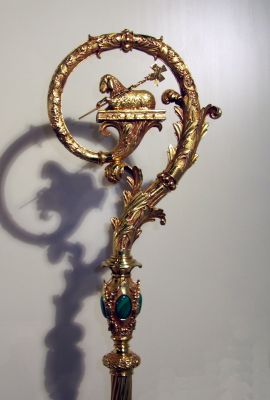
the pastoral staff who are challenging the bishops during the sacred celebrations
The means are: necessary that the bishops with a humble and courageous leap of faith in their own charisma, resume control of the situation. At the bottom of the flock of Christ, bewildered by intriguers and rebels, can not wait. The shepherd is smitten and the sheep gone astray. But God will never miss the good shepherds? In no way! The Catholic world has still, thank God, at least in democratic countries, numerous media, of teaching, of pastoral action, of preaching: from the pulpits to the conferences of all kinds, from the parishes to school, from print to the internet, from publishers websites, contacts with movements and associations to those with private, from conference rooms to the squares. And the themes of possible and desirable interventions specific and exclusive jurisdiction of the bishop are numerous and urgent. I'm not even to list.
That a bishop to intervene at the party kiwi or the firework display or meeting with the Buddhists or the benefit concert can be certain sympathetic and bring the bishop to the people. However, it remains to bring people to Christ. How come the bishops feel or appear so little if only they would be the most qualified to speak? Do not just "be between people "; we need to see what is being done among the people. Why then let the laity, as competent and good will of the debate or even more the decision or judgment on matters of faith and morals where instead so important and irreplaceable, by the command of Christ Himself, is the word of the pastor?
Fontanellato, 1 April 2014
Click below to listen to a Marian song of the popular tradition
HTTPS://i0.wp.com/isoladipatmos.com/wp-content/uploads/2014/10/cavalcoli56.jpg?fit=150,150&ssl=1150150Father GiovanniHTTPS://isoladipatmos.com/wp-content/uploads/2022/01/logo724c.pngFather Giovanni2014-10-21 12:31:042021-04-21 00:40:53The Bishops are watching?
CARDINAL KASPER AND THE PARADIGM OF THE’USEFUL IDIOT
I offer my sincere esteem to Cardinal Kasper whose theology and ecumenism I do not at all share, but whose fidelity to his idea of Pietro, pushed to the point of offering himself to the public slaughter as a target practice, I appreciate, in this poor Church of ours which looks more and more like a amusement park where no one controls who enters and who exits and in which the roller coaster is now free of technical maintenance, without all this, however, erodes our assurance of faith: the gates of hell will never prevail over the Church founded on the rock of Peter, to whom Christ gave the keys of the kingdom [CF. Mt 16, 18].
.
.
Author Ariel S. Levi di Gualdo
.
.
QED …
After the release of the libretto by Cardinal Walter Kasper, in which the cardinal celebrates the praises of the heresiarch Luther and of Protestantism, I propose again on the columns ofPatmos Island one of the first articles written shortly after the opening of our online magazine. Perhaps it is worth mentioning that when I published and wrote about some two years ago useful nonsense, ran the 19 October 2014, as anyone can check from our archive, where all our writings are collected in order of date. I was really wrong? [ 7 June 2016 ]
That of "useful idiot" is not a term abusivebecause if it were, I would not dare use them, all the more towards a bishop like Cardinal Walter Kasper, famous theologian whose cristologia and ecclesiology we can discuss, species in this church so free, collegial and democratic in which Alberto Melloni seems only to be granted a right of thought, of speech and expression, up to go to Catholic bullshitting without restraint directly at the Masonic Lodges [cf. My previous article,who, who, who], happy to host not so much the "builders of peace" [CF. Mt 1, 5-10] that this work will be blessed Christological, but the de-builders of the Church, for this very welcome to the Masons today do not attack us more directly from outside but from inside.
.
The term of purely political "useful idiot"that nothing, I repeat, has in common with the concept of human idiocy, those loyalists who were mentioned in the countries of the West defended in all ways and at all costs the Soviet regime, even against the evidence of the facts. And of this, the true champions, were not the placid Italian communists from the sacristy, but hardened communists French and Spanish.
.
ET, Michelangelo, Judgement and … the Vaticanists
In the days preceding the opening of the Synod on the FamilyI've read many accounts of real or alleged vaticanologi, I have isolated their words by certain ecclesiastical dramas going on and I allowed myself a smile, because these characters in the immediate present paralyzed and unable to understand what heavy and ironic give feedback on them tomorrow history, are becoming more similar to ufologists discussing extraterrestrial aliens and visits to our planet, exercising their sacrosanct right to alienate the tragic ecclesial reality in corso. For the time being the only ones to get out of this chorus of flatterers by Kominform [seewho] seem to be Marco Tosatti [see who] e Sandro Magister [seewho].
.
In certain events that escapes is to practice the obvious:Cardinal Kasper fully deserves the loyalty bonus, because lending itself as useful idiot - and again I repeat: always within the meaning of the word used in the political sense totally flattering - is making a great service, offering to the attacks of various fringes of the Catholic world, of various theologians and not least to the objections expressed gracefully theological everything from a group of cardinals and scholars who have just published a book that examines some burning questions that have formed the subject of discussion at the Synod on the Family [who].
.
Cardinal Walter Kasper
From the ongoing affair, that Cardinal Kasper is making out of it?It is a bishop of the Catholic Church, is a cardinal elector no longer octogenarian, President Emeritus of the Pontifical Secretariat, theologian appreciated and rigorously imposed as the only verb in certain theological studies full of all the worst modernist and pro-Protestant heresies, that is, almost all of the existing ones… so it has very little to lose, little or nothing to gain, as opposed to other bishops always on the track instead groped no longer know how to please the Supreme Pontiff in a desperate attempt to get him the benefits and promotions …
.
a manifestation of popular faith in Peru
We seek to be clear: Latin Americans respect the authorities provided it is united and moved by profound authority. If one confronts the typical Latin American in a decisive and determined way, if you want even with a respectful but light touch of authority, there are two solutions: or that reacts ammazzandoti, upand reacts by loving you. However, if you choose to love you, at that point he will be ready to be to get killed if someone were to dare to touch him in whom he recognized all the trappings of masculinity and power of the man who deserves as such all the more indefatigable than. And as we all know, today, one of these typical psychologies sits on the Chair of Peter.
.
Who agrees with Cardinal Kasper, tends to tacere, as agreed and just; those who do not is, attacks him. And ever when it comes to gentle attacks prelatizi, that it is settled practice of certain members of the College of Cardinals before addentarti with the bite of the cobra you sprinkle the anesthetic to bite, everything is alright; however, when it comes to certain hard and pure Catholics or certain blogs and sites in the so-called ultra-traditionalist area, they don't even know where that respect always due to a bishop and a collaborator of the Roman Pontiff lives, things change somewhat, because in this case the German cardinal was overwhelmed by insults in which the slightest offense was that of "apostasy from the faith".
.
I have some experience of life lived in the midst of the Latin American,from my closest and valuable contributor, and one thing with which I have learned to familiarize yourself is this: for a discussion of culture and custom tend not to act in a direct way, but in an indirect way. Other times it happens that the things that they say they would like to say to other. All this to protect their authority figure, the person or persons subject to certain thoughts and expressions, then to preserve the serenity of the relationship between them, the person or persons.
.
Eleonora Barbara Ciccone, aka Madonna, interpretation Evita Peron
Rado says certian warlordsthey first sowed friction and created all the conditions for furious quarrels,then I finally intervened to sedarli with paternal kindness, Eleonora mentre Barbara Ciccone, aka Madonna, played Evita Peron singing from the balcony of the presidential palace: Don’t cry for meArgentina[who].
.
The Pied Piper
Let's try to analyze the obvious:it may be that the Holy Father has favored a real crawl space through an intermediary for the astute purpose of bringing out the rats in the open like the Pied Piper, to see who was in favor and who was against the hypothesis of certain discussions on delicate issues discussed in recent days at the synod on the family? It is my hypothesis, fperegrine bears, but it is worth reflecting on what, nothing else to give me wrong. In the event, however, was so, appear obvious to what extent the Holy Father could not have been put forward himself in the first person, because in this case no, in this climate of clerical cowardice, would never have come into the open [cf. My previous article,who], from the great defenders of the historical "non-negotiable values", but when they had to choose between certain non-negotiability and the possibility of finally reaching a prestigious bishopric, they promptly mitigated both the language is the fighting spirit, hiding behind the finger of spurious prudence; and in the face of his own interest or the possibility that made him see or hope purple red, if necessary they have become masters of negotiation even on “non-negotiable values”, rather: above all, on “non-negotiable values”.
.
Cardinal Walter Kasper during an interfaith prayer
I have much to disagree with on Cardinal Kasper's theologyand on its ecumenism, from which I believe that only the deleterious Catholic-Protestantism can arise over time, place under the lines its reference points tend to be Kant and Hegel, over the onnipotente Rahner, with an eye of sympathy for the heretic Küng. I feel, however, to say how much I appreciate him more of certain fringes which now represent only the alleged Catholic tradition of themselves and that of their loved ones and untouchables ghettos they started to growl at the dog, while others instead of pretending not to know who is the master and the dog took off the muzzle telling: "Come on Fido, barks! I want to see who will answer, but above all as. Then, in time and place, I'll think of it, perhaps in the way that no one can imagine ... ".
.
Peter and Paul in Antioch, Byzantine mosaic
How many bishops and cardinals, from the tireless defenders of sound doctrine and values are not negotiable,in his capacity as members of the Apostolic College, it crossed my mind to make that obvious which is also indicated with extreme clarity in the Gospel? And the obvious Christian and apostolic to do this would be: go to Antioch, ie in the Vatican, to the Casa di Santa Marta, clothed with manhood Pauline, take the Prince of the Apostles and ask: "Look here, 'Peter, you want to explain to your devoted and obedient brother apostles who share the honor and burden of the episcopate with you, what games certain fringes increasingly restless are trying to play under your eyes? Assuming they play under your eyes and it is not you who make them move like pawns?» [CF. Gal 1-2,7.14].
.
… qua the command!
I offer my sincere esteem to Cardinal Kasper whose theology and ecumenism I do not at all share, but whose fidelity to his idea of Pietro, pushed to the point of offering himself to the public slaughter as a shooting target, I appreciate,in this poor Church of ours which looks more and more like a amusement park where no one controls who enters and who exits and in which the roller coaster is now free of technical maintenance, without all this, however, erodes our assurance of faith: the gates of hell will never prevail over the Church founded on the rock of Peter, to whom Christ gave the keys of the kingdom [CF. Mt 16, 18].
.
… I will give you the keys of the kingdom
Like it or not some people today to Petercalled Francesco, and to him we owe devout and filial obedience. If you want to use and abuse the Catholic Church to be more, the question changes, since memo other with respect to the Church founded by Christ above Pietra precise, which is that of Peter. And today the stone is Francesco, Bishop of Rome and Pontifex Maximus, without the possibility of any Catholic discussion, if faithful to Catholic tradition we want to be, regardless of whether the Holy Father may or may not surround himself with bad company, of bad advisors and even of “useful idiots”.
.
.
.
.
.
.
HTTPS://i0.wp.com/isoladipatmos.com/wp-content/uploads/2014/10/Patmos1.jpg?fit=150,150&ssl=1150150father arielHTTPS://isoladipatmos.com/wp-content/uploads/2022/01/logo724c.pngfather ariel2014-10-19 22:33:062016-06-22 14:40:57Cardinal Kasper and idiot profit paradigm
[…] Küng is the inventor of the conceptual frameworks that govern the many revolutionary proposals advanced in recent months by theologians and representatives of the worldwide on the occasion of the Extraordinary Synod on the Family called by Pope Francis.
Author Antonio Love
Il teologo Svizzero Hans Küng, in its long history the human and intellectual, he never abandoned his "dress scene", that is the "bad teacher" at odds with the authentic magisterium of the Catholic Church. His favorite themes are those who yesterday were replicated by the Archbishop of Milan, cardinal Carlo Maria Martini, and today they are vulgarized pseudo-prophetic literature of Enzo Bianchi. Are the reform of the Church, the abolition of papal primacy, a "new" moral addressed to implement the "sexual revolution" sessantottino - mold Freudian-Marxist -, granting the priesthood to women, l'euthanasia. Lately Küng, ill with Parkinson's, has come to announce the intention to use it himself assisted suicide, in imitation of Cardinal Martini.
The Reverend Hans Küng in a photo juvenile
Küng's career started in the sixties with significant interventions in the preparatory phase of the Second. With the tempo andar, its positions open to contestation have found more and more space in newspapers, with articles or interviews focused on this or that topic, thus gaining a significant reputation not only in the theological circles, but also among the general public. One of the joints of his battle and controversy was and is the virulent challenge encyclical Human life of Paul VI: ideal sacramental - and therefore certainly divine, but for this very mysterious - the family and procreation Christian Küng is reduced by a restoration of medieval, up to accuse the document Pauline and subsequent claims of the popes on the topic, "The main cause of the spread of AIDS in the world".
The controversy of Küng, in the years, invested primarily the pontificate of John Paul II St. [seewho, who, who] and then Benedict XVI[see who, who] the first considered reactionary, the second even schismatic. But it is the blessed Paul VI, the pope who brought to fruition the Vatican, raged the controversy of the Swiss theologian, who could not tolerate his genuine insight reform of the Council, as opposed to an interpretation misleading - because historicist and humanistic - that was leveraging the "council of mass media», how keenly he had to say, then Benedict XVI.
The Rev. Prof. Hans Küng in a picture of maturity
Küng is the inventor of the conceptual frameworks that govern the many revolutionary proposals advanced in recent months by theologians and representatives of the worldwide on the occasion of the Extraordinary Synod on the Family called by Pope Francis. It will therefore be instructive to draw a doctrinal ecclesiology of the Swiss theologian. The ecclesiology of Hans Küng in fact deserves to be well known today because it has no theological weight marginal, indeed is precisely the philosophical-religious ideology dominant in the Catholic. The conceptual categories and the main sources of literature are those of the Lutheran Reformation and the religious philosophy of the matrix Lutheran, represented by the system in the nineteenth century idealism of Georg Friedrich Hegel and in the twentieth century by the "dogma of the Church" - the ecclesiastical Dogmatics — Karl Barth. The cornerstones of this philosophical-religious ideology are represented by historicism and dialectics immanentistic. The Catholic Church is thus interpreted as a historic moment of the dialectic of the Spirit - understood, this, not so much as the Agion Pneuma of Catholic dogma but rather as "the ghost» by Hegel —, which aims at a development in the near future that will see, as a first step, the removal of doctrinal barriers between Catholics and Protestants - with the full acceptance of the Lutheran view of "justification by grace alone" - and the creation of a single "Church of Christ" (ecumenism). In the end, as the second and final stage, the establishment of a "universal Church" based solely on ethical-political (the 'Weltethik»). This ideology permeates today, clearly identifiable as background a careful conceptual analysis, most of the proposals, doctrinal or pastoral, Catholic theologians most prominent, cominciare and Karl Rahner, that the same Hans Küng considers a master in theology and a model adopting Hegel's dialectic (1).
These teologi Catholics, many of whom became bishops, exerted a well-documented influence on the work of Vatican II, to then assume the role (arbitrary) the only authoritative interpreters of the Council in the next fiftyO, up to, today, the preparation and conduct of the work of the Synod on the possible changes to the dual prasis pastoral in relation to the problems of families.
A prominent figure of this theological current was Cardinal Walter Kasper, supported by most of the German and Italian by other theologians became cardinal Gianfranco Ravasi as Dionigi Tettamanzi and. His argument most characteristic, in line with the proposals of the theological-moral Hans Küng, is the need to accelerate the process of reform of the Church with a stronger adaptation to the moral conscience of the "men of our time" and alignment with the practice of ecclesial communities Protestant and Orthodox. In his speeches Leitmotiv is the need to de-dogmatise the Catholic Church, starting with a new pastoral family is separate and independent from the doctrine on the sacraments, temporarily not abolished but kept aloof (2). In Italy, the ideology of ecclesiological Hans Küng, especially as regards "ecumenical", is disclosed and constantly revived by Enzo Bianchi, "Prior" of the community of Bose, much heard by the majority of bishops and even the Holy See (3).
Photo of Dr.. Enzo Bianchi dress monaco (public image found on any internet search engine)
THE CONDITIONS DOCTRINE OF THE PROJECT
KUNGHIANO OF REFORM
CATHOLIC CHURCH
To understand well, in its theoretical and its practical implications, the ecclesiology of Hans Küng, it is essential to mention some biographical data, on the basis of the Swiss theologian works in which he narrated the process of his intellectual formation (4). From these data will be very clearly the nature Lutheran-idealistic reformers of his intentions and his ideal of Catholic Church life, based on its particular conception of the priesthood and pastoral, present in all his work, from the youth Justification the works of his maturity as Does God exist? and the "manifesto" conclusive "future Church", namely the Project Weltethos.
Reinhard Marx, Archbishop of München, during an interreligious prayer meeting
Hans Küng, born in 1928, is formed in a setting where you practice done some "inter-religious dialogue", by the contact quotidiyear, in the same class, with Catholics, Protestants and Jews (5). Although he had thought of becoming an architect medicoo, "Tended to something that was both more spiritual and more practical, more useful to young, so he decided to become a Catholic priest and theologian » (6). In following, these trends will become much more pronounced, that will have more resonance and evidence in its production. The show works like Truthfulness e Being a Christian, and then his activity in Rome as chaplain of employees and Sursee as a preacher in hospital (7).
Rome, the historic entrance of the Pontifical Germanic-Hungarian College
Arriving in Rome, In the 1948, Küng comes as a seminarian at the Pontifical German College and studied philosophy and theology at the Gregorian University. The Germanic, in those years, There were scholars such as Emerich Coreth, William Klein, W. Core, all engaged in the study of Hegel's Philosophy. Just at that time, In the 1952, Coreth had published an essay, titled The dialectical Being in Hegel's Logic. As stated in the same Küng, from him he learned to interpret the priestly spirituality and pastoral zeal in dialectical terms and storicistici, in frontal opposition with the doctrinal directives of the Magisterium of Pius XII, which included the recommendation not to abandon metaphysics and logic inherent in the Catholic theological tradition:
Father Wilhelm Klein
"He probably would not have lasted in those seven years without my spiritual father to the German College, Father Wilhelm Klein, which - prepared by a multiple activities as a professor of philosophy, as Provincial of the Jesuit Province of Northern Germany and as a visitor to the Society of Jesus from Scandinavia to Japan - carrying a horizon of views rare and very large […]. He was also the man who first made me careful about many philosophical and theological problems burning. I spoke with him especially of Hegel and then Karl Barth. And at first I showed him my brief theological manuscripts, that redigevo alone and that he mostly before he cut down in the most cutting edge and then force me to really think about a dialectical, that included already in the synthesis of the opposite " (8).
And it was Klein who led"Decisively" the young Küng to choose as a topic of doctoral thesis theology Barth. In another book, Küng, thanked for his help in drafting the text, remembers with gratitude Coreth, Small, Kern as his "venerable masters to the Germanic-Hungarian College in Rome», that, along with others, "I have given suggestions decisive for my theology in general and for the understanding of Hegel in particular ' (9).
Over the years, ranging from 1951 on Küng is mainly dedicated to the study of dialectical theology of Barth, and the theologian draws in Basel 1955 the licentiate thesis under the guidance of one of his professors of dogmatics at the Gregorian, ie Maurizio Flick, who would later become famous for his theory on the reduction of the dogma of original sin to a mere myth of origins. And Barth Küng recognizes then be grateful for having allowed to range overere the properly theological significance of Hegel's philosophy, then erasing not only the distinction between theology Catholic and Lutheran theology but also between theology and philosophy. Justification. The Doctrine of Karl Barth and a Catholic reflection is the first work of Küng and demonstrates the passion with which the theologians of Tübingen he devoted himself to assimilate the barthiano thought in the seven-year stay at the Collegio Germanico; the same Karl Barth wanted to emphasize then publicly:
"My joy comes first of all from the opening and the firmness with which she, at the German College in Rome […] as well as the brave fellow he studied my books and made it clear to himself dialectically the theological phenomenon that riscontrava » (10).
Another author passionately studied was de Lubac, then in the middle of the inevitable controversy for his book Supernatural. Historical studies(Paris 1946) that questioned the traditional doctrine about the gratuity of the supernatural. Such disputes, together with those on other issues relating to polygenism, evolutionism, to communism, led to the resolute stance of Pius XII in his encyclical The human race (1950). The Catholic scholar Antonio Russo, University of Trieste, admirer of Henri de Lubac, and therefore very understanding in regards to Küng, paints bleak the situation doctrinal, pastoral and discipline in the pre-conciliar Church, identifying with the vision of the Church that was typical of the progressives, and with them the young seminarian Swiss Hans Küng:
"In those same years, then, the spiritual atmosphere prevailing in Rome is anything but open to new. Magazines such as La Civiltà Cattolica host not infrequently articles as Perennial vitality of the Papacy; Action pacificatrice of the Papacy in old age; Peacemaking and charitable of the Papacy in the age contemporanea; The Vatican beacon of cultural progress. Excommunicate the Communists and those who offer their support; and announce solemn pilgrimages, acts of devotion to Mary and "enthusiasm even plebiscitary"; proclaimed the dogma of the Assumption of the Blessed Virgin Mary, the Holy Year of 1950, the Marian Year of 1954. The young theologian, Anyway, lived continuously in contact with both the "Roman theology" with both the spiritual and cultural environment of the Germanic, being uncomfortable and threatening to wreck his Roman conversio. So much so that his readings are oriented towards the deepening of positions and authors such as Hegel, De Lubac, but especially of Karl Barth, the study of which will shape it in a sustainable way, because the open "access to evangelical theology ", pushing to get passionate for theology » (11).
As si Sciences, the influence received from Küng in the early years of its formation is decidedly Lutheran mold, and Lutheran is the conception of the Church and of ecclesial theology from the beginning that orients his studies. The result is a theological method, which proceeds from the substantial elimination of the Magisterium of the Church – especially the Pontificalor - as a basis for the scientific interpretation of the faith. Even the concrete life of the Church - the liturgy, popular piety - is seen as "outside", as something to be overcome or eliminated altogether because appartenent to the "Church of the past ', that should leave room for the "Church of the Future".
Küng warns a bitter annoyance to Marian devotion that the Church professes and practice, and conseguentance with is brought to devalue, not only of popular devotion but also a solemn dogmatic as that of the 1954 relative to the Assumption into Heaven, in body and soul, Assumption of the Blessed Virgin Mary. Having disconoscithe UTO The power of teaching of the hierarchical Church, Küng instead of the Magisterium adopted as the guiding principle for theology, ie for the interpretation of what Küng always calls "thechristlischer faith» (more "the Catholic faith»), the thought of Karl Barth Lutheran, which in turn introduces Küng to a practice of theology inspired exclusively to the Hegelian dialectic.
THE CONSEQUENCES OF THEOLOGICAL
ADOPTION OF Dialectic
HEGELIANA
It should be noted at this point that these methodological premises make the discourse on Church done by Küng is not exactly theological: none of his thesis can be considered - from a point of view rigorously critical-epistemological - as a hypothesis scientifically admissible, like one theological quaestio held, because the method he follows is by no means typical of ecclesial theology but rather to a "threadsofia religious ", in the precise sense that I give to this term in my treatise on True and false theology (12). and that the thought of Küng is to be considered mere "religious philosophy" is determined not only by the fact that is inspired by Hegel's dialectic - which reduces explicitly Christian theology to philosophy, and this one "Phenomenology of the Spirit» (13) – , but also by the fact that even the thought of Barth transcends the narrow methodological limitations of the "religious philosophy"; indeed, as I reiterated in a dialogue with the epistemological Brunero Gherardini (14), the assumption of a Lutheran "Sola Scriptura», with the exclusion a priori of the Magisterium from the scientific determination of the object of theology (what else can it be but the faith of the Church), means that what the scholar calls "thechristlischer faith"The"the word of god"Remains undetermined, or otherwise determined only by subjective choices, and then reduced to data obtainable only from the uncertain phenomenology of individual consciousness or historical-Community, that which is entrusted to interpret Scripture without the need for an ecclesiastical magisterium. Now, you can not develop a science without a clear determination of its specific object, which then depends on the adoption of the method more appropriate to interpret. A theology that does not have as its object the faith of the Church (and not the "feeling of faith" subjectively someone, inside or outside of the Church) can not be considered "theology" in the Catholic sense of the term, ie as ecclesial theology. E, within that theology, the ecclesiology of those who are not directly connected and essentially the Church's faith to the Magisterium of the Church is reduced to an ambiguous religious discourse which then ends up adopting the themes and rhetorical modes in a socio-political ideology, as was the case with the latest works by Hans Küng, come Projeckt Weltethos, that very little differ, in substance, by similar works of propaganda universalist ideology of the theosophical inspiration or Masonic. Indeed, for explicit admission of Küng, only after meeting with the works of Barth:
"I realized, what can be theology as a science. Barth kritischkonstruktive confrontation with the entire Christian tradition […] sat for me lasting yardsticks theological thought and action " (15).
Opera Masked ball: Archbishop woman. Below is a photo below right from the opera Funny mystery: women-priests
To put it even more explicit, and even more stringent in terms of epistemological,the ecclesiology of Hans Küng not be considered as "a theology with some mistakes": it is rather the negation of the "theology as a science"(theology as science), as a way to refer to the Church of Christ - that mystery of the Christian faith that the science and technology should take as their subject-specific and take into consideration - clearly shows that Küng refers to another. When parla di "ecumenism", It seems that simply refers to something – he detectable sociologically locates in the "lowest common denominator" of the various "confessions of faith" produced by Christian communities. This something sociologically need detectable then – just like Hegel in designing its historical synthesis of religious consciousness – to develop the project of "universal religion", that would mark the passing of the Catholic Church and all other Christian denominations, dialectical unity with Islam, with Buddhism, with Hinduism and also with atheism. Requests today Küng moves to speed up the "reform of the Church" (the annulment of the ecclesiastical magisterium and especially the primacy of the Pope, the synodical government in the Church, abolition of clerical celibacy, the admission of women to the ordained priesthood, the recognition of same-sex marriage, acceptance of euthanasia, etc.) are nothing but preparing what will be unavoidably tomorrow, will be fully realized when the fate inherent in the very essence of the Church as a phenomenon (= HandsfesTazion momentary) of the Spirit. Nothing different, both in terms of ch and concepts, from what Hegel said in early work The Spirit of Christianity and its fate; but nothing like what is a speech propriamente theological, that begins with the unconditional acceptance of the truth revealed (the dogma) e continues with the elaborateaction of rational interpretation hypothesis that privileged instrument metaphysics. As he rightly observed at the beginning of the twentieth century Réginald Garrigou-Lagrange, at odds with the modernist theologians and cattolici believe we can reconcile the dogma with the evolutionism of Bergson, the truth of the fefrom, contained in the "dogmatic formulas", can not be understood by believers if not based on evidence of "common sense", that are substantially metaphysical in nature and which in their turn constitute a prerequisite for the rational scientific interpretation of the dogma, ie for theology (16). Effectively, without metaphysics, without the logic that it is intrinsically linked, especially without the principle of non-contradiction, the dogma is no longer the divine truth preserved by the Church, but can and should be contradicted dialectically, in accordance with the cultural and social changes (17). This is what comes to support Küng in the church (1967) and in Infallible? A request (1970):
"Every formula of faith, not only the individual but also in the whole church, remains imperfect, incomplete, enigmatic […] This fragmentation not only based on the character often polemical and narrow doctrinal formulations of church, but the necessarily dialectical character of every human affirmation of the truth […]. Every proposition can be true and false » (18).
So it is not surprising that the Congregation for the Doctrine of the Faith issued the following This orientation:
The Cardinal Franjo Šeper (Osijek, 2 October 1905 - Rome, 30 December 1981) at that time prefect of the Congregation for the Doctrine of the Faith
"The Congregation for the Doctrine of the Faith fulfilling its duty to promote and safeguard the doctrine of the faith and of costume throughout the church has submitted to the two works of Professor Hans Küng, The church e Infallible? A question, that have been published in several languages. With two different letters, dated respectively 16 May 1971 e 12 July 1971, the congregation notified the author of the difficulties he found in his opinions and asked him to explain in writing how such views do not contradict Catholic doctrine. In a letter dated 4 July 1973 the congregaziProfessor Küng one offered a further opportunity to explain their ideas through an interview. With a sua lettera part 4 September 1974 he teacher. Küng also left out this possibility. On the other hand with his answers did not feel that some opinions about the church does not conflict with Catholic teaching but continued to support them even after the publication of the declaration The mystery of the church. Therefore, in order not remain doubts about the doctrine that the Catholic Church professes and because the faith of Christians is not in any way tarnished, this sacred congregation, invoking the doctrine of the magisterium shown in the statement The mystery of the church declares: In the works of Professor sopradette. Hans Küng some opinions that are contained, in different degree, are opposed to the doctrine of the Catholic Church, which must be professed by all the faithful. We note only the following most important now apart from a judgment about some others that Prof. Küng defends. The opinion that at least puts in doubt the dogma of the faith of the Church's infallibility and reduces it to a certain fundamental truths of the Church in indefectibility, with the ability to err in its judgments that the magisterium of the Church definitively teaches to believe, contradicts the doctrine defined by Vatican Council I and confirmed by the Second Vatican Council. Another error that seriously affects the doctrine of Professor. Küng regards his opinion of the Magisterium of the Church. In reality, he does not adhere to the authentic magisterium of the genuine concept according to which the bishops in the church are "authentic teachers, endowed with the authority of Christ and preach to the people committed to them the faith they must believe and put into practical life "; In fact, "the task of authentically interpreting the word of God, written or handed on, has been entrusted exclusively to the living teaching office of the Church". Even the opinion already insinuated by Professor. Küng nel book The church and according to which the Eucharist, at least in cases of necessity, can be validly consecrated by baptized without priestly order, can not be reconciled with the doctrine of the Councils of the Lateran IV and Vatican II " (19).
In 1979 Hans Küng accustom a revocata let missio canonical on the teaching of Catholic theology.
AN APPRAISAL OF THE TEACHINGS on ecclesiology
Historicist
Father Anthony De Mello S.j.. and his book: Pilot's license for eagles and chickens.
The ecclesiology of Hans Küng historicist, popularized by many authors nonfiction theological, found a note in a timely condemnation of the Congregation for the Doctrine of the Faith. It directly concerns not the Swiss theologian but an Indian follower, the Jesuit Anthony De Mello. In the document of the Congregation, made known in 1998 — the same year that Pope John Paul II published the Encyclical Faith and Reason - we read that in the works of De Mello is observed:
"A progressive distancing from the essential contents of the Christian faith. The revelation took place in Christ, he substitutes an intuition of God without form or image, to speak of God as a pure void. […] Religions, including the Christian, are one of the main obstacles to the discovery of truth. This truth, of altronde, it is never defined in its precise contents. To think that the God of their religion is the only one is, simply, fanaticism. "God" is seen as a cosmic reality, vague and onnipresente. His personal character is ignored and in practice denied ".
Enzo Bianchi, Donizetti theater Bergamo, 20 September 2012 (public image available on all internet search engines)
This is the Hegelian conception of the Absolute which is not transcendent, it is not personal, but is identified with the Holy Spirit and thus become dialectic with History. The Catholic Church, once denied the absolute value of revealed truth, is relativized and reduced to a transitory moment in the development of consciousness of humanity destined to unity based on global ethics. Christ - says the document signed by Josef Ratzinger - is to be considered"As a master alongside others. […] Is not recognized as the Son of God, but simply as the one who teaches us that all men are children of God ".
In this complaint the Magisterium meeting the a priori condemnation of that 'atheistic humanism I have noted many times in the writings of another follower of the Swiss theologian, ie Enzo Bianchi, Christ comes to qualify as a simple "creature" [Ed. See previous article by Antonio Livi, who].
NOTE
Cf. Hans Küng, Incarnation of God. An Introduction to Hegel's Theological Thought as Prolegomena to a future Christology, Publisher Herder, Freiburg - Basel - Vienna 1970, p. 643: "In the more recent Catholic theology was Karl Rahner to open new orizzoni […]. The spirit that distinguished hovers in the background of this study […] others do not is whether or not Hegel, although there also influences Heideggerians. His sporadic attempts to distance himself from Hegel in subtopics only confirm this fact " (my translation).
See Antonio Livi, in The New Compass Daily, 10 October 2014.
See Antonio Livi, in The New Compass Daily, 10 February 2012.
Cf. Hans Küng, Fought for freedom. memories, Munich 2002; The same thing, Controversial Truth. memories, Munich 2007.
Cf. Hans Küng, The justification, Trad.. en. T's. Federici, EDITRICE Queriniana, Brescia 1969, p. 21.
Hans Küng.Way and Work, a cura di Haring und K. (J). Stuffed, Piper publisher, Munich 1978, p. 123.
Cf. Hans Küng, interview with A. W. Scheiwiller, "Awkward Confederates: Hans Küng the faithful church reformer ", in Week, 14 June 1972, p. 23.
Hans Küng. Way and Work, cit., p. 128.
Hans Küng, Incarnation of God in Hegel. Prolegomena to a Future Christology, Trad.. it., Queriniana, Brescia 1970, p. 10.
Karl Barth, letter of safe conduct, in Hans Küng, Justification. The Doctrine of Karl Barth and a Catholic reflection, John Publisher, Einsiedeln 1957 cit.; Trad.. en: Letter to the author, in Hans Küng, The justification, cit., p. 8.
Antonio Russo, "Hans Kung and theology as science", in Study, 106 (2010), pp. 185-206, here p. 188.
See Antonio Livi, True and false theology. How to distinguish the authentic "science of faith" from an equivocal "religious philosophy", Leonardo da Vinci's publishing house, Rome 2012.
See Antonio Livi, True and false theology, cit., pp. 141-148.
(14) See Antonio Livi, Some clarification, in dialogue with fans and critics, in Truth of Theology. Discussion of logic aletica from"True and false theology", by Antonio Livi, curated by Marco Bracchi and Giovanni Covino, Leonardo da Vinci's publishing house, Rome 2014, pp. 167-185.
(15) Hans Küng. Way and Work, cit., p. 137.
(16) CFR Reginald Garrigou-Lagrange, Common Sense, the philosophy of being and dogmatic formulas, Beauchesne, Paris 1912; Trad.. it.: The Common sense, the philosophy of being and dogmatic formulas, edited by Antonio Livi and Mario Padovano, Leonardo da Vinci's publishing house, Rome 2013.
(17) See in this regard Antonio Livi, Rationality of faith in Revelation. Philosophical analysis in the light of logic aletica, Leonardo da Vinci's publishing house, Rome 2005.
(18) Hans Küng, The church, Herder, Freiburg in Breisgau 1967, p. 397.
(19) Congregation for the Doctrine of the Faith, Warning, 15 February 1975.
REFERENCES
Louis Bouyer, "Ecumenism without overpasses», in Catholic Studies, 13 (1969), pp. 30-35.
Pier Carlo Lad, «Here's Hans Küng», in Catholic Studies, 22 (1979), pp. 549-54.
Luigi Ibizugbe, Heretic Hans Küng. Christological heresies in the work "Christ sein", Editions Civilization, Brescia 1977.
Luigi Ibizugbe, Theology and Christology. "God exists", in Hans Küng, Editions Quadrivium Genoa 1982.
Antonio Love, "Dogma and Teaching after the" case Küng '", in Catholic Studies, 24 (1980), pp. 171-177.
Antonio Love, True and false theology. How to distinguish the authentic "science of faith" from an equivocal "religious philosophy", second edition increased, Leonardo da Vinci's publishing house, Rome 2012, pp. 241-246.
Emanuele Samek Lodovico, "The infallible dogma of Han Küng», in Catholic Studies, 16 (1971), pp. 171-177.
Emanuele Samek Lodovico, "The way to Hegel to Hans Küng», in Catholic Studies, 16 (1971), pp. 243-251.
Click below to listen to a song the folk tradition
HTTPS://i0.wp.com/isoladipatmos.com/wp-content/uploads/2014/10/Antonio-Livi-Patmos2.jpg?fit=150,150&ssl=1150150Father AntonioHTTPS://isoladipatmos.com/wp-content/uploads/2022/01/logo724c.pngFather Antonio2014-10-19 21:51:232021-04-21 00:59:39The ecclesiology of the historian Hans Küng
The evil man can be moderated, often, tempering, measured, controlled, gentile, good manners, courteous, easy going, well-behaved, sympathetic, Allegro, psychically normal, cultured, from fine stretch, apparently pious and serene; indeed the devil preferably choose these alien people from the excesses of emotional, by outbursts of anger, by uncontrolled impulses, people who do not seem suspicious, maybe in high places, prelates, theologians or religious, and are therefore subject to estimation and respect, to make them instruments of his action when he wants to do really serious damage to the souls and long-lasting ...
Author John Cavalcoli OP
In recent years,, is thanks to the intervention of the Church or of the Shepherds, and thanks to the publication of valuable works on the subject or to the fame acquired by skilled exorcists, as the Father Gabriele Amorth and other, in many Catholic circles has been recovered awareness action of Satan in this world [CF. Pietro Cantoni, The Dark Lord,who], although much remains to be done to undoinate two persistent errors opposed to each other, the first, more prevalent in educated circles, consisting in the denial short existence deldigrandfather; The second one, instead present the working classes, which consists in spectacularization action satanic and in too much agocilitates with whom you would like to explain certain phenomena hateful or certain doom to repeat. It happens then to meet misconceptions about demtheyor both the first and in the second case.
With regard to the action ofthe Satangenerally gives space and advertising, sometimes for some useless curiosity or search for success by the publications on the subject, the most striking phenomena, puzzling and impressive, as possessions, appearances and Satanism. This phenomenology, But, thank God, is rather rare.
Vice versa, exists uNo other aspect of the action of Satan, more frequent and more important, but less flashy and more neglected, and that is what we have to close all, it is of primary interest to our path of salvation, although he did not own the spectacle of the first, unlike ma, placing itself purely in terms of the spirit – the rest, Satan is not a spirito? – affects less sense, the emotions and the imagination and challenges the more delicate work of the intelligence, of consciousness and volontà, especially in relation to the exercise of the theological virtues of faith, the speranzand a charity, and the exercise of the gifts of the Holy Spirit.
The phenomenon of possessions or harassmentall in all is a tough test for the obsessed and certainly engages the skilled exorcist, but in the end does not affect or endanger the moral conduct of the patient, since, as is known, during the presence of the devil, the patient is in an unconscious state, so it can not exercise the will.
Instead, the entry of Satan into the consciousness of the subject lucid and consciousis the real issue about the working of Satan, as he, with its suggestions, seductions and temptations, seriously jeopardizes the spiritual health of the subject, pushing him to sin. In fact, all the action of Satan in this world can be summed up in this single end: deceive man precisely with "doctrines of devils" to persuade him to sin knowing sin, making him look evil good or good evil;.
The imagine Satan as a being frightening or repellentstop means on the level of metaphor and imagination, without grasping the true meaning of the satanic, that is to say without seeing Satan in his real danger that, I repeat, lies in its fine art to lead us to sin, to show us the sin as attractive.
was the Prince of Light, the most beautiful of the angels
In this sense, Satan does not appear repugnant but otherwise looks fascinating,seductive and bewitching. Satan tries to dull our consciousness, yes you do not repent of the sin committed. This is the true characteristic, rest of the day for those who warn, s actionatanica. Or instills false guilt to block us in the fulfillment of the good and to lead us to despair.
In this respect, which is what should be there more to heartif we keep to our salvation, the working of Satan does not have an external character and material, relevant under, to emotions or states of our physical, as in the first case, but a thin appearance, inner, insinuating, we could say "serpentine", that's up toppunto the life of our spirit, our intimate, our ideas, our beliefs, feelings, trends or spiritual aspirations, our moral acts, our interpersonal relationship with others, our relationship with God. This raises the level of ideas, communication of thought, verbal messages, impulses or stimuli to the will.
The main aim of Satan is not even so much the corruption of passions but the corruption of the spirit.Do not push so much to carnal sins, but for the spiritual: the Superbia, the empietà, the presumption, the blind, hatred, the ipocrisia, the lie, duplicity. He poses the most serious obstacle to the achievement of good, of virtue, of God, obstacle that is not of the flesh but of the spirit or, as Christ says, not come from outside, but from the inside, from the heart, by the will.
He aims to make murky and false intelligence, unfair, double and the poor will. The sin of Satan was obviously a spiritual sin, since he is pure spirit, and for this the spiritual sins can be called "evil". These sins contaminate primarily the intellect and the will, thought and action, which are the powers proper to the spirit.
a poster advertising the “creative thinking”
The first sin spiritual, the starting point of perdition, therefore, concern the thought: what St. Paul calls "diabolical doctrine". It consists in instigating the lie into the advocacy of lying about the most important values, which are those that concern the salvation, then the falsification of the Word of God, of the truth of faith, of the doctrine of the Church.
In the sin of thought obviously plays a willingness, since every sin leads to ill will. But then the diabolical sin also concerns those acts that relate to the specific commitment of the will, in other words exactly sins or action related to the operation, the practical implementation of the diabolical thought, and here we have all of the most serious acts of violence, of cruelty, of sacrilege, dell'incredulità, of the desperation, of injustice, the theft, dell'assassinio, dell'aborto, the sadomasochismo, of contention, of defamation, of denigration, of disobedience, of sedition, of the massacre, terrorism.
The wolf and the lamb …
The evil man can be moderated, often, tempering, measured, controlled, gentile, good manners, courteous, easy going, beneducated, sympathetic, Allegro, psychically normal, cultured, from fine stretch, apparently pious and serene;indeed the devil preferably choose these alien people from the excesses of emotional, by outbursts of anger, by uncontrolled impulses, people who do not seem suspicious, maybe in high places, prelates, theologians or religious, and are therefore subject to estimation and respect, to make them instruments of his action when he wants to do really serious damage to the souls and long-term: This is especially the heretics, whose malignant influence is able to last for centuries.
These are the authors of what St. Paul calls "doctrines of devils"[CF. The Tm 4,2]. The evil person can put on an appearance noble, may seem like a very spiritual person, a profondo teoreta, an inspired prophet, un Wall ente, a mystic, Giacchè, as St. Paul says, "Satan disguises himself as an angel of light" [CF. II Cor 11,14].
Satan knows to some extent simulate even the sanctity, although the trained eye can easily recognize counterfeits and frauds, for Satan since he is a business after all too difficult. Hence the proverb: "The devil is, but not the covers ". The fiction evil can not last long.
Artistic representation of the Holy Spirit
It falls just who wants us fall.Ordinarily, the devil does not aim so high, because few love holiness, and he wants to conquer the highest possible number of fools and blockheads. For this ordinarily lies beneath the features and style of successful people that draw the crowds, false philosophers, theologasters, sophists and clever impostors, reformers of the Church and society, genes of thought and science, seducers, political leaders, spiritists, Hypnotists, atMarket, Withthose, poets and maghi.
But we mention Paul's expression in its context,which is very interesting: "The Spirit expressly says that in latter times some shall depart from the faith, paying attention to deceitful spirits and doctrines of demons, lies in hypocrisy impostors, already seared in their own conscience ".
First, the reference to the Holy Spirit, that is the Spirit of truth,used to give certainty of this statement. The "last days" or "fullness of time" in the language of the Bible represent the apocalyptic times, ie those conclusive and decisive, the most highly dramatic, the history of salvation, the timing of the final battle. Recall the apostasy of which the Apostle speaks [Ii Ts 2,3]. Primarily concern the future, but can also affect the present, as early as this will decide our salvation, it builds our salvation.
The same coming of Christ,according to the Gospel, inaugurated the "last times" foretold by the prophets, yes the last in chronological order, but especially intensive: times more full of meaning, time solving, also called "end times", end of this world of sin and the beginning of the new world of justice, time of the final battle of the forces of good against those of evil.
Dr.. Enzo Bianchi and Prof. Alberto Melloni (Public photos can be found on any search engine on the internet)
In this final struggle emerging doctrines most dangerous, which are precisely the "doctrines of devils". They must be exposed and refuted with the same power of the Spirit, which reveals the appearance and the danger. It is the Holy Spirit, Spirit of truth, accompanied by prayer, that discovers and banishes the unclean spirit, the spirit of falsehood.
These doctrines are aimed above all the destruction or falsification of faith– – heresy, by that faith which is the beginning of salvation. The devil tries to suppress the Christian life to the root, turning off the light of faith with doctrines who make it appear false, odious, irrational, degrading, inhuman, intolerant, illiberal, exceeded, enslaving and many other deceptions such.
Iconography of the Apostle Paul with book and sword
St. Paul is very strict in judging these "seducing spirits" who spread heresy.Indeed, declares that they are "seared into their consciousness"; therefore are not in good faith, which, however, can happen when one defends heresy without knowing that it is a heresy. In this case, since the time of St. Augustine the Church speaks of heresy "material", who is not guilty, since the subject exchanges involuntaryously the error to the truth, and the truth for error.
Instead heresy veritable, this "Formale", there is real guilt, the fact that the heretic knows that his idea is heretical and everything defends presenting it as Catholic truth, or simply excluding it as if it were contrary to Catholic truth. It is a grave fault, well described by the Apostle with the expression "seared into their consciousness", as if to signify the fire of hell in this life begins to haunt the heretics.
Certainly it is not always easy in practice to distinguish the formal heretic from the material,but it is very important, though very different is the behavior that must be taken in the two cases. However there are signs that indirectly but with certainty allow us to distinguish and then to adopt the appropriate behavior that is necessary in the two cases.
The essential difference between the two types of heretic is given by the presence of certain characteristics moral:the formal heretic is superb, conceited, unfair, arrogant, obstinate, ambitious, vindictive, cruel, scornful and mocking towards opponents, an implacable hater of those who dare to criticize or rebuke, smart guardian of his image or his look, so as to obtain the highest possible reputation in the world, committed to seek ways and to form disciples and collaborators who support him in his unholy activities.
The heretic is the subject of fanatical admiration from the followers,that place it above any other authority, is almost a god. A classic example is Luther, though of course we should recognize in him some quality, as his "deep religiosity", as he said Blessed John Paul II.
Conversely the heretic simply material is actually orthodox and can also be a holy. You can not not even properly say heretic, but it is only one person who errs. Simply does not realize his mistake, and if they become aware, would reject decisively, but God can allow for a long time and maybe even for life not noticing. It is therefore not guilty of ignorance, so-called "invincible", or caused by insufficient training received or the inherent limitations of his intelligence or misinterpretations or misunderstandings insurmountable maybe related to the environment, language or character flaws or his psyche.
Blessed Antonio Rosmini, a life of holiness. Have fallen into the error of doctrine involuntary, not at all precluded the recognition of the heroic virtues.
The heretic material, we might even say heretical pseudo-,errs only in certain points within a system of thought essentially orthodox and indeed from this point of view can be of great value and do very well to the culture and the Church. It can even be a mystic and a master of holiness. It is faithful to the Church, conscientious, concerned about orthodoxy, enemy of heretics, humblee, pious, prudent, Modesto, disinterested, magnanimous, charitable, generous, ready to correct himself when he realizes the error, gentle and patient with opponents, who may mistreat him, not attached to his ideas, not worried about a worldly fame, but to please God unsoloed, not closed in his ideas, but always ready to learn. Famous example is the Blessed Antonio Rosmini.
As stated in the passage from St. Paul, Satan is the major contributor of Hypocrisy.How often Jesus throws accusations of hypocrisy! And against whom? Against the tax, prostitutes and sinners? No; against priests, Scribes and Pharisees! What a lesson for us priests, for us religious, Rated to perfection and the guide of souls! So between us that the devil is the most suitable soil to sow his doctrines!
peacock's tail, emblem della vanity
The first thing to do in life- And this is especially true for those who are called to insegnare theology or the truths of faith, and to lead souls to salvation - is to act in good conscience before God, detached from human glory, seek God first and at all costs: if men approve, well, and names willthey try, patience. It is therefore necessary to avoid human glory and not be a slave to other people's opinion. Instead the Heretic first seeks himself and the favor of men; God and religion are just a means for him to succeed in the world and to get a fleeting glory that opens to him and to his disciples on the road to perdition.
Bologna, 16 May 2013
Click below to listen to a song popular tradition Marian
HTTPS://i0.wp.com/isoladipatmos.com/wp-content/uploads/2014/10/cavalcoli56.jpg?fit=150,150&ssl=1150150Father GiovanniHTTPS://isoladipatmos.com/wp-content/uploads/2022/01/logo724c.pngFather Giovanni2014-10-19 21:22:092021-04-21 00:59:56The issue of “Doctrines of devils”
We use cookies to improve your experience. You can accept them all or manage your preferences.
Functional
Always active
Technical storage or access is strictly necessary for the legitimate purpose of enabling the use of a specific service explicitly requested by the subscriber or user, or for the sole purpose of carrying out the transmission of a communication over an electronic communications network.
Preferences
Technical storage or access is necessary for the legitimate purpose of storing preferences which are not requested by the subscriber or user.
Statistics
Technical storage or access that is used solely for statistical purposes.Technical storage or access that is used exclusively for anonymous statistical purposes. Without a subpoena, voluntary compliance by your Internet Service Provider, or further registrations by third parties, information stored or retrieved for this purpose alone cannot usually be used for identification.
Marketing
Technical storage or access is required to create profiles of users to send advertising, or to track you across a website or websites for similar marketing purposes.