
Lost time and the eternal present: Saint Augustine for the contemporary man hungry for time – The lost time and the eternal present: Saint Augustine for the contemporary man starved of time – Lost time and the eternal present: Saint Augustine for the time-hungry contemporary man


Italian, english, español
LOST TIME AND THE ETERNAL PRESENT: AGOSTINO FOR THE TIME-HUNGRY CONTEMPORARY MAN
The past is no more, the future is not yet. It would seem that only the present exists. But the present is also problematic. If it had a duration, it would be divisible into a before and an after, therefore i would no longer be present. The present, to be such, it must be an instant without extension, a vanishing point between what is no longer and what is not yet. But how can something that has no duration constitute the reality of time?
— Theologica —

Author:
Gabriele Giordano M. Scardocci, o.p.
.

PDF print format article – PDF article print format – PDF article in printed format
.
Contemporary society lives a schizophrenic relationship with time. On one side, it is the most precious asset, a perennially scarce resource.

Our life is marked by busy agendas, pressing deadlines and the overwhelming feeling of "never having time". Efficiency, the speed, the optimization of every moment have become the new categorical imperatives of a humanity that runs breathlessly, anxiously often without knowing the destination. Man today is hungry for time, a hunger that today seems to increasingly take up space in the soul and spirit. Indeed, often the hunger for time visibly affects the most fragile, with the many generalized anxiety syndromes, panic attacks and other mental pathologies. Paradoxically, on the other side, this longed-for and measured time escapes us, it dissolves into a series of commitments that leave a feeling of emptiness, of incompleteness. In the era of instant connection, we are increasingly disconnected from the present, projected towards a future that never arrives or anchored to a past that cannot be changed. We are rich in moments, but poor in time lived.
This experience of fragmentation and anguish was lucidly analyzed by the philosopher Martin Heidegger, almost a century ago. For the German philosopher, human existence (the To be there, l’being-there) it is intrinsically temporal. Man does not "have" time, but "it is" time. Our existence is a «be-for-death», a continuous projection towards the future, aware of being finite people, limited and not eternal. Authentic time, per Heidegger, it is not the homogeneous sequence of moments measured by the clock (called "vulgar" time), but the openness to the three dimensions of existence: the future (the project), the past (being-thrown) and the present (de-jection in the world). Anguish in the face of death and one's limitations, so, it's not a negative feeling to escape, but the condition that can reveal to us the possibility of an authentic life, in which man takes ownership of his own temporality and his own finite destiny[1].
Although profound, however, this analysis remains horizontal, confined in the immanence of an existence that ends with death. The horizon is nothingness. This is where the Christian reflection, e, in particular, the genius of Saint Augustine of Hippo, opens up a radically different perspective: vertical, transcendent[2]. Augustine does not limit himself to describing the experience of time, but he questions it until it becomes a way to question God. In this question, discovers that the solution to the riddle of time is not found in time itself, but outside of it, in the Eternity that founds and redeems him.
In Book XI of his confessions, Augustine addresses a seemingly naive question with disarming honesty, but theologically explosive: «What was God doing?, before he made heaven and earth?» (What did God do before he created the heavens and the earth?)[3]. The question presupposes a "before" creation, a time when God would exist in a kind of idleness, waiting for the right moment to act. Augustine's response is a conceptual revolution that dismantles this assumption at its root. He doesn't answer, evading the question with a joke («He prepared hell for those who investigated mysteries that were too lofty», as some suggested), but it demolishes it from the inside. There is no "before" creation, because time itself is a creature. God did not create the world In the time, ma with the weather: «You are the creator of all time», writes Doctor D'Ippona[4]. Before creation, simply, there was no time.
This intuition opens the way to understanding the nature of divine eternity. Eternity is not an infinitely extended time, an "always" that extends endlessly into the past and the future. This would still be a conception “temporal" of eternity. The eternity of God is the total absence of succession, the perfect and simultaneous fullness of an endless life. To use a classic image of theology, God is one Now standing, an "eternal present"[5]. In Him there is no past (memory) no future (wait), but only the pure and immutable act of His Being. «Your years are just one day», says Augustine, turning to God, «and your day is not every day, but today, because your today does not give way to tomorrow and it does not happen to yesterday. Your today is eternity"[6].
Catholic doctrine he formalized this concept by defining eternity as one of the divine attributes, one of the elements that makes up the "DNA" of God. God is immutable, absolutely perfect and simple. Temporal succession implies change, a passage from potency to act, which is inconceivable in Him who is "Pure Act", as taught by St. Thomas Aquinas[7]. Therefore, every attempt to apply our temporal categories to God, which are categories of us men who are in time, it is doomed to fail. He is the Lord of time precisely because he is not a prisoner of it.
«So what is time??». Once God's "extraterritoriality" with respect to time has been established, Agostino finds himself in front of the second, and perhaps more difficult, issue: define the nature of time itself. It is here that the famous paradox that has fascinated generations of thinkers emerges: «So what is the time?? If no one asks me, scio; I would like to explain to the inquirer, I don't know» (So what is time?? If no one asks me, I know; if I want to explain it to anyone who asks me, I do not know)[8] . This statement is not a statement of ignorance and agnosticism, but the starting point of a profound spiritual and phenomenological investigation. Augustine experiences the reality of time, lives it, the measurement, yet he is unable to enclose it in a concept. A process of dismantling the common beliefs of one's century then begins. Time is perhaps the movement of celestial bodies, of the sun, of the moon and stars? No, he replies, because even if the heavens stopped, a potter's vessel would continue to turn, and we would measure its movement over time. The weather, so, it is not the movement itself, but the measure of movement. But how can we measure something so elusive?
The past is no more, the future is not yet. It would seem that only the present exists. But the present is also problematic. If it had a duration, it would be divisible into a before and an after, therefore i would no longer be present. The present, to be such, it must be an instant without extension, a vanishing point between what is no longer and what is not yet. But how can something that has no duration constitute the reality of time?
The Augustinian solution is as ingenious as it is introspective. After looking for time in the outside world, in the skies and in objects, Agostino finds him inside, in the soul of man. Time has no ontological consistency outside of us; its reality is psychological. It's one distension of the mind, a "distension" or "dilation" of the soul. How it works? We see …
The human soul has three faculties which correspond to the three dimensions of time:
- memory (memory): Through it, the soul makes present what is past. The past no longer exists in re, but it exists in the soul as a current memory.
- The waiting (expectation): Through it, the soul anticipates and makes present what is not yet. The future doesn't exist yet, but it exists in the soul as a present expectation.
- Attention (attention O bruised): Through it, the soul focuses on the present moment, which is the point at which waiting turns into memory.
When we sing a song, Agostino explains with a beautiful example, our soul is "stretched out". The entire song is present in the wait before starting; as the words are spoken, they move from expectation to attention and finally are deposited in memory. The action takes place in the present, but it is made possible by this continuous «détente” of the soul between the future (which shortens) and the past (which lengthens)[9].The weather, so, it is the measure of this impression that things leave on the soul and that the soul itself produces.
Augustinian speculation, despite being of the highest philosophical and theological level, it is not a simple intellectual exercise. It offers all of us today a key to redeeming our experience of time and to living in a more authentic and spiritually fruitful way.. I therefore offer three reflections that arise from the Augustinian perspective.
Our daily life is dominated by Chronos, quantitative time, sequential, measured by the clock. It's the time for efficiency, of productivity, of anxiety, we said at the beginning. Augustine's reflection invites us to discover the Kairòs, qualitative time, the "favorable moment", the moment full of meaning in which eternity intersects our history. If God is an "eternal present", then every present of ours, every "now", it is the privileged place of meeting with Him. Augustinian teaching urges us to sanctify the present, to live it with attention, with full awareness. Instead of constantly escaping into the future of our projects or the past of our regrets, we are called to find God in the ordinariness of the present moment: in prayer, in work, in relationships, in the service. It is the invitation to experience the spirituality of the "present moment", dear to many masters of interior life.
There is a place and a time where the Kairos breaks into Chronos supremely: the Sacred Liturgy, and in particular the celebration of the Eucharist. During Mass, the time of the Church is connected to the eternal present of God. The sacrifice of Christ, happened once and for all in history (ephapax), it is not "repeated", but «re-presented», made sacramentally present on the altar[10] Past, present and future converge: let's remember the Passion, Death and Resurrection of Christ (past), we celebrate His real presence among us (here I'm) and we anticipate the glory of His return and the eternal banquet (future)[11]. The Liturgy is the great school that teaches us to live time in a new way, no longer as an inexorable escape towards death, but as a pilgrimage full of hope towards the fullness of life in the eternity of God.
In the end, the conception of time come distension of the mind offers us profound consolation. The "détente" of the soul between memory and waiting, which for the man without faith can be a source of anguish (the weight of the past, the uncertainty of the future), for the Christian it becomes the space of faith, of hope and charity. Memory is not just a reminder of our failures, but it is above all memory of salvation, memory of the wonders that God has worked in the history of salvation and in our personal lives. It is the foundation of our faith. Waiting is not anxiety about an unknown future, but the certain hope of the definitive encounter with Christ, the blessed vision promised to the pure in heart. And attention to the present becomes the space of charity, of concrete love for God and neighbor, the only act that "remains" for eternity (1 Color 13,13).
Our life moves, as in a spiritual breath, between the grateful memory of the grace received and the confident expectation of the promised glory. In this way, the Augustinian man is not crushed by time, but he lives in it like a temporary tent, with the heart already projected towards the celestial homeland, where God will be "all in all" and where time will dissolve into the unique, eternal and beatifying today of God.
Santa Maria Novella, in Florence, 12 November 2025
.
NOTE
[1] M. Heidegger, Being and Time,1927. In particular, the sections dedicated to the existential analysis of temporality: First section § 27; Second Section. §§ 46-53; Second Section §§ 54-60 e §§ 65-69.
[2] A theme so important and felt by contemporary culture that these days the actor Alessandro Preziosi is taking a show about Augustine and time around Italy (WHO).
[3]Augustine of Hippo, The Confessions, XI, 12, 14. «What did God do before he created the heavens and the earth?»
[4] Ibid., XI, 13, 15.
[5] The classical definition of eternity is found in Boethius, On the consolation of philosophy, V, 6: «Eternity is the endless and complete possession of life» («Eternity is entire possession, simultaneous and perfect of an interminable life"). This definition has been adopted by all scholastic theology.
[6]The Confessions, XI, 13, 16.
[7] S. Thomas Aquinas, QUESTION, Ia, q. 9 («The immutability of God») e q. 10 («The eternity of God»).
[8]The Confessions, XI, 14, 17.«So what is time?? If no one asks me, I know; if I want to explain it to anyone who asks me, I do not know"
[9] The Confessions, XI, 28, 38.
[10] Catechism of the Catholic Church, NN. 1085, 1362-1367.
[11] The term ephapax (one time) is a Greek word found in the New Testament, crucial to understanding the unique and definitive nature of Christ's sacrifice. The main source of this term is the Letter to the Hebrews. This New Testament writing builds a long and profound parallel between the Levitical priesthood of the Old Testament and the high priesthood of Christ. The most significant steps are the following:
- Jews 7, 27: Talking about Christ as high priest, the author says that He «does not need every day, like the other high priests, to offer sacrifices first for one's own sins and then for those of the people: in fact he did it once and for all (ephapax), offering himself". Here it is emphasized that, unlike the Jewish priests who had to continually repeat the sacrifices, Christ's sacrifice is unique and definitive.
- Jews 9, 12: «[Christ] entered once and for all (ephapax) in the sanctuary, not by the blood of goats and calves, but by virtue of his own blood, thus obtaining an eternal redemption ". The verse highlights that the effectiveness of Christ's sacrifice is not temporary, but eternal.
- Jews 10, 10: “By that will we have been sanctified through the offering of the body of Jesus Christ, Once for all (ephapax)». Here our sanctification is directly connected to this unique and unrepeatable event.
The concept is also found in other passages of the New Testament, as in the Letter to the Romans (6, 10), where Sao Paulo, speaking of the death and resurrection of Christ, dice: «As for his death, he died to sin once and for all (ephapax)».
_________________________
.
THE LOST TIME AND THE ETERNAL PRESENT: AUGUSTINE FOR THE CONTEMPORARY MAN STARVED OF TIME
The past no longer exists; the future is not yet. It would seem, then, that only the present exists. But even the present is problematic. If it had duration, it would be divisible into a before and an after — and thus it would no longer be the present. The present, to be what it is, must be an instant without extension, a vanishing point between what is no more and what is not yet. But how can that which has no duration constitute the reality of time?
— Theologica —
Author:
Gabriele Giordano M. Scardocci, o.p.
.
Contemporary society lives in a schizophrenic relationship with time. On the one hand, time has become our most precious possession, an ever-scarce resource. Our lives are ruled by crowded schedules, relentless deadlines, and the oppressive sensation of “never having enough time.” Efficiency, speed, and the optimisation of every instant have become the new categorical imperatives of a humanity rushing breathlessly forward, often without even knowing its destination. Modern man is starved of time¹ — a hunger that increasingly devours the soul and the spirit. Indeed, this hunger for time visibly afflicts the most fragile among us, manifesting itself in the many forms of generalised anxiety, panic attacks, and other mental disorders.
Paradoxically, however, this time so longed for and so precisely measured constantly escapes us. It dissolves into a sequence of tasks and commitments that leave behind only a sense of emptiness and incompleteness. In the age of instant connection, we are increasingly disconnected from the present — projected towards a future that never seems to arrive, or chained to a past that cannot be changed. We are rich in moments, yet poor in lived time.
This experience of fragmentation and anguish was lucidly analysed almost a century ago by the philosopher Martin Heidegger². For the German thinker, human existence (To be there, the “being-there”) is intrinsically temporal. Man does not “possess” time — he is time. Our existence is a “being-toward-death,” a continual projection towards the future, fully aware of our finitude, limitation, and non-eternity.
Authentic time, for Heidegger, is not the homogeneous sequence of instants measured by the clock — what he calls vulgar time — but rather the openness to the three dimensions of existence: the future (as project), the past (as thrownness), and the present (as being-in-the-world). The anxiety that arises before death and our own limitations is therefore not a negative feeling to be avoided, but the very condition that can reveal to us the possibility of an authentic life, in which man takes possession of his own temporality and his finite destiny.
Profound as it is, this analysis nevertheless remains horizontal — confined within the immanence of an existence that ends with death. Its horizon is the nothingness. It is precisely here that Christian thought, and above all the genius of Saint Augustine of Hippo, opens a radically different perspective: a vertical and transcendent one. Augustine does not merely describe the experience of time; he interrogates it until it becomes a path by which he interrogates God Himself. And in this questioning he discovers that the solution to the enigma of time is not to be found within time itself, but beyond it — in the Eternity that grounds and redeems it.
In Book XI of his Confessions, Augustine confronts with disarming honesty a question that seems naïve yet is theologically explosive: «What was God doing?, before he made heaven and earth?» — “What was God doing before He created heaven and earth?”³. The question presupposes a before creation, a time in which God might have existed in a sort of divine idleness, waiting for the right moment to act. Augustine’s response is a conceptual revolution that dismantles this assumption at its very root. He does not evade the question with the witty remark attributed to some (“He was preparing hell for those who pry into mysteries too high for them”), but rather refutes it from within. There was no “before” creation, for time itself is a creature. God did not create the world in time but with time: “Thou art the maker of all times,” writes the Doctor of Hippo. Before creation, there simply was no time⁴.
This intuition opens the way to the understanding of the divine eternity. Eternity is not an infinitely extended duration — a “forever” stretching endlessly backward and forward. Such would still be a temporal notion of eternity. God’s eternity is the total absence of succession, the perfect and simultaneous fullness of life without end. To use a classical image of theology, God is a Nunc stans — an “eternal now”⁵. In Him there is neither past (memory) nor future (expectation), but only the pure and immutable act of His Being. “Thy years are one day,” says Augustine to God, “and Thy day is not every day, but today; for Thy today yields not to tomorrow, nor does it follow yesterday. Thy today is eternity”⁶.
Catholic doctrine has formalised this insight by defining eternity as one of the divine attributes — one of the essential elements that compose the very ‘DNA’ of God. God is immutable, absolutely perfect, and simple. Temporal succession implies change, a passage from potentiality to act, which is inconceivable in Him who is Pure Act, as taught by Saint Thomas Aquinas⁷.
Therefore, every attempt to apply our human temporal categories to God — categories that belong to us precisely because we are within time — is bound to fail. He is the Lord of time precisely because He is not its prisoner.
“What, then, is time?” Once Augustine has established God’s extraterritoriality in regard to time, he faces a second and perhaps even more arduous question: to define the nature of time itself. Here emerges the celebrated paradox that has fascinated generations of thinkers: «So what is the time?? If no one asks me, scio; I would like to explain to the inquirer, I don't know». — “What, then, is time? If no one asks me, I know; if I wish to explain it to one who asks, I do not know”⁸. This statement is not a confession of ignorance or agnosticism, but the point of departure for a profound spiritual and phenomenological inquiry.
Augustine experiences the reality of time — he lives it, he measures it — and yet he cannot enclose it within a concept. Thus begins a process of dismantling the common assumptions of his age. Is time perhaps the movement of the heavenly bodies, of the sun, the moon, and the stars? No, he answers, for even if the heavens were to stand still, the potter’s wheel would continue to turn, and we would still measure its motion in time. Time, therefore, is not movement itself but the measure of movement. Yet how can we measure something so elusive?
The past no longer exists; the future is not yet. It would seem, then, that only the present exists. But even the present is problematic. If it had duration, it would be divisible into a before and an after — and thus it would no longer be the present. The present, to be what it is, must be an instant without extension, a vanishing point between what is no more and what is not yet. But how can that which has no duration constitute the reality of time?
Augustine’s solution is as ingenious as it is introspective. After seeking time in the external world — in the heavens and in material things — he finds it within, in the depths of the human soul. Time has no ontological substance outside ourselves; its reality is psychological. It is a distension of the mind, a “stretching” or “distension” of the soul. The human soul possesses three faculties corresponding to the three dimensions of time: memory (memory), by which the soul makes the past present; expectation (expectation), by which the soul anticipates and makes present what is not yet; and attention (attention or bruised), by which the soul focuses on the present instant, the point at which expectation is transformed into memory.
When we sing a hymn, Augustine explains in a beautiful example, our soul is “stretched.” The entire song is present in expectation before it begins; as the words are sung, they pass from expectation to attention, and finally they rest in memory. The action unfolds in the present, yet it is made possible by this continuous “stretching” of the soul between the future (which shortens) and the past (which lengthens). Time, therefore, is the measure of this impression that things leave upon the soul — and that the soul itself impresses upon them⁹.
Although Augustine’s speculation reaches the highest levels of philosophical and theological depth, it is far from being a mere intellectual exercise. It offers, rather, to each of us today a key by which to redeem our own experience of time and to live in a way that is more authentic and spiritually fruitful. Three reflections arise, therefore, from the Augustinian perspective.
Our daily life is dominated by Chronos — quantitative time, sequential, measured by the clock. It is the time of efficiency, productivity, and anxiety, as we noted at the beginning. Augustine’s reflection invites us to rediscover Kairos — qualitative time, the “favourable moment,” the instant filled with meaning in which eternity intersects our history. If God is an “eternal present,” then every present moment, every now, becomes the privileged place of encounter with Him. Augustine’s teaching urges us to sanctify the present, to live it with attentio, with full awareness. Instead of constantly fleeing into the future of our projects or the past of our regrets, we are called to find God in the ordinariness of the present moment: in prayer, in work, in relationships, in service. It is the invitation to live the spirituality of the “present moment,” so dear to many masters of the interior life.
There is a place and a time where Kairos breaks into Chronos in its most supreme form: the Sacred Liturgy, and in particular the celebration of the Eucharist. During the Holy Mass, the time of the Church is joined to the eternal present of God. The Sacrifice of Christ — accomplished once for all in history (ephapax)¹¹ — is not “repeated” but “re-presented,” made sacramentally present upon the altar. Past, present, and future converge: we recall the Passion, Death, and Resurrection of Christ (past); we celebrate His real presence in our midst (present); and we anticipate the glory of His return and the eternal banquet (future)¹⁰. The Liturgy is the great school that teaches us to live time in a new way — no longer as a relentless flight towards death, but as a hopeful pilgrimage towards the fullness of life in God’s eternity.
Finally, the conception of time as distentio animi offers profound consolation. The “stretching” of the soul between memory and expectation — which for the man without faith may be a source of anguish (the weight of the past, the uncertainty of the future) — becomes for the Christian the very space of faith, hope, and charity. Memory is not merely the recollection of our failures; it is above all memoria salutis — the remembrance of the wonders that God has wrought in the history of salvation and in our personal lives. It is the foundation of our faith. Expectation is not the anxiety of an unknown future, but the sure hope of the definitive encounter with Christ, the beatific vision promised to the pure of heart. And attention to the present becomes the space of charity — of concrete love of God and neighbour — the one act that “abides” for eternity (1 Color 13:13).
Our life thus moves, as in a spiritual breath, between the grateful remembrance of grace received and the confident expectation of the glory promised. In this way, the Augustinian man is not crushed by time but dwells within it as within a provisional tent, his heart already turned towards the heavenly homeland where God shall be “all in all” — and where time itself shall dissolve into the single, eternal, and beatifying today of God.
Santa Maria Novella, Florence, on the 12th of November, 2025
NOTES
- M. Heidegger, Being and time (Being and Time), 1927, especially the sections devoted to the existential analysis of temporality: First Division § 27; Second Division §§ 46-53; Second Division §§ 54-60 and §§ 65-69.
- This theme is so present in contemporary culture that it is even the subject of recent Italian stage performances on Augustine and time.
- Augustine of Hippo, Confessiones, XI, 12, 14: «What was God doing?, before he made heaven and earth?»
- Ibid., XI, 13, 15.
- Boethius, On the consolation of philosophy, V, 6: «Eternity is the endless and complete possession of life».
- Confessiones, XI, 13, 16.
- Thomas Aquinas, QUESTION, I, q. 9 (“On the Immutability of God”) and q. 10 (“On the Eternity of God”).
- Confessiones, XI, 14, 17.
- Confessiones, XI, 28, 38.
- Catechism of the Catholic Church, NN. 1085, 1362-1367.
- On the term ephapax (one time), see Hebrews 7:27; 9:12; 10:10; Romans 6:10 — indicating the definitive and unrepeatable character of Christ’s sacrifice, “once for all.”
_______________________
LOST TIME AND THE ETERNAL PRESENT: SAINT AUGUSTINE FOR THE CONTEMPORARY MAN HUNGRY FOR TIME
The past is no longer, the future is not yet. It would seem that only the present exists. But even the present is problematic. If it had duration, It would be divisible into a before and an after, and would cease to be present. The present, to be, It must be an instant without extension, a vanishing point between what is no longer and what is not yet. But how can something without duration constitute the reality of time??
— Theologica —
Author:
Gabriele Giordano M. Scardocci, o.p.
.
contemporary society lives a schizophrenic relationship with time. On the one hand, This has become the most precious asset, a perpetually scarce resource. Our lives are marked by saturated agendas, Pressing deadlines and the oppressive feeling of “never having time”. The efficiency, The speed and optimization of each moment have become the new categorical imperatives of a humanity that runs busily., many times without knowing your goal. Modern man is hungry for time², a hunger that increasingly devours the soul and spirit. In fact, This hunger for time visibly hits the most fragile, manifesting itself in multiple forms of generalized anxiety, panic attacks and other mental disorders.
Paradoxically, however, that time so longed for and so meticulously measured escapes us. It dissolves into a sequence of commitments that leave behind a feeling of emptiness and incompleteness.. In the age of instant connection, we are increasingly disconnected from the present: projected towards a future that never arrives or anchored in a past that cannot be changed. We are rich in moments, but poor in lived time.
This experience of fragmentation and anguish was lucidly analyzed almost a century ago by the philosopher Martin Heidegger¹. For the German thinker, human existence (To be there, the "being-there") It is inherently temporary.. Man does not "own" time: he is time. Our existence is a “being-for-death”, a continuous projection towards the future, fully aware of our finitude, limitation and not eternity.
authentic time, for Heidegger, It is not the homogeneous sequence of moments measured by the clock - what he calls "vulgar" time -, but the openness to the three dimensions of existence: the future (as project), the past (like being thrown) and the present (how to be-in-the-world). Anguish in the face of death and one's own limitations is not, therefore, a negative feeling to escape from, but the condition that can reveal to us the possibility of an authentic life, in which man appropriates his own temporality and his finite destiny.
No matter how deep, this reflection remains, however, in the horizontal plane, confined in the immanence of an existence that ends with death. Your horizon is nothing. It is precisely here where Christian thought, and especially the genius of Saint Augustine of Hippo, opens a radically different perspective: vertical and transcendent. Augustine does not limit himself to describing the experience of time, but interrogates it until it becomes a path to interrogate God himself. And in this search he discovers that the solution to the enigma of time is not found in time itself., but outside of it: in the Eternity that grounds it and redeems it.
In Book XI of his Confessions, Augustine addresses a question that seems naive with disarming sincerity., but it is theologically explosive: «What was God doing?, before he made heaven and earth?» — «What did God do before creating heaven and earth?»³. The question presupposes a “before” of creation, a time when God would have existed in a kind of divine leisure, waiting for the right moment to act. Augustine's response is a conceptual revolution that dismantles that assumption at its roots.. He does not evade the question with the ingenious response attributed to some ("He prepared hell for those who investigate mysteries that are too high"), but refutes it from within. There is no “before” of creation, because time itself is a creature. God did not create the world in the time, sino with the time: «You are the architect of all time», writes the Doctor of Hippo. Before creation, simply, there was no time⁴.
This intuition opens the way towards understanding divine eternity. Eternity is not an infinitely extended duration—an “ever” that stretches endlessly into the past and the future—. Such would still be a temporal conception of eternity.. God's eternity is the total absence of succession, the perfect and simultaneous plenitude of an endless life. To use a classic image of theology, God is a Now standing, an “eternal present”⁵. In Him there is no past (memory) no future (expectation), but only the pure and immutable act of his Being.
"Your years are a single day", Augustine says to God, «and your day is not every day, but today; because your today does not give way to tomorrow nor does it follow yesterday. Your today is eternity»⁶. Catholic doctrine has formalized this intuition by defining eternity as one of the divine attributes., one of the elements that make up the “DNA” of God. God is immutable, absolutely perfect and simple. Temporal succession implies change, a step from power to action, which is inconceivable in Him who is Pure Act, as Saint Thomas Aquinas teaches⁷.
So, every attempt to apply to God our temporal categories—categories proper to us, that we are in time — it is destined to fail. He is the Lord of time precisely because he is not its prisoner..
"What is, well, the time?» Once the extraterritoriality of God with respect to time is established, Agustín faces the second, and perhaps more arduous, issue: define the nature of time itself. Here arises the famous paradox that has fascinated generations of thinkers: «So what is the time?? If no one asks me, scio; I would like to explain to the inquirer, I don't know" - "What is, well, the time? If no one asks me, I know; If I want to explain it to the person who asks me, I don't know»⁸. This statement is not a confession of ignorance or agnosticism, but the starting point of a deep spiritual and phenomenological inquiry.
Augustine experiences the reality of time: lives it, measures it, and yet he fails to enclose it in a concept. Thus begins a process of dismantling the common convictions of his century. Is time perhaps the movement of celestial bodies, of the sun, the moon and the stars? No, respond, because even if the heavens stopped, the potter's wheel would keep turning, and we would measure its movement in time. time, therefore, it is not the movement itself, but the measure of movement. But how to measure something so elusive?
The past is no longer, the future is not yet. It would seem that only the present exists. But even the present is problematic. If it had duration, It would be divisible into a before and an after, and would cease to be present. The present, to be, It must be an instant without extension, a vanishing point between what is no longer and what is not yet. But how can something without duration constitute the reality of time??
The Augustinian solution It's as cool as it is introspective.. After searching for time in the outside world, in the skies and in the objects, Agustín finds it inside, in the soul of man. Time has no ontological consistency outside of us.; its reality is psychological. It is a distension of the mind, a "distension" or "dilation" of the soul. The human soul has three faculties that correspond to the three dimensions of time: memory (memory), through which the soul makes the past present; the expectation (expectation), by which the soul anticipates and makes present what is not yet; and attention (attention O bruised), by which the soul concentrates on the present moment, the point at which expectation transforms into memory.
When we sing a hymn, Agustín explains with a beautiful example, our soul is "extended". All the singing is present in the expectation before beginning; as the words are spoken, go from expectation to attention, and finally they are deposited in memory. The action takes place in the present, but it is possible thanks to this continuous "distension" of the soul between the future (that is shortened) and the past (that lengthens). time, therefore, It is the measure of this impression that things leave on the soul and that the soul itself produces⁹.
Although Augustinian speculation reaches the highest philosophical and theological level, It is far from being a mere intellectual exercise. Offers, rather, to each of us a key to redeem our own experience of time and live in a more authentic and spiritually fruitful way. From the Augustinian perspective arise, well, three reflections.
Our daily life is dominated by Chronos: quantitative time, sequential, measured by clock. It is the time of efficiency, productivity and anxiety, as we said at the beginning. Augustinian reflection invites us to discover the Cairo: qualitative time, the "opportune moment", the moment loaded with meaning in which eternity intersects with our history. If God is an "eternal present", then every present, every "now", becomes the privileged place of encounter with Him. Augustine's teaching exhorts us to sanctify the present, to live it with attention, with full awareness. Instead of constantly fleeing towards the future of our projects or towards the past of our regrets, We are called to find God in the everyday life of the present moment.: in prayer, at work, in relationships, in the service. It is the invitation to live the spirituality of the "present moment", so loved by many teachers of inner life.
There is a place and a time in which the Cairo breaks into the Chronos supremely: the Sacred Liturgy, and in particular the celebration of the Eucharist. During the Holy Mass, the time of the Church is united to the eternal present of God. The Sacrifice of Christ, fulfilled once and for all in history (ephapax)¹¹, it is not "repeated", but it is "re-presented", becoming sacramentally present at the altar. Past, present and future converge: we remember the Passion, Death and Resurrection of Christ (past); we celebrate his real presence in our midst (here I'm); and we anticipate the glory of his return and the eternal banquet (future)¹⁰. The Liturgy is the great school that teaches us to live time in a new way: no longer as an inexorable flight towards death, but as a hopeful pilgrimage towards the fullness of life in the eternity of God.
Finally, the conception of time as distension of the mind offers deep consolation. The "distension" of the soul between memory and expectation - which for the man without faith can be a source of anguish (the weight of the past, the uncertainty of the future)— becomes for the Christian the very space of faith, hope and charity. Memory is not just the memory of our failures, but above all the memory of salvation: the memory of the wonders that God has worked in the history of salvation and in our personal lives. It is the foundation of our faith. Expectation is not anxiety about an uncertain future, but the sure hope of the definitive encounter with Christ, the beatific vision promised to the pure in heart. And attention to the present becomes the space of charity, of concrete love for God and neighbor, the only act that "remains" for eternity (1 Color 13,13).
Our life moves like this, like a spiritual breath, between the grateful memory of the grace received and the confident expectation of the promised glory. Thus, the Augustinian man is not crushed by time, but inhabits it like a temporary tent, with the heart already oriented towards the heavenly homeland, where God will be "all in all" and where time will dissolve into the one, eternal and beatifying today of God.
Santa Maria Novella, Florence, a 12 November 2025
Notes
- M. Heidegger, Being and time, 1927, especially the sections dedicated to the existential analysis of temporality: First section § 27; Second section §§ 46-53; Second section §§ 54-60 y §§ 65-69.
- A topic so present in contemporary culture that it has even been the subject of theatrical performances in Italy about Augustine and time..
- Saint Augustine of Hippo, Confessions, XI, 12, 14: "What was God doing?", before he made heaven and earth?»
- Ibid., XI, 13, 15.
- Boethius, On the consolation of philosophy, V, 6: "Eternity is the interminable possession of life all at once and perfect".
- Confessions, XI, 13, 16.
- Saint Thomas Aquinas, QUESTION, I, q. 9 («On the immutability of God») and what. 10 («On the eternity of God»).
- Confessions, XI, 14, 17.
- Confessions, XI, 28, 38.
- Catechism of the Catholic Church, NN. 1085, 1362-1367.
- About the term ephapax (one time), see Hebrews 7,27; 9,12; 10,10; Romans 6,10: indicates the unique and definitive character of Christ's sacrifice, "once for all".
.
Subscribe to our Channel Jordan the Theological club directed by Father Gabriele by clicking on the image
THE LATEST EPISODES ARE AVAILABLE IN THE ARCHIVE: WHO
.
Visit the pages of our book shop WHO and support our editions by purchasing and distributing our books.
.
.
.
______________________
Dear Readers,
this magazine requires management costs that we have always faced only with your free offers. Those who wish to support our apostolic work can send us their contribution through the convenient and safe way PayPal by clicking below:
Or if you prefer you can use our
Bank account in the name of:
Editions The island of Patmos

n Agency. 59 From Rome – Vatican
Iban code:
IT74R0503403259000000301118
For international bank transfers:
Codice SWIFT:
BAPPIT21D21
If you make a bank transfer, send an email to the editorial staff, the bank does not provide your email and we will not be able to send you a thank you message:
isoladipatmos@gmail.com
We thank you for the support you wish to offer to our apostolic service.
The Fathers of the Island of Patmos
.
.
.
With Leo XIV Bishop of Rome, the title of Primate of Italy resurfaces
WITH LEO XIV, BISHOP OF ROME, THE TITLE OF ITALIAN PRIMATE RE-emerges
This definition, remained silent for a long time in official texts, now comes back alive in the voice of the Pontiff as a sign of orientation for the Church and for Italy. After years of mostly universal interpretations of the papacy, Leo XIV wanted to renew the original dimension of his ministry: the Supreme Pontiff is Bishop of Rome and, for this, guide and father of the Churches of Italy.
- ecclesial topicality -

Author
Teodoro Beccia
.

.
Among the words pronounced by the Supreme Pontiff Leo XIV in his recent speech at the Quirinale, the 14 last October, one in particular resonated with theological force and historical intensity: «As Bishop of Rome and Primate of Italy».
This definition, remained silent for a long time in official texts, now comes back alive in the voice of the Pontiff as a sign of orientation for the Church and for Italy. After years of mostly universal interpretations of the papacy, Leo XIV wanted to renew the original dimension of his ministry: the Supreme Pontiff is Bishop of Rome and, for this, guide and father of the Churches of Italy.
The title of Primate of Italy expresses the ecclesiological truth that unites the universal Church to its concrete roots, tracing the primacy of Peter back to the sacramental source and the communion of the local Churches (cf.. The light, 22; The Eternal Shepherd, cap. (II)). In the vision of the Second Vatican Council, the Petrine function is never separated from the episcopal and collegial dimension: the Bishop of Rome, as successor of Peter, exercises a presidency of charity and unity (The light, 23), which is rooted in its own episcopal see. In this sense,, the title of Primate of Italy does not represent a legal privilege, but a theological and ecclesial sign that manifests the intimate connection between the universal primacy of the Roman Pontiff and his paternity over the Churches of Italy. As Saint John Paul II reminds us, the ministry of the Bishop of Rome "is at the service of the unity of faith and communion of the Church" (To be one, 94), and it is precisely from this communion that the national and local dimension of his pastoral concern arises.
In the Catholic hierarchy of the Latin Church, at the beginning of the second millennium, primate bishops are also envisaged, prelates who with that title - only honorific - are in charge of the oldest and most important dioceses of states or territories, without any prerogative (cf.. Pontifical Yearbook, ed. 2024). The Bishop of Rome is the Primate of Italy: ancient title, implemented over the centuries and still in force today, although with different prerogatives that have occurred over time.
Over the centuries other bishops in the Peninsula have had the honorific title of Primate: the Metropolitan Archbishop of Pisa maintains the title of Primate of the islands of Corsica and Sardinia, the Metropolitan Archbishop of Cagliari bears the title of Primate of Sardinia, the Metropolitan Archbishop of Palermo maintains the title of Primate of Sicily, and the Metropolitan Archbishop of Salerno as Primate of the Kingdom of Naples (cf.. Pontifical Yearbook, sez. “Metropolitan and Primate Headquarters”).
The territorial scope referred to by the term Italy was varied: from suburban Italy of the first Christian centuries, to Gothic and Lombard Italy, until the Kingdom of Italy incorporated into the Roman-German Empire, substantially made up of northern Italy and the Papal State. This primacy did not concern the territories of the former patriarchate of Aquileia, nor the territories forming part of Germanic kingdom — the current Trentino-Alto Adige, Trieste and Istria —, later belonged to the Austrian Empire. Today the primacy of Italy is implemented on a territory corresponding to that of the Italian Republic, of the Republic of San Marino and the Vatican City State (cf.. Pontifical Yearbook, ed. 2024, sez. “Primal Headquarters and Territories”).
The notion of "Italy" applied to ecclesiastical jurisdiction it has never had a political value, but an eminently pastoral and symbolic meaning, connected to the unifying function of the Bishop of Rome as a center of communion between the particular Churches of the Peninsula. Since the late ancient era, indeed, the suburbicaria regio designated the territory that, by ancient custom, recognized the direct dependence on the Roman See (cf.. Pontifical Book, vol. I, ed. Duchesne). Over the centuries, while changing civil constituencies and state structures, the spiritual dimension of primacy has remained constant, as an expression of ecclesial unity and the apostolic tradition of the Peninsula.
In the two thousand years of Christianity, the people of the Peninsula and the episcopate itself have constantly looked to the Roman See, both in the ecclesiastical and civil spheres. In 452 the Bishop of Rome, Leone I, at the request of Emperor Valentinian III, he was part of the embassy that went to northern Italy to meet the king of the Huns Attila, in an attempt to dissuade him from proceeding with his advance towards Rome (cf.. Prosper d'Aquitania, Chronicon, to a year 452).
They are the Popes of Rome who, in centuries, support the Municipalities against the imperial powers: the Guelph party - and in particular Charles of Anjou - becomes the instrument of papal power throughout the Peninsula. The Roman Pontiff will appear as the friend of the Municipalities, the protector of Italian liberties, contributing to dissolving the very idea of Empire understood as the holder of full sovereignty, in favor of widespread and multiple sovereignty.
The concept of jurisdiction will be expressed clearly by Bartolo da Sassoferrato (1313-1357): it is not understood only as the power of speaking the law, but above all as the complex of powers necessary for the governance of a system that is not centralized in the hands of a single person or body (cf.. Bartolo of Saxoferrato, Treatise on Jurisdiction, in All works, New York, 1588, vol. IX). In this pluralistic vision of law, the Apostolic See represents the principle of balance and justice among the multiple forms of sovereignty that develop in the Peninsula, placing itself as a guarantor of the order and freedom of Christian communities.
Even in the 19th century, Vincenzo Gioberti proposed the neo-Guelph ideal and a confederation of Italian states under the presidency of the Roman Pontiff, outlining a vision in which the spiritual authority of the Pope should have acted as a principle of moral and political unity of the Peninsula (cf.. V. Gioberti, Of the moral and civil primacy of the Italiansi, Bruxelles 1843, lib. (II), cap. 5). In tune, Antonio Rosmini also recognized the Apostolic See as the foundation of the Christian political order, while distinguishing between spiritual power and temporal power, in a perspective that intended to heal the fracture between Church and nation (cf.. A. Rosmini, The Five Wounds of the Holy Church, Lugano 1848, Part II, cap. 1).
The title of Primate of Italy, in the modern age, he was therefore referring to the Bishop of Rome, ruler of a vast territory and head of a sprawling state, like others, in the Peninsula. The territory of primacy, Consequently, it was not identified with that of a single state, but it overlapped with the plurality of political jurisdictions of the time. If he Concordat of Worms (1122) had attributed to the Popes of Rome the power to confirm the appointment of bishops, in Italy — or rather in Kingdom of Italy, including central-northern Italy —, over the centuries the choice of bishops was agreed with the territorial sovereigns, according to the customs of European states: or through backhoe presentations, the first of which was generally the chosen one, or with a single designation by the prince holding the right of patronage, as also happened for the Kingdom of Sicily (cf.. Bullarium Romanum, t. V, Rome 1739).
The involvement of the state authority often determined a substantial balance between State and Church, in which the recognition of the respective spheres of action allowed the Apostolic See to maintain its influence on episcopal appointments, albeit within the boundaries of the concordats and sovereign privileges.
In the midst of the jurisdictionalist era of the 18th century, Episcopalian claims found no space in the episcopate of the Peninsula, nor the Gallican or Germanic ones, despite some Italian princes trying to comply, if not patronize, such theories (cf.. P. Study Program, Jurisdictionalism in the history of Italian political thought, Bologna 1968). In Tuscany, state interference in religious matters reached its full implementation under Grand Duke Peter Leopold (1765-1790). Animated by sincere religious fervor, the Grand Duke believed he was carrying out a work of true devotion and piety when he worked to combat the abuses of ecclesiastical discipline, superstitions, the corruption and ignorance of the clergy.
At first no protest was raised by the Tuscan episcopate, or because he saw the futility of opposing, or because he approved those measures; maybe even why, in the Tuscan episcopate as in the clergy, there was an antipathy towards religious orders and a form of autonomy from the Holy See was willingly accepted. However, in the general synod of Florence of 1787, all the bishops of the State - except Scipione de' Ricci and two others - rejected these reforms, reaffirming fidelity to communion with the Roman Pontiff and defending the integrity of ecclesiastical tradition (cf.. Proceedings of the Synod of Florence, 1787, arch. the court of Florence).
The Catholic Church has always fought the formation of national churches, since such attempts are in open contrast with the very structure of ecclesial communion and with the ancient canonical discipline. Already the dog. XXXIV day Canons of the Apostles — a collection dating back to the 4th century, around the year 380 — prescribed a fundamental principle of episcopal unity:
It is agreed that the bishop should know the individual nations, because he is considered the first among them, whom they regard as their head and bear nothing more than his consent, than those alone, which parishes [in greco τῇ paroiᾳ] proper and the towns that are under it are competent. But neither should he do anything apart from the conscience of all; for thus there will be unanimity and God is glorified through Christ in the Holy Spirit (“The bishops of each nation must know who among them is the first and consider him as their leader, and do not do anything important without his consent; each will only deal with what concerns their own diocese and the territories that depend on it; but he who is first must also do nothing without the consent of all: thus harmony will reign and God will be glorified through Christ in the Holy Spirit.”)
This rule, of an apostolic flavor and synodal matrix, affirms the principle of unity in collegiality, where primacy is not domination, but communion service. This conception, assumed and deepened in the Catholic tradition, found its full expression in the doctrine of Roman primacy. As Pope Leo XIII teaches:
«the Church of Christ is one by nature, and as one is Christ, so one must be one's body, his faith is one, his doctrine is one, and one his head visible, established by the Redeemer in the person of Peter" (Well known, 9).
As a result, any attempt to found particular churches or national independent from the Apostolic See has always been rejected as contrary to a, holy, Catholic and Apostolic Church. The subordination of the episcopal college to the Petrine primacy constitutes in fact the bond of unity that guarantees the catholicity of the Church and preserves the individual particular Churches from the risk of isolation or doctrinal deviation (cf.. The light of the nationm, 22; Christ the Lord, 4).
The title of Primate, attributed to some locations, it was actually a mere honorific, like that of Patriarch conferred on some episcopal sees of the Latin rite (cf.. Code of Canon Law, can. 438). Such dignity, of an exclusively ceremonial nature, it did not carry effective jurisdictional power, nor a direct authority over the other dioceses of a specific ecclesiastical region. The title was intended to honor the age or particular historical relevance of an episcopal seat, according to a practice consolidated in the second millennium.
However, the position is different and above all the prerogatives of the two primate seats of Italy and Hungary, which preserve a singular juridical-ecclesial physiognomy within the Latin Church. According to a centuries-old tradition, the Prince-Primate of Hungary is covered with both ecclesiastical and civil duties. Between these, the privilege of crowning the sovereign — a privilege last exercised on 30 December 1916 for the coronation of King Charles IV of Habsburg by St. E. Mons. János Cernoch, then Archbishop of Esztergom - and to replace him in case of temporary impediment (cf.. Journal of the Holy See, vol. XLIX, 1917).
Hungarian primacy it is attributed to the archiepiscopal seat of Esztergom (today Esztergom-Budapest), whose ancient primacy dignity dates back to the 11th century, when King Stephen I obtained from the Pope the foundation of the Hungarian national Church under the direct protection of the Apostolic See. L'Archivescovo di Esztergom, as Primate of Hungary, enjoys a special position over all Catholics present in the State and a power quasi-governmental on bishops and metropolitans, including the metropolis of Hajdúdorog for the Hungarian faithful of the Byzantine rite. There is a primary court near him, always presided over by him, which judges cases in third instance: a privilege founded on an immemorial custom, rather than on an express legal norm (cf.. Code of Canon Law, can. 435; Pontifical YearbookO, sez. “Primary Headquarters”, ed. 2024). He is a Hungarian citizen, resident in the State, and often also holds the position of President of the Hungarian Episcopal Conference, exercising a mediation function between the Apostolic See and the local Church.
Italian primacy, attributed to the Roman See, It has a very particular configuration: its owner, the Bishop of Rome, he can be - and in fact in recent pontificates he has been - a non-Italian citizen. He is sovereign of a foreign state, the Vatican City State, not part of the European Union, and does not belong to the Italian Episcopal Conference, while maintaining direct authority over it. By virtue of his title of Primate of Italy, the Roman Pontiff in fact appoints the President and General Secretary of the Italian Episcopal Conference, as required by the art. 4 §2 of the CEI Statute, which expressly recalls «the particular bond that unites the Church in Italy to the Pope, Bishop of Rome and Primate of Italy" (cf.. Statute of the Italian Episcopal Conference, approved by Paul VI 2 July 1965, updated in 2014).
This singular legal configuration shows how Italian primacy, despite having no autonomous administrative structure, retains a real ecclesiological function, as a visible expression of the organic bond between the universal Church and the Churches of Italy. In this the continuity of the Petrine primacy is manifested in its dual dimension: universal, as a service to the communion of the whole Church, and local, as pastoral paternity exercised on Italian territory (The light, 22–23).
An opening is thus outlined the end of the Church to international and global problems, something which is also found in some paragraphs of the Catechism of the Catholic Church, dedicated to human rights, to international solidarity, to the right to religious freedom of various peoples, to the protection of emigrants and refugees, to the condemnation of totalitarian regimes and the promotion of peace. What is most relevant is the invitation, incitement, of the Church a to complete the good it is not only anchored to the eternal salvation, to the achievement of the otherworldly goal, but also to the contingent, to the immanent needs of man in need of material help.
Based on the claimed primacy and pursuant to art. 26 the Lateran Treaty, the pastoral action of the Pontiff himself takes place in several regions of Italy, through visits to many cities and sanctuaries, carried out without these presenting themselves as trips to foreign countries. The widespread practice of considering the Pope of Rome as the first Bishop of Italy means that Italian events are often present in his speeches or speeches.. He often visits areas of the Peninsula where painful events have occurred, and the presence of the Pope is seen by the populations as dutiful, requested as a sign of comfort and help. It also comes back, in the broad sense of primacy, receiving delegations from Italian state bodies. In this perspective, the figure of the Roman Pontiff as Primate of Italy takes on the value of a sign of communion between the Church and the Nation, in the line of the universal mission that he exercises as successor of Peter. The national dimension of his pastoral concern is not opposed, but rather it integrates, with the Catholic mission of the Apostolic See, because the Pope is also Bishop of Rome, Father of the Churches of Italy and Pastor of the universal Church (Preach the Gospel, art. 2).
The triple dimension of his ministry — diocesan, national and universal — makes that visible the unity of the Church that faith professes and history bears witness to. Thus the title of Primate of Italy, resurfaced in the voice of Leo XIV, it does not appear as a remnant of past honors, but as a living reminder of the spiritual responsibility of the Papacy towards the Italian people, in continuity with his apostolic mission towards all people.
Velletri of Rome, 16 October 2025
.
.
Visit the pages of our book shop WHO and support our editions by purchasing and distributing our books.
.
______________________
Dear Readers,
this magazine requires management costs that we have always faced only with your free offers. Those who wish to support our apostolic work can send us their contribution through the convenient and safe way PayPal by clicking below:
Or if you prefer you can use our
Bank account in the name of:
Editions The island of Patmos
n Agency. 59 of Rome --vatico
Iban code:
IT74R0503403259000000301118
For international bank transfers:
Codice SWIFT:
BAPPIT21D21
If you make a bank transfer, send an email to the editorial staff, the bank does not provide your email and we will not be able to send you a thank you message:
isoladipatmos@gmail.com
We thank you for the support you wish to offer to our apostolic service.
The Fathers of the Island of Patmos
.
.
.
Funeral funeral of the apostolic nuncio Adriano Bernardini. Homily pronounced by Father Ariel S. Levi di Gualdo - Funeral Mass for Apostolic Nuncio Adriano Bernardini. Homily delivered by Father Ariel S. Levi di Gualdo -


Italian, english, español
Funeral funeral of the apostolic nuncio Adriano Bernardini. Homily pronounced by Father Ariel S. LEVI GUALDO
Diocese of San Marino-Montefeltro, Church of Monastery of Piandimeleto, 15 September 2025 hours 15:00. Exequine of S.E. Mons. Adriano Bernardini, Archbishop the owner of Faleri and apostolic nuncio.
- Church news -
.

Author
Ariel S. Levi di Gualdo
.
 PDF print format article – PDF article print format – PDF article in print formatO
.

.
† From the Gospel according to John (14, 1-6)
During that time, Jesus told his disciples: “Your heart is not troubled. Have faith in God and have faith in me too. In the house of my Father there are many places. if not, I would have told you. I go to prepare a place; When I am gone and I will have prepared you a place, I'll come back and take you with me, Why be you where I am. And the place where I go, You know the way ". Tommaso told him: "Man, we do not know where you are going and how can we know the way?». Jesus told him: «I am the way, the truth and the life. No one comes to the Father except through me. Your heart is not troubled. Have faith in God and have faith in me too. In the house of my Father there are many homes. if not, I would have ever told you: I'm going to prepare a place? When I am gone and I will have prepared you a place, I will come again and take you with me, Because where I am you too. And the place where I go, You know the way ". Tommaso told him: “man, We don't know where you go; How can we know the way?». Jesus told him: “I am the way, the truth and the life. No one comes to the Father except through me”».
.
Esteemed Bishops Domenico, shepherd of this ours Particular church e Andrea, emeritus, Confreres friends and all of you dear present here: «Grace to you and peace from God, our father, and by the Lord Jesus Christ ".
Receiving the 30 August the sacred anointing of the sick Adriano Bernardini Archbishop the owner of Miss and apostolic nuncio, The words of the Gospel of John whispered to me: "Dad, The time has come " (GV 17, 1-2). This is why I chose to greet him with a homily taken from this fourth Gospel, where the apostle Peter asks Jesus: "Man, where are you going?». Jesus responds to Pietro who was not yet ready: "Where I go, You can't follow me for now; You will follow me later ". The same had said just before all the disciples: «Where I'm going, You cannot come " (GV 13, 33-34).
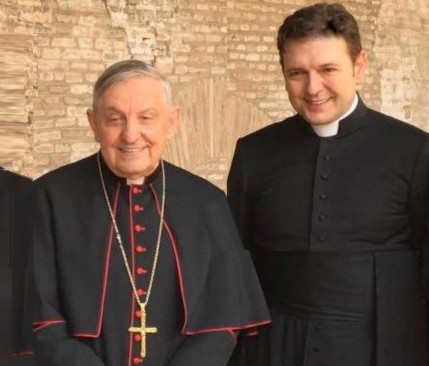
In the picture: S.E.R. Mons. Adriano Bernardini (13.08.1942 – †11.09.2025) and Father Ariel S. Levi di Gualdo, his private secretary (2017-2025)
They are fragments which reveal the emotion for the imminent detachment from the divine Master. Perhaps this is why the words of the newly proclaimed Gospel open up with an invitation of Jesus who becomes, In addition to being promised also Balsamo: “Your heart is not troubled. Have faith in God and have faith in me too. In the house of my Father there are many homes ".
With his words Jesus is making his departure and emptiness that leaves an opportunity for rebirth for his disciples. Asking for faith, He pushes them to transform the fear of the new and the terror of abandonment in the courage to give themselves, leaning on the Lord who promises to go to prepare a place for them. He lives his departure in relation to those who stay and show that he is not abandoning them, But a different phase of relationship with them is inaugurating. The detachment is in view of a new reception based on a precise promise: "I'll take you with me" (GV 14,2-3).

In a difficult circumstance like this it's nice to go back to the beginning, When the disciples, the future of the Apostle, they had the first contact with Jesus and asked him: "Rabbi, Maestro, where you live?». He told them: «Come and see».
"Staying" or "dwelling", "Coming" and "see" They are the verbs that especially in the Gospel of John describe the path of faith, The arrival of the disciple and the answer to Pietro's question: "Where are you going, where we can meet and find you again?». Jesus will say one day: “Stay in my love, how the branch remains in the vine, Because I observed the commandments of my Father and I remain in his love. That is the place where I live, I remain and live " (GV 15,9-10).
Here is the goal of the disciple for which it will not be necessary to wait for the transit of death, because it is here, Now, Available for everyone, Because Jesus got away. It is not a future reality that will prove to be beyond this life through death, hard pass for those who have to go beyond it and a painful legacy for those who have to live with memory, But it is a gift present for those who "believe in him" (GV 14,12).
It is therefore not even troubled our heart in the face of detachment, rather, let's get ready to recognize the place that each of us is responsible for the eternal home that awaits us. Similar in place of the beloved disciple who reclined his head on the chest of Jesus in the last dinner. He was placed in the breast of Jesus (GV 13,25), who, As the prologue Giovanneo says "he returned to his father's breast and opened the way" (GV 1,18), Now "he came his hour to go from this world to his father (GV 13,1) tells us: "Nobody comes to the Father except by means of me".

To try to propose the not easy reasons, but pursuable and feasible of the Holy Gospel, the Church has always used many means, including diplomacy. This is the apostolic nuncio: a bearer and announcer of the Holy Gospel called to create the Peace of Christ in the world. But let's try to depict everything with a concrete example: in October 1962 The world touched the third world war with the "Cuba crisis". By now the two interlocutors, Nikita Kruscev and John Fitzgerald Kennedy could no longer speak or treat, because neither was willing to take a step back. It was at that tragic moment that the Holy Pope John XXIII intervened that, good to remember, It was not properly that simple farmer who is affected in certain popular iconographies, it came from the world of diplomacy and had been a diplomat also refined, Especially in his mandate as an apostolic nuncio in France. The two interlocutors accepted the appeal both simultaneously and the missile heads on the course of Cuba returned back. A few months later, in April 1963, The Holy Pontiff published his encyclical Peace on Earth. The peace message of the Gospel prevailed thanks to pontifical diplomacy. Today, The books of contemporary history, They narrate that that diplomatic intervention saved humanity from the risk of a third world war.
Instead of reciting the litanies of its virtues I will mention one of its flaws, To demonstrate how a servant of the Church and the Papacy can change a defect by virtue through the three virtues of faith, hope and charity (cf.. The Cor 13, 1-13), who do not stand on emotions, worse on visceral ideologies, but on reason. Faith seeking understanding and by reverse understanding seeking faith, or: faith requires reason and by reverse the reason requires faith, As the father of the school classical Sant'Anselmo d’Aosta enunciated, in turn renovated at the thought of the Holy Father and Doctor of the Agostino Church Bishop of Hippona: I believe in order to understand and by reverse I understand that you can trust, or, I believe to understand, I understand to believe. Until to reach the Holy Pontiff John Paul II who summarized this relationship between reason and faith in the encyclical Faith and Reason, faith and reason.

Resolved by temperament, he was capable of becoming unwatchable. In the last months of life it has been weakened by the disease, but keeping its peculiar character. A day, During his last hospitalization in the Roman nursing home Villa del Rosario - where incidentally he was accurately cared for by doctors, from paramedics and nuns -, He began to consider just a wrong thing that could have been harmful to him. I said to him and, on the first ones, Almost angry, But I subsided him reminding him of the page of the Gospel in which the speech in which Jesus tells Pietro is told: "" In truth, I say to you: when you were younger, you used to dress yourself, and walked where you; but when you are old you will stretch out your hands, and someone else will dress you and lead you where you do not want ' (GV 21, 18). He smiled and replied ironic: that is fine, I will follow you, But try to take me where I want to go ".
People with a resolved character Christianity owes a lot, Just think of the passage of the acts of the apostles where it is told of the blessed apostle Paul who "discussed with the Greeks" (translation: argued with them); "But these tried to kill him" (translation: because they didn't stand it). «The Brothers, knowing it, They led him to Caesarea and from there they sent him to Tarsus " (translation: We try to save his life in the name of the newborn Christian charity). And in closing the diplomatic conclusion of this chronicle: «So the Church, Throughout Judea, at Galilea is at Samaria, he had peace " (which translated means: Luckily he left) (At 9, 29-31). but yet, What we owe to the resolute and not very angular character of the blessed apostle Paul?

I honored his will avoiding beatifications by means of epic tales and triumphal biographies, as sometimes it is used to the funeral, Things from him detestates, Also because none of us know the judgment of God, But we all know how big his reward is for his faithful servants, Because only the men of faith forged by the authentic virtues manage to change their apparent defects in precious service to the Church; and in this sense, From San Paolo to Sant’Agostino, The list of these extraordinary men is very long. To damage the Church are not the men made resolved by their strength of character, But those who don't know how to say yes when it is yes and no when it's no (See. Mt 5, 37); They are the weak proud of their veiled weakness of spiritualisms and mysticisms, unaware that we, in the following of Christ, We are called to be salt, no sugar land (cf.. Mt 5, 13-16). Indeed, When we were consecrated priests, we were not given a sweet thought, The consecrating bishop told us: "Understand what you do, imitate what you celebrate, conform your life to the mystery of the cross of Christ the Lord ". All based on the words of the divine master who warned us: “If someone wants to come behind me deny himself, Take his cross and follow me " (Mt 16, 24-25).
All this he tried to understand it, live it and transmit it through a particular way to announce and bring the Gospel: Ecclesiastical diplomacy at the service of the Church of Christ and the Apostolic See.
The source of true ecclesiastical diplomacy It is all enclosed on the lines, inside the lines and beyond the lines of the Gospel that, from century to century, until the return of Christ at the end of the time, will not cease to highlight our miseries and our human wealth, our limits and our sizes, our sins and our Christian virtues. And these days, Perhaps more than ever comes to say with the blessed apostle Paolo: «I fought the good fight, I finished my race, I kept faith " (II Tm 4,6). Because it is not easy to keep faith, Not even within that human society that is the visible Church, defined as "holy and sinner" by the Holy Bishop Ambrogio, followed centuries later by Cardinal Joseph Ratzinger who mediating in 2005 The ninth station of the Via Crucis complained: "How much dirt is in the church, and precisely also among those who, in the priesthood, they should belong completely to him!».

Who is this priest climbed on the pulpit To preach in memory of Adriano Bishop? I am a useless servant. As the Lord Jesus says in fact: “When you have done everything you have been ordered, said: “We are useless servants. We did what we had to do "" (LC 17, 10). What was my intimate relationship with him? I reply saying that in the Lucanian Gospel we speak of the great confidentiality of the Blessed Virgin Mary that "for her part, he took all these things by meditating in his heart " (LC 2, 19).
The apostle writes to the inhabitants of Corinth: "Where, death, your victory?» (The Cor 15, 55). Reflecting on this step at the end of his life, The Supreme Pontiff Benedict XVI commented: «I do not prepare in the end but to a meeting since death opens to life, to the eternal one, which is not an infinite duplication of the present time, But something completely new ".
Have a nice trip to the "new" good trip "in the eternal", Adriano Bishop, you did how much you had to do, like all of us "useless servants", I witness it as a child, friend and brother. Every 11 September, until I can physically, I will be in this place at the particular church of San Marino-Montefeltro, to which I belong as a presbyter - although it was not lived in Montefeltro but in Rome with you -, To celebrate in your birthplace, Today also your burial place, A Holy Mass for the immortal soul of the Father, of the friend and brother you have been for me.
Praised be Jesus Christ!
Santa Maria del Mutino, loc. Monastery of Piandimeleto, 15 September 2025
.
.
Funeral Mass for Apostolic Nuncio Adriano Bernardini. HOMILY DELIVERED BY FATHER ARIEL S. LEVI GUALDO
Diocese of San Marino-Montefeltro, Monastery Church of Piandimeleto, September 15, 2025, 3:00 PM. Esequial Mass for His Excellency Msgr. Adriano Bernardini, Holder Archbishop of Federi and Apostolic Nuncio.
— Ecclesial actuality —
.
Author
Ariel S. Levi di Gualdo
† Gospel of John (14, 1-6)
«”Do not let your hearts be troubled. You have faith in God; have faith also in me. In my Father’s house there are many dwelling places. If there were not, would I have told you that I am going to prepare a place for you? And if I go and prepare a place for you, I will come back again and take you to myself, so that where I am you also may be. Where [I] am going you know the way”. Thomas said to him, “Master, we do not know where you are going; how can we know the way?” Jesus said to him, “I am the way and the truth and the life. No one comes to the Father except through me”».
Venerable Bishops Dominic, shepard of this particular Church, and Andrew, Bishops emeritus, Brother friends, and all of you dearly beloved present here: «Grace to you and peace from God our Father and the Lord Jesus Christ!».
Receiving the sacred anointing of the sick on August 30, Adriano Bernardini, Holder Archbishop of Federi and Apostolic Nuncio, whispered to me the words of the Gospel of John: «Father, the hour has come» (Jn 17:1-2). For this reason, I chose to greet him with a homily taken from this Fourth Gospel, where the Apostle Peter asks Jesus: «Lord, where are you going? Jesus responds to Peter, who was not yet ready: “Where I am going, you cannot follow me now; you will follow me later”. He had said the same thing shortly before to all the disciples: “Where I am going, you cannot come”» (Jn 13:33-34).
These fragments reveal the emotion of the imminent separation from the Divine Master. Perhaps this is why the words of the Gospel just proclaimed open with an invitation from Jesus that becomes not only a promise but also a balm: «Do not let your hearts be troubled. Believe in God, believe also in me. In my Father’s house are many rooms».
With his words, Jesus is making his departure and the void it leaves an opportunity for rebirth for his disciples. By asking them for faith, he pushes them to transform their fear of the new and the terror of abandonment into the courage to give themselves, relying on the Lord who promises to go and prepare a place for them. He experiences his departure in relationship with those who remain and shows that he is not abandoning them, but is inaugurating a different phase of relationship with them. This separation is in preparation for a new welcome based on a specific promise: «I will take you to myself» (Jn 14:2-3).
In a difficult circumstance like this, it’s beautiful to return to the beginning, when the disciples, future apostles, first encountered Jesus and asked him: «Rabbi, Master, where are you staying?». He said to them: «Come and see».
«To remain» or «to abide», «to come» and «to see» are the verbs that, especially in the Gospel of John, describe the journey of faith, the disciple’s arrival, and the answer to Peter’s question: «Where are you going? Where can we meet you and find you again?» Jesus will one day say: «Remain in my love, as the branch remains in the vine, for I have kept my Father’s commandments and remain in his love. There is my dwelling place, where I remain and dwell» (Jn 15:9-10).
This is the disciple’s goal, for which there is no need to wait for the passing of death, because it is here, now, available to all, because Jesus has become the way. It is not a future reality that will be revealed beyond this life through death, a difficult passage for those who must cross it and a painful legacy for those who will have to live with the memory, but it is a present gift for those who «believe in him» (Jn 14:12).
Let not our hearts, then, be troubled by separation; rather, let us prepare ourselves from now to recognize the place that belongs to each of us in the eternal home that awaits us. Similar to the place of the beloved disciple who leaned his head on Jesus’ chest at the Last Supper. He was reclining in Jesus’ bosom (Jn 13:25), who, as the John prologue says, «has returned to the bosom of the Father and has opened the way» (Jn 1:18), now «when his hour has come to pass from this world to the Father» (Jn 13:1), he tells us: «No one comes to the Father except through me».
To try to propose the difficult, yet attainable and achievable, reasons for the Holy Gospel, the Church has always used many means, including diplomacy. This is the Apostolic Nuncio: a bearer and proclaimer of the Holy Gospel called to establish the Peace of Christ in the world. But let’s try to illustrate this with a concrete example: in October 1962, the world came close to World War III with the “Cuban crisis”. By then, the two interlocutors, Nikita Khrushchev and John Fitzgerald Kennedy, could no longer speak or negotiate, because neither was willing to take a step back. It was at that tragic moment that the Holy Pontiff John XXIII intervened. It is worth remembering that he was not exactly the simpleton depicted in certain popular iconography; he came from the world of diplomacy and had been a refined diplomat, especially during his tenure as Apostolic Nuncio to France. Both sides simultaneously accepted the appeal, and the missile warheads headed toward Cuba were turned back. A few months later, in April 1963, the Holy Pontiff published his encyclical Pacem in Terris. The Gospel’s message of peace prevailed thanks to papal diplomacy. Today, contemporary history books tell us that this diplomatic intervention saved humanity from the risk of a Third World War.
Rather than reciting the litany of his virtues, I will mention one of his defects, to demonstrate how a servant of the Church and the Papacy can transform a defect into a virtue through the three virtues of faith, hope, and charity (cf. 1 Color 13:1-13), which are not based on emotions, or worse, on visceral ideologies, but on reason. Faith seeking understanding and and vice versa understanding seeking faith, or faith requires reason, and conversely, reason requires faith, as the father of classical scholasticism, Saint Anselm of Aosta, stated, in turn drawing on the thought of the Holy Father and Doctor of the Church, Augustine, Bishop of Hippo: I believe in order to understand and vice versa I understand that you can trust, or I believe in order to understand, I understand in order to believe. This culminated in the Holy Pontiff John Paul II, who summarized this relationship between reason and faith in the encyclical Faith and Reason, Faith and Reason.
Resolute by temperament, he was capable of becoming immovable. In the last months of his life, he was weakened by illness, but retained his peculiar character. One day, during his final stay at the Roman nursing home Villa del Rosario — where, incidentally, he was excellently cared for by doctors, paramedics, and nuns — he began to consider a wrong thing that could have been harmful to him as right. I told him this, and at first he almost became angry, but I calmed him by reminding him of the Gospel passage recounting Jesus speech to Peter: «Truly, truly, I say to you, when you were younger, you girded yourself and walked where you wished; but when you grow old, you will stretch out your hands, and another will gird you and carry you where you do not wish to go» (Jn 21:18). He smiled and replied ironically: «All right, I will follow you, but try to take me where I want to go».
Christianity owes much to people of resolute character. Just think of the passage in the Acts of the Apostles where the Blessed Apostle Paul is described as «arguing with the Greeks» (translation: he argued with them); «but they sought to kill him» (translation: because they could not stand him). «When the brothers learned of this, they took him to Caesarea, and from there they sent him to Tarsus» (translation: we tried to save his life in the name of the nascent Christian charity). And finally, the diplomatic conclusion to this chronicle: «So the church throughout all Judea, Galilee, and Samaria had peace» (which translated means: thank goodness he left) (Acts 9:29-31). And yet, how much do we owe to the resolute and not a little rough-edged character of the Blessed Apostle Paul?
I have honored his will by avoiding beatifications through epic tales and triumphal biographies, as is sometimes customary at funerals, things he detested, also because none of us know God’s judgment, but we all know how great his reward is for his faithful servants, because only men of faith forged by authentic virtues are able to transform even their apparent defects into precious service to the Church; and in this sense, from Saint Paul to Saint Augustine, the list of these extraordinary men is very long. Those who harm the Church are not men made resolute by their strength of character, but those who cannot say yes when it is yes and no when it is no (cf. Mt 5:37); they are the weak, proud of their own weakness veiled in spiritualism and mysticism, unaware that we, in following Christ, are called to be the salt, not the sugar, of the earth (cf. Mt 5:13-16). In fact, when we were consecrated priests, we weren’t given a sentimental thought; the consecrating Bishop told us: «Realize what you will do, imitate what you will celebrate, conform your life to the mystery of the cross of Christ the Lord». All of this was based on the words of the Divine Master who admonished us: «If anyone would come after me, let him deny himself, take up his cross, and follow me» (Mt 16:24-25).
He sought to understand, live, and transmit all of this through a particular way of announcing and bringing the Gospel: ecclesiastical diplomacy in the service of the Church of Christ and the Apostolic See.
The source of true ecclesiastical diplomacy lies entirely inside and beyond the written lines of the Gospel, which, from century to century, until Christ’s return at the end of time, will never cease to highlight our human miseries and riches, our limitations and our greatness, our sins and our Christian virtues. And in these times, perhaps more than ever, we can say with the Blessed Apostle Paul: «have competed well; I have finished the race;f I have kept the faith» (2 Tim 4:7). Because it is not easy to maintain the faith, not even within that human society which is the visible Church, defined as “holy and sinful” by the Holy Bishop Ambrose, followed centuries later by Cardinal Joseph Ratzinger who, meditating on the ninth station of the Way of the Cross in 2005, lamented: «How much filth there is in the Church, and even among those who, in the priesthood, should belong completely to him!»
Who is this priest who ascended the pulpit to preach in memory of Bishop Hadrian? I am an unprofitable servant. As the Lord Jesus says: «When you have done all that you were commanded, say, “So should it be with you. When you have done all you have been commanded, say, “We are unprofitable servants; we have done what we were obliged to do”» (Page 17:10). What was my intimate relationship with him? I answer by saying that the Gospel of Luke speaks of the great reserve of the Blessed Virgin Mary, who «And Mary kept all these things, reflecting on them in her heart» (Page 2:19).
The Apostle writes to the people of Corinth: « Where, O death, is your victory?» (1 Color 15:55). Reflecting on this passage at the end of his life, the Roman Pontiff Benedict XVI commented: «I am not preparing for the end but for an encounter, since death opens the way to life, to eternal life, which is not an infinite duplicate of the present time, but something completely new».
Have a good journey into the «new» world, and a good journey into the «eternal», Bishop Adriano. You have done what you had to do, like all of us «unprofitable servants». I bear witness to this as a son, friend, and brother. Every September 11th, as long as I am physically able, I will come to this place, to the particular Church of San Marino-Montefeltro, to which I belong as a priest — although I did not live in Montefeltro but in Rome with you — to celebrate in your birthplace, now also your burial place, a Holy Mass for the immortal soul of the father, friend, and brother you were to me.
Praised be Jesus Christ!
Santa Maria del Mutino, Monastery of Piandimeleto, 15 September 2025
.
.
Funeral funerals of the Apostolic Nuncio Adriano Bernardini. Homily pronounced by Father Ariel S. LEVI GUALDO
Diócesis de San Marino-Montefeltro, PIANDIMELETO MONASTERIO CHURCH, 15 September of 2025. Funeral Exequises of S.E. Mons. Adriano Bernardini, Archbishop holder of Fallei and Apostolic Nuncio.
- Ecclesial news -
.
Author
Ariel S. Levi di Gualdo
.
† From the Gospel according to John (14, 1-6)
«At that time, Jesus said to his disciples: “Do not worry. They believe in God and also create in me. In my father's house there are many rooms; If so, I would have told you. I'm going to prepare a place. And when I went and prepared a place, I will return again to take them with me, so that where I am, You are too. They already know the path of the place where I'm going”. Tomás told him: “Señor, We do not know where you go. How are we going to know the way?”.Jesus replied: “I am the way, The truth and life. No one goes to the father, but for me”».
.
Venerable Bishops Domenico, pastor of this Particular church and Andrea emeritus, Cohermans priests, friends and all estimated present: "Grace and peace to you from God our Father and the Lord Jesus Christ".
Receiving the 30 August the anointing of the sick Adriano Bernardini, Archbishop holder of Fallei and Apostolic Nuncio, I was whispered by the words of the Gospel of John: "Dad, The time has come » (Jn 17, 1-2). That is why I have chosen to fire him with a homily extracted from this fourth gospel, where the apostle Peter asks Jesus: «Señor, Where are you going?». Jesus responds to Peter that he was not yet prepared: «Where I go, You can't follow me now; You will follow me later ». The same had said shortly before all the disciples: «Where I go, You can't come » (Jn 13, 33-34)
They are fragments that reveal the emotion for the imminent separation of the divine teacher. Perhaps that is why the words of the newly proclaimed Gospel open with an invitation from Jesus that becomes, In addition to promise, In balm: «Your heart is not turned. HAVE FAITH IN GOD AND HAVE FAITH IN ME. In my father's house there are many dwellings ».
With his words Jesus is doing his departure and the vacuum that leaves an occasion of rebirth for his disciples. Asking for faith, It drives them to transform fear towards the new and terror to abandonment into value to surrender, leaning on the Lord who promises to prepare a place for them. He lives his departure in relation to who stays and shows that he is not leaving him, but it is inaugurating a different phase of relationship with them. The separation is in view of a new reception based on a precise promise: "I'll take you with me" (Jn 14, 2-3).
In a difficult circumstance like this It is good to return to the beginning, When the disciples, future apostles, They had the first contact with Jesus and asked him: "Rabbi, Maestro, Where Moras?». He told them: "Come and you will see".
"Stay" the "living", "Come" and "see" They are the verbs that above all in the Gospel of John describe the path of faith, The arrival of the disciple and the answer to Pedro's question: «Where are you going, Where can we find and find you again?». Jesus will say one day: «Remove in my love, As the Sarmiento remains in the vine, Because I have kept my father's commandments and remain in his love. That is the place where I live, I remain and Moor » (Jn 15, 9-10).
Here is the goal of the disciple for which there is no need to wait for the transit of death, Because it's here, now, Available for everyone, Because Jesus has made his way. It is not a future reality that will be revealed beyond this life through death, A difficult step for those who must carry it and a painful legacy for those who must live with the memory, but a present gift for those who "believe in him" (Jn 14, 12).
That is not disturbed our heart before the separation, but let's prepare from now on to recognize the place that corresponds to each of us in the eternal abode that awaits us. Which is similar to the place of the beloved disciple who reclined his head in Jesus's chest at the last dinner. This was reclined in Jesus' bosom (Jn 13, 25), which, As the Joan prologue says "he has returned to the father's bosom and opened the way" (Jn 1,18), Now «having arrived his time to move from this world to the father (Jn 13, 1) He tells us: "No one goes to the father but for me".
To try to propose the reasons not easy, But attainable and realizable of the Holy Gospel, The Church is always served as many media, including diplomacy. This is the Apostolic Nuncio: a bearer and announcer of the Holy Gospel called to make the Peace of Christ In the world. But let's try to represent all this with a specific example: In October of 1962 The world touched the third world war with the "crisis of Cuba". Already the two interlocutors, Nikita Jrushchov and John Fitzgerald Kennedy could not speak or negotiate, Because neither was willing to step back. It was at that tragic moment when the Holy Pontiff John XXIII intervened that, It is good to remember it, It was not properly that simple peasant represented in certain popular iconographies. He came from the world of diplomacy and had been a refined diplomat, especially in its function as Apostolic Nuncio in France. The two interlocutors welcomed the call simultaneously and the missile heads en route to Cuba. A few months later, In April of 1963, The Holy Pontiff published his encyclical Peace on Earth. The peace message of the Gospel prevailed thanks to the pontifical diplomacy. Hoy, Contemporary history books tell that this diplomatic intervention saved humanity from the risk of a third world war.
Instead of reciting the litanies of the virtues I will refer to a defect of yours, To demonstrate how a server of the Church and the papacy can mutate a defect under the three virtues of faith, hope and charity (cf.. The Cor 13, 1-13), which do not support emotions, or worse about visceral ideologies, but about reason. Faith seeking understanding and conversely understanding seeking faith, that is to say: Faith requires reason and inversely reason requires faith, As the father of the classic scholasticic San Anselmo de Aosta stated in turn to the thought of the Holy Father and Doctor of the Agustín Bishop's Church of Hipona: I believe in order to understand and conversely I understand that you can trust, I mean, I think to understand, I understand to believe. And finally, the Holy Pontiff John Paul is reached that summarized this relationship between reason and faith in the encyclical Faith and Reason, Faith and reason.
Decided by temperament, was able to become immovable. In recent months of life it was weakened by the disease, But it retained its peculiar character. One day, During his last stay at the house of Cura Romana Villa del Rosario - where, by the way, He was treated excellently by doctors, paramedics and religious -, It began to consider correct a wrong thing that could have been harmful to him. I told him and, at first, He almost got angry, But I calmed him by reminding him of the Gospel page in which the speech in which Jesus says to Peter is narrated: ""Actually, I really tell you: When you were younger, You gave up and you were where you wanted; But when you are old, You will extend your hands, And another will stick to you and take you wherever you want ”» (Jn 21, 18). Smiled and replied ironic: Alright, I will follow you, But try to take me where I want to go ».
To people of a determined nature, Christianity must a lot, It is enough to think about the passage of the Acts of the Apostles where it is told that the Blessed Apostle Paul "argued with the Greeks" (translation: He rejected with them); "But these sought to kill him" (translation: because they didn't support him). «The brothers, Knowing it, They led him to Cesarea and from there they sent him to Tarso » (translation: Let's try to save his life on behalf of the nascent Christian charity). And at the end of the diplomatic conclusion of this chronaca: «Thus the Church, all over, Gather was the Samaritan, had peace » (which translated means: Luckily he left) (Hch 9, 29-31). And yet, How much should we owe to the determined and not little spiny character of the Blessed Apostle Paul?
I have honored his will avoiding beatifications through epic stories and triumphal biographies, as sometimes it is usually done in funerals, things held by him, Also because none of us know God's judgment, But we all know how big is his reward for his faithful servants, because only the men of faith forged by the authentic virtues manage to mutate in precious service for the Church even their apparent defects; And in that sense, From San Pablo to San Agustín, The list of these extraordinary men is very long. It is not the men determined by their strength of nature that damage the Church, but those who do not know how to say when it is yes and not when it is not (See. Mt 5, 37); They are proud of their evening weakness in spiritualisms and mysticisms, unconscious that we, In the sequel of Christ, We have been called to be salt and not the sugar of the earth (cf.. Mt 5, 13-16). In fact, When we were consecrated priests, we were not given an cloy, The consecrating bishop told us: «Realize what you will do, imitates what you will celebrate, Conform your life to the mystery of the Cross of Christ Lord ». All this, based on the words of the divine teacher who has warned us: «If anyone wants to come after me, Note yourself, Take your cross and follow me » (Mt 16, 24-25).
All this he has sought to understand it, live and transmit it through a particular way of announcing and carrying the gospel: Ecclesiastical diplomacy at the service of the Church of Christ and the Apostolic Headquarters.
The source of true ecclesiastical diplomacy All contained in the lines, within the lines and beyond the lines of the Gospel that, from century to century, Until the return of Christ at the end of time, It will not cease to highlight our miseries and our human wealth, our limits and our greatness, our sins and our Christian virtues. And in these times, Maybe more than ever, We can say with the Blessed Apostle Paul: «I have fought the good combat, I've finished my career, I have kept faith » (2 Tim 4, 6). Because it is not easy to conserve faith, Not even within that human society that is the visible church, defined "holy and sinner" by the Holy Bishop Ambrosio, Or centuries later, by Cardinal Joseph Ratzinger who meditating on 2005 The ninth station of Crucis lamented: «How much dirt is in church, and precisely among those who, In the priesthood, They should belong completely!».
Who is this priest uploaded to the pulpit to preach in memory of Adriano Bishop? I am a useless servant. As the Lord Jesus says in fact: «“ When you have done everything that has been sent to you, DECIDED: “We are useless servants. We have done what we should do ”” » (LC 17, 10). What was my intimate relationship with him? I respond by saying that in the Lucan gospel there is talk of the Gran Reserva of the Blessed Virgin Mary who «for her part, He kept all these things by meditating them in his heart » (LC 2, 19).
The Apostle writes to the inhabitants of Corinth: "Where is, oh death, Your victory?» (The Cor 15, 55). Reflecting on this step at the end of your life, The high pontiff Benedict XVI commented: «I do not prepare for the end but for an encounter because death opens to life, to eternal life, which is not an infinite duplicate of the present time, but something completely new ».
Good trip to the "new" good trip "to the eternal", Adriano Obispo, You have done how much you should do, Like all of us "useless servants", I am witness as a child, Friend and brother. Each 11 September, While physically possible to me, I will come to this place under the jurisdiction of the particular church of San Marino-Montefeltro, to which I belong as a presbyter - although I have not lived in Montefeltro but in Rome with you -, To celebrate in your native place, Already today your burial place, A Holy Mass for the immortal soul of the Father, of the friend and brother that you have been for me.
Praise be Jesus Christ!
Santa Maria del Mutino, Monastery of Piandimeleto, 15 September 2025
.
.
______________________
Dear Readers, this magazine requires management costs that we have always faced only with your free offers. Those who wish to support our apostolic work can send us their contribution through the convenient and safe way PayPal by clicking below:
Or if you prefer you can use our Bank account in the name of:
Editions The island of Patmos
n Agency. 59 From Rome – Vatican
Iban code: IT74R0503403259000000301118
For international bank transfers:
Codice SWIFT: BAPPIT21D21
If you make a bank transfer, send an email to the editorial staff,
the bank does not provide your email and we will not be able to send you a thank you message: isoladipatmos@gmail.com
We thank you for the support you wish to offer to our apostolic service.
The Fathers of the Island of Patmos
.
.
.
.
.
.
.
.
.
Paying your own pocket to work for free is a privilege that only a few “elected” can afford
PAYING OUT OF YOUR OWN POCKET TO WORK FOR FREE IS A PRIVILEGE THAT ONLY A “SELECTED” FEW CAN AFFORD THEMSELVES
In his work Nature Tito Lucrezio Caro criticizes religion, indicating it as a source that generates fear, superstition and suffering, preventing man from reaching true happiness, or to that knowledge of the truth - as the Blessed Apostle John states - which will make us free. A concept that Karl Marx referred to with the famous aphorism "religion is the opium of the people". They were both right, Tito Lucrezio Caro and Karl Marx …
- Actuality -
.
Author
Ariel S. Levi di Gualdo
.
.
It hurts to indulge in jeremiads, especially when you are aware that they are of no use, only to express understandable discomfort as an end in itself.

In October of 2024 this magazine of ours has accomplished 10 years of activity, during which it offered services that may be more or less shareable in terms of content and settings, but of undoubted quality, something recognized even by our adversaries and those who do not think like us.
In a Catholic world increasingly devastated by fideism, from forms of millenarianism with an esoteric flavour, polluted in the present by all the old returning heresies, the Fathers of the Island of Patmos have always offered a service based on the closest respect to the deposit of faith, to the doctrine and magisterium of the Church, fighting dangerous drifts when necessary and recovering over the years quite a few people who had lost their way in the wake of various charlatans who today abound disproportionately, especially thanks to social media.
A complex pontificate ended a few months ago complicated by a very delicate global geopolitical context, the judgment on which will be up to history, which will only be able to give it in the future, perhaps even in many years. A pontificate during which several people, already immature and fragile in their faith, they went totally astray by marching behind priests who were out of balance, ended up suspended peep, excommunicated or even dismissed from the clerical state, followed, in turn, by laymen without art or part who improvised as ecclesiologists, canonists and theologians in a tantalizing Dan Brown-style conspiracy sauce of noartri. Our over ten-year pastoral mission on the Island of Patmos has focused mainly on the call to unity with Peter and under Peter, regardless of the obvious defects of the man Jorge Mario Bergoglio, without forgetting that in various respects, that rough Galilean fisherman chosen by Christ himself, not elected by a conclave of cardinals, in his time he turned out to be much worse than many problematic pontiffs in history, both on a pastoral and doctrinal level, just think of when he denied Christ by swearing and cursing (cf.. Mt 26, 69-75) or when in Antioch he was reprimanded by Paul on issues related to the doctrine of the faith (cf.. Gal 2, 11-21)
Given that in life nothing is owed, that everything must be deserved and that everything is a grace, it must be said, however, that the lack of generosity on the part of people - starting from the many to whom we have done good -, leads us to take note that the pastoral work carried out by 2014 by a group of priests and theologians perhaps does not deserve to be supported. For this reason, the numerous people that the Fathers of The Island of Patmos have helped and supported over the years arouse particular bitterness in us - and it is difficult to deny our priestly discomfort in this sense., healing their sore wounds after they had been deceived by “holy men”, “santuzze” and “seers”, before whom they did not hesitate to open their wallets as if they were accordions, the same ones who instead remained hermetically sealed before our work to which they never paid a single euro.
There is little to be surprised about, we know how what was once called the common people usually acts, he already knew it Giovanni Boccaccio when in the distant 14th century he immortalized in Decameron the paradigmatic Novella 10 dedicated to Friar Cipolla. Just intoxicate him, the populace, with the guarantee of the true "secret" of Fatima finally revealed after having been kept hidden by the lying and lying Church; or get him drunk with the "ten secrets" that a talkative and repetitive Gospa, now suffering from evident senile dementia, would have given it to a group of clever Bosnian gypsies who, thanks to this great scam of the twentieth century, made their guts out of gold; or drug him with some Madonna who stamps her feet like a hysterical narcissist while sending word to some other starstruck visionary that she wants to be proclaimed co-redeemer at all costs and who also peddles "secrets" around the globe, waiting for the magical and definitive triumph of her immaculate heart. Well yes, we give these kinds of opiates to the populace and their wallets open as if by magic. This is what happened in Boccaccio's Certaldo in the 14th century and this is what happens today in the Third Millennium.
In his work Nature Tito Lucrezio Caro addresses a criticism of religion, indicating it as a source that generates fear, superstition and suffering, preventing man from reaching true happiness, or to that knowledge of the truth - as the Blessed Apostle John states - which will make us free (cf.. GV 8, 32). A concept to which he will refer again Karl Marx with the famous aphorism "religion is the opium of the people". They were both right, Tito Lucrezio Caro and Karl Marx, However, both the concept and the term were wrong, confusing faith with the fideism of the Boeotians following Brother Cipolla, which have nothing to do with the purity of faith, vilified by them and transformed into a grotesque parody of talking madonnas, weeping Madonnas, secrets revealed, catastrophic prophecies and so on to follow.
We have reached the conclusion, sad but realistic, that ultimately these people deserve the various Cipolla Friars capable of arousing morbid itches in them, making money come out of him like the charmers make the snake come out of the basket at the sound of the hypnotic sting.
The paradox is that The Island of Patmos is not a failure, quite the opposite: it is an extraordinary and at times incredible success. The volume of visits amounts to an average of over three million per month, the year 2024 it closed with almost forty million total visits. Soon said: I just know 0,1% of these visitors had donated one euro to us, management costs would be fully covered and we would even have some left over for some charity work.
Anyone who understands only a little about certain technical aspects, with a few glances you immediately grasp the quality of the site that hosts our magazine, starting from the graphics. Offer printable versions of articles, audio reading, often also the translation of the same into three languages, involves considerable editorial work, all carried out by the Fathers purely free of charge. Of course, It is surprising that in the course of a calendar year it is not possible to collect even half of what is necessary to pay the living expenses of management and that we must promptly take care of it out of our own pocket when the payment deadlines arrive. Why use your personal resources to have the rare privilege of working for free for people who take and don't give, or that after having given to the crafty snake charmers, once the sound of the pipe ends and with it the hypnotic effect they come to cry to us to be helped and supported, It's really a great satisfaction, rather: It's truly a privilege, work free the amor Dei for these people! But we are priests and how much would the desire be, put these people out the door, as they deserve, it is against our priestly ontological nature.
The Island of Patmos is concluding its eleventh year of activity without ever having experienced declines but only a continuous increase, this is proven by the high number of visits starting from 2016 forced us to move the site to a dedicated-server, which constitutes the largest annual expense item followed by other expenses for the various subscriptions such as the purchase of graphics programs, audio, video, security systems… In short, we are talking about something that works and works very well, but who does not have the means of subsistence. This is why we decided to give ourselves another year: if in September of 2026 we will not have collected everything necessary to support the expenses of the following year 2027, or if we cannot find a public or private body willing to finance us, we will conclude our happy and fruitful experience of apostolate by closing the magazine The Island of Patmos, always preserving the indelible memory of this beautiful experience lived in the Catholic union of intent in full communion between a group of priests who tried to bear witness to the living and true Christ. However, as the Blessed Apostle Paul teaches in his epistle to his disciple Timothy:
«The day will come, indeed, when they will not endure sound doctrine;, ma, having itching ears they, will accumulate for themselves teachers to suit their own likings, refusing to listen to the truth to turn to fairy tales. But you shall carefully, endure suffering, do the work of an evangelist, fulfill your ministry " (II Tm 4, 1-4).
And that day has come today, Unfortunately, we believe we too have suffered a sad expense. But, also in this case, the Holy Gospel teaches us:
«If anyone does not welcome you and will not listen to your words, leave that house or town and shake the dust off your feet '.
From the island of Patmos 31 August 2025
.
______________________
Dear Readers, this magazine requires management costs that we have always faced only with your free offers. Those who wish to support our apostolic work can send us their contribution through the convenient and safe way PayPal by clicking below:
Or if you prefer you can use our Bank account in the name of:
Editions The island of Patmos
n Agency. 59 From Rome – Vatican
Iban code: IT74R0503403259000000301118
For international bank transfers:
Codice SWIFT: BAPPIT21D21
If you make a bank transfer, send an email to the editorial staff,
the bank does not provide your email and we will not be able to send you a thank you message: isoladipatmos@gmail.com
We thank you for the support you wish to offer to our apostolic service.
The Fathers of the Island of Patmos
.
.
.
.
.
.
.
.
.
Carlo Acutis, the Eucharist. Sometimes having crickets for the head is sterile and dangerous
Carlo acute, The Eucharist. SOMETIMES HAVING CRICKETS FOR YOUR HEAD IS STERILE AND DANGEROUS
We have heard prophetic words, who are not only addressed to information professionals, But to each of us. Because everyone, today, we communicate. We do it in the family, at work, sui social, in communities. And every word, each image, every silence... is a fragment of culture, it is a choice of peace or conflict. The Pope told us that «peace begins with how we look, let's listen, let's talk about others".
Author:
Gabriele Giordano M. Scardocci, o.p.
.
.
The canonization of new saints it is always a moment of gift for the Church. For new figures who are models and intercessions for us who remain. Also to focus on some themes that those same saints explored and experienced in their lives.

Pope Leo, confirming the path taken so far by Pope Francis, confirmed the canonization of two saints: Carlo Acutis and Piergiorgio Frassati for the next one 7 September. If therefore in front of the new canonizations, a minimum of debate and reflection are always understandable, and indeed desirable even in a more theological speculative line, some exasperations on the theological and doctrinal assumptions of the saints themselves can be dangerous and sterile if not downright cloying.
The impression that, it seems to me, there is some recent writing behind it is not to enhance the work of a saint, which if as known, by faith, in itself we are obviously not asked to welcome it as the fourth person of the Trinity, however, we are not even asked to use it as a picklock to dismantle a classic vision of Eucharistic theology. This is the case of a recent article by Prof. Andrea Grillo on the Eucharistic theology of Carlo Acutis. An article that does not seem to fully capture the saint's potential. Let's now understand it one step at a time. First of all, let's focus on Carlo Acutis.
Carlo acute: A SAINT OF THE INTERNET OF THINGS[1]
Carlo Acutis, born in London in 1991 and moved to Milan shortly after, he is a figure venerated by the Catholic Church, known for his early and deep faith. His biography reveals a short but intense life, characterized by an extraordinary devotion and an exceptional talent for information technology, which he put at the service of his spirituality. Since I was a child, Acutis showed a notable inclination towards faith. This innate devotion led him to ardently desire to receive his First Communion, which was granted to him in advance, at the age of seven. From that moment, daily Mass, Eucharistic adoration and the rosary became pillars of his day. He attended schools with the Marcelline Sisters and subsequently the Leo XIII Institute, distinguishing himself as a bright and sociable student. Parallel to his studies, Acutis developed a notable passion for information technology, becoming self-taught and earning the nickname of “computer genius”. This skill was not a mere feat for him hobby, but an instrument of evangelization. At just fourteen years old, created a website dedicated to cataloging the Eucharistic miracles recognized by the Church, a work that became an instrument of evangelization worldwide, attracting the attention of numerous faithful. His objective was to make known the real presence of Jesus in the Eucharist, spreading the faith through new technologies.
Despite his profound spirituality, He was acutely ill when he was young, who loved playing football, playing video games and spending time with friends. His charity was a distinctive trait: he used his savings to help the homeless and dedicated his time as a volunteer in soup kitchens. He was also a point of reference for his classmates, helping them with their studies and offering support to those facing bullying or family difficulties.
In October of 2006, Acutis' life was abruptly ended from a diagnosis of fulminant leukemia. He faced his illness with surprising serenity, offering his sufferings for the Pope and for the Church. He died on 12 October 2006, at the age of 15 year old. His reputation for sanctity spread rapidly, leading to the opening of his beatification process in 2013. Pope Francis declared him Venerable in 2018 It is in the 2020 he recognized a miracle attributed to him, paving the way for his beatification, occurred on 10 October 2020 to Assist. His body is preserved and exposed for veneration in Assisi.
Carlo Acutis is today considered a model of holiness for young people in the digital age, often called “God's influencer” or “the cyber-apostle of the Eucharist”, for its ability to combine faith and technology.
Being personally linked to the digital preaching apostolate, I believe that this propensity for spreading the faith on the internet is one of the points of light, where all young people can take model and inspiration, to become "digital cyber preachers", without becoming bigots or extremists.
AN EXCESSIVE SKIRMISH
Professor Andrea Grillo, in his article The young Carlo Acutis and Eucharistic rudeness [2], offers a critical examination of the theological interpretation of the Eucharist conveyed by the figure of Blessed Carlo Acutis, with particular attention to the insistence on the so-called "Eucharistic miracles". Ask Grillo if you ask him to come to you, a "super-communicator", may have been oriented towards such a "distorted" and "one-sided" understanding of the Eucharist, focused on "miracles" rather than on the genuine ecclesial value of the sacrament.
The Professor carefully examines the official website of the Carlo Acutis Association, in particular the section dedicated to Eucharistic miracles, and critically analyzes the introductory texts written by Cardinal Angelo Comastri, by Monsignor Raffaello Martinelli and the Dominican father Roberto Coggi, who was also my teacher of natural philosophy during the years of my education in Bologna. Grillo defines these texts as «old … heavy … obsessive", suggesting that they embody a "bad theology" imposed on Acutis by "bad teachers". He highlights inconsistencies and outdated theological views in their writings, like the defensive preface by Cardinal Angelo Comastri, the justification of miracles as “occasions” to address other topics by Monsignor Paolo Martinelli, and Father Roberto Coggi's old-fashioned understanding of the words of consecration. The Professor argues that this emphasis on physical miracles distracts attention from the "true" and”unique" Eucharistic miracle, which resides in ecclesial communion and in the unity between the sacramental body and the ecclesial body. The "Eucharistic rudeness", concludes Grillo, it is not attributable to the young Carlo Acutis, but rather to the adults who promoted these unbalanced interpretations, finally proposing one “distorted fixation on Eucharistic miracles” as a role model for young people.
HAVING CRICKETS IN YOUR HEAD
If on the one hand I concede that excessive attention to Eucharistic miracles "carried by adults" in a devotionalistic and almost "eucharistolatric" way risks not understanding the true meaning of Adoration in Jesus Christ present in the body, blood, soul and divinity and also in the Eucharist as communion of the new people of God [3], it seems to us that the professor's focus is not on dismantling a false Eucharistic devotion, ma, as for the opposite, to minimize to the point of almost describing as obsolete the conception of the substantial presence of Christ in the Eucharistic species. Although this is not explicitly said, the the way things are seems excessive. If you really wanted to hit only a "eucharistolatric" tendency, I personally think it is more right to also exalt the passages of goodness of Acutis himself and his desire to commune in Christ also via the internet. Skipping over the reference to the next saint, every reference seems to be designed to attack the doctrine of the real presence, without doctrinally valid reasons.
So jokingly, compared to the professor's positions, I wrote some time ago that this propensity to use Carlo Acutis as a picklock to unhinge "the closed ones left at the Tridentine Council" or as a springboard to skip all the beauty of the reflection on Eucharistic contemplation, this propensity is like having crickets in your head. Three jumps — long, exaggerated and out of focus — of a cricket which I think goes a bit’ resettled. We will now try to answer promptly, documents in hand, to the positions of the Professor.
"Old" and "out of fashion" Eucharist? The truth about the Eucharist as a real presence has no age and cannot be "out of fashion" as Coke Zero will probably become in fifteen years. The doctrine of the Real Presence of Jesus in the Blessed Sacrament is the heart of our faith and an immutable pillar, not a passing "fad".. The Council of Trent solemnly affirmed that Christ is «truly, truly and substantially" present in the Eucharist [4]. The Second Vatican Council, far from denying this truth, he explored it further, urging us to participate more fully and consciously in the Eucharistic Sacrifice [5] .Carlo Acutis, with his life, it simply tempted us to remind ourselves of the beauty and power of this eternal truth, demonstrating that it can inflame the hearts of every generation. He tried to make digital and virtual communion starting from real communion with the Eucharistic Christ. If the Eucharist is truly "the source and summit of all Christian life" [6] then it is not at all inessential, but the center of everything.
Eucharistic Miracles vs. the «True Miracle»? Eucharistic miracles recognized by the Church, although they are not "objects of faith" like dogmas, they can be a great help to our faith. Monsignor Raffaello Martinelli, in one of the texts that presents Carlo's exhibition, explains that they can "constitute a useful and fruitful aid to our faith". They are extraordinary signs that God, in His infinite wisdom, offers us to strengthen our adherence to the Mystery. Saint Thomas Aquinas himself explained how the properties of flesh and blood are substantially expressed in the Eucharistic species, even if this property inheres in God by a miracle [7]. This reminder is truly necessary for us who could not worship those properties in the glorious body of Christ, because they were born centuries and millennia after the presence of the Incarnate Word on earth. These phenomena do not eliminate the true miracle of Transubstantiation, but they can help highlight it visibly, leading many to a deeper faith in the Real Presence. Carlo Acutis did not "neglect" the true miracle, but he used these signs to lead others to the heart of that Mystery which for him was "my highway to Heaven".
“Eucharistic rudeness” and "bad teachers"? These propositions of the Professor seem imprudent to us. No theological article authorizes us to process the intentions of other theologians. Father Roberto Coggi, Monsignor Paolo Martinelli and Cardinal Angelo Comastri seem almost described as bad teachers, bearers of an obsolete and stale theology, that, as described, it seems almost distant from Catholic doctrine. We don't think this is the case. Let's read together what the Church tells us. The words of consecration, as the Catechism teaches us (n. 1353), they have their fulcrum in the words of Christ: «This is my Body… This is my Blood…». The Missal reformed in 1970 he took up this formula by translating it from Latin: and in fact he thus proved the essential words that operate the Sacrament remain those instituted by the Lord. How all this can fall into the category of "rudeness" or "fantasy", or bad workmanship, It completely escapes me. None of the authors mentioned above, Furthermore, has never denied the importance of the Eucharist as the Communion of the New People of God, and in particular Father Coggi, in his beautiful book The church, fruit of his meditations on Radio Maria, writes;
«The Church is not presented by the Council only as the mystical Body of Christ, but also as the new People of God. On the contrary, it can be said that the Council particularly emphasized this aspect of the Church, that is, the Church is the People of God. This is demonstrated by the fact that the Council dedicates an entire chapter to this topic among the eight that comprise it The light. In fact the second chapter of the dogmatic constitution The light on the Church is titled: The People of God. Seeing the Church as the People of God opens many perspectives. First of all, it underlines the continuity of the New Testament with the Old Testament: as Israel was the People of God of the Ancient Covenant, thus the Church is the People of God of the New Covenant. It also underlines the historical aspect of the Church. The denominations we have examined in past broadcasts, when we said that the Church is the Kingdom of God, the Temple of God, the mystical Body of Christ, focus our attention on the Church's connection with God, with the Holy Trinity, with the risen and glorious Jesus, that is, they underline the eternal dimension of the Church. But the Church does not only have this aspect, which in a certain sense takes her away from the world and history. The Church is also inserted into human history, the Church walks through time. Saying that the Church is the People of God, the People of God pilgrimage through history towards the goal of eternity – like the ancient People of Israel wandered in the desert towards the promised land -, to say this is to grasp an essential aspect of the Church" [8].
It is truly a splendid passage to also understand the Church as the people of God. In short, attention to the Real Presence is not inattention towards the faithful: but of attention to the core of the Mystery that reaches the faithful. Accusing those who try to communicate the centrality of the Real Presence of "bad theology"., also through popular devotion and miracles, it means not understanding the plurality and richness of the ways through which the faith is transmitted and lived.
Conclusions
The future saint Carlo Acutis is a model of holiness precisely because of his ardent Eucharistic faith, a shining example for all of us and for young people. A non-devotional faith anchored in semi-pagan or Protestant heritage. Acutis' faith is a Eucharistic faith that helps us repeat the action of the little apostle John at the Last Supper. That is, in front of Jesus he rested his head on the chest of Jesus on his Sacred Heart. And in that "huddle" he abandoned all of himself to God. So do we during adoration of the Blessed Sacrament, we can rest our heads on His Sacred Heart. Abandon all our anxieties, all our fears, and also offering everything we have to Him. A beautiful moment of prayer that, from the heart, I also wish Professor Andrea Grillo.
Santa Maria Novella in Florence, 23 July 2025
.
For further information
– Council of Trent, Session XIII, Decree on the Eucharist, Canon 1. See. Denzinger-Hünermann, Enchiridion, definitions and declarations on matters of faith and morals, n. 1651.
– Vatican Council II, Constitution on the Sacred Liturgy Holy Council, n. 14.
– Vatican Council II, Dogmatic Constitution on the Church The light, n. 11.
– San Tommaso Aquino, QUESTION, III, q. 77, a. 1.
– Catechism of the Catholic Church, n. 1353.
– R.Coggi, The church, ESD, Bologna, 2002, 81.
NOTE
[1] I'll summarize from here https://biografieonline.it/biografia-carlo-acutis
[2] If ban
https://www.cittadellaeditrice.com/munera/il-giovane-carlo-acutis-e-la-maleducazione-eucaristica/
[3] The communion of the faithful in Christ does not exist without the real presence of Christ in the Eucharist, although this too, by the way, seems to be hired by the professor.
[4] Denzinger-Hünermann, n. 1651
[5] Holy Council, n. 14.
[6] The light, n. 11
[7] QUESTION, III, q. 77, a. 1, Summa Theologica III, q.76,a.8.
[8] R.Coggi, The church, ESD, Bologna, 2002, 81.
.
.
Subscribe to our Channel Jordan the Theological club directed by Father Gabriele by clicking on the image
THE LATEST EPISODES ARE AVAILABLE IN THE ARCHIVE: WHO
.
Visit the pages of our book shop WHO and support our editions by purchasing and distributing our books.
.
.
.
______________________
Dear Readers,
this magazine requires management costs that we have always faced only with your free offers. Those who wish to support our apostolic work can send us their contribution through the convenient and safe way PayPal by clicking below:
Or if you prefer you can use our
Bank account in the name of:
Editions The island of Patmos
n Agency. 59 From Rome – Vatican
Iban code:
IT74R0503403259000000301118
For international bank transfers:
Codice SWIFT:
BAPPIT21D21
If you make a bank transfer, send an email to the editorial staff, the bank does not provide your email and we will not be able to send you a thank you message:
isoladipatmos@gmail.com
We thank you for the support you wish to offer to our apostolic service.
The Fathers of the Island of Patmos
.
.
.
The website of this magazine and the editions take name from the Aegean island in which the Blessed Apostle John wrote the Book of the Apocalypse, isola also known as «the place of the last revelation»

«God revealed the secrets of others ALTIUS»
(in higher than the others, John has left the Church, the arcane mysteries of God)

The bezel used as the cover of our home page is a 16th century fresco by Correggio. preserved in the Church of San Giovanni Evangelista in Parma

creator of the website of this magazine:
MANUELA LUZZARDI